 Back
BackElasticity in Microeconomics: Price, Supply, and Other Demand Elasticities
Study Guide - Smart Notes
 Tailored notes based on your materials, expanded with key definitions, examples, and context.
Elasticity
Introduction to Elasticity
Elasticity is a fundamental concept in microeconomics that measures the sensitivity of prices and quantities to economic shocks. It helps us understand not just the direction, but the magnitude of changes in equilibrium price and quantity in response to shifts in demand or supply. The shapes of demand and supply curves determine these sensitivities.
Elasticity of demand and elasticity of supply quantify how much quantity demanded or supplied responds to changes in price.
Elasticity is crucial for predicting market outcomes and policy effects.
Price Elasticity of Demand
Definition and Measurement
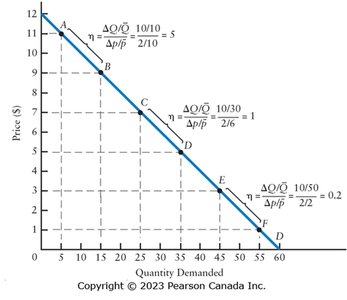
Price elasticity of demand measures the responsiveness of quantity demanded to a change in the product’s own price. It is denoted by the Greek letter eta (η).
Elastic demand: Quantity demanded is highly responsive to price changes.
Inelastic demand: Quantity demanded is less responsive to price changes.
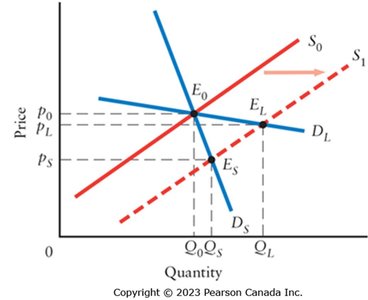
The more elastic the demand, the less the change in equilibrium price and the greater the change in equilibrium quantity for a given supply shift.
Formula:
Where is the change in quantity demanded, is the change in price, is the average quantity, and is the average price.
Elasticity is unit-free and calculated using absolute values.
Elasticity Along the Demand Curve
A linear demand curve has a constant slope but varying elasticity along its length. Elasticity is highest at the upper end (where price is high and quantity is low) and lowest at the lower end (where price is low and quantity is high).
Types of Demand Elasticity
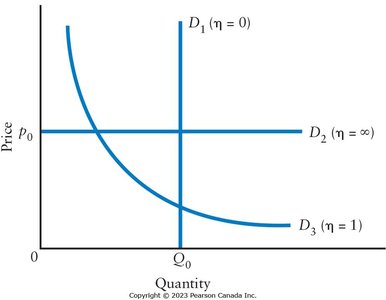
Perfectly inelastic demand: Vertical demand curve ()
Perfectly elastic demand: Horizontal demand curve ()
Unit elastic demand: Elasticity equals 1 ()
Determinants of Price Elasticity of Demand
Availability of substitutes: More substitutes lead to more elastic demand.
Importance in consumer budgets: Goods that take up a larger fraction of budgets are more elastic.
Time horizon: Demand is more elastic in the long run as consumers adjust habits and substitutes develop.
Elasticity and Consumers’ Total Expenditure
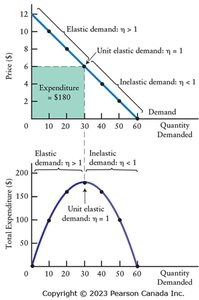
Total expenditure is the product of price and quantity. The effect of a price change on total expenditure depends on the price elasticity of demand:
If demand is elastic, a price decrease increases total expenditure; a price increase decreases it.
If demand is inelastic, a price decrease decreases total expenditure; a price increase increases it.
If demand is unit elastic, total expenditure remains unchanged.
Price Elasticity of Supply
Definition and Measurement
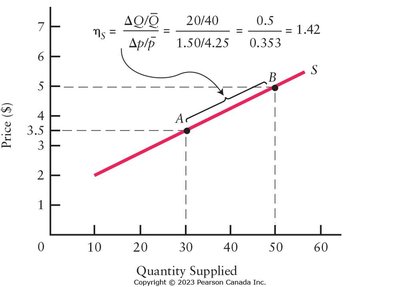
Price elasticity of supply measures the responsiveness of quantity supplied to a change in the product’s price. It is denoted by .
Formula:
Where is the change in quantity supplied, is the average quantity supplied, is the change in price, and is the average price.
Determinants of Supply Elasticity
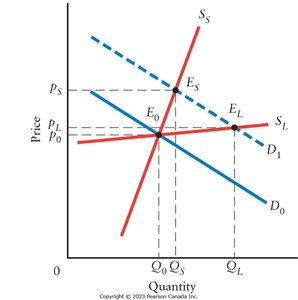
Ease of substitution: The easier it is for producers to shift production, the more elastic supply is.
Time horizon: Supply is more elastic in the long run as producers can adjust capacity.
Elasticity and Excise Taxes
Tax Incidence and Elasticity
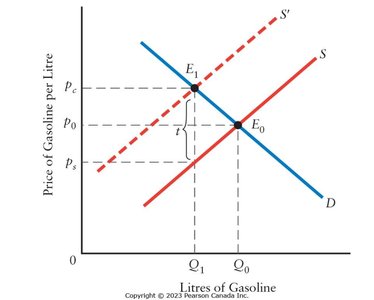
An excise tax is a tax on the sale of a particular product. It shifts the supply curve upward by the amount of the tax. The burden of the tax (tax incidence) depends on the relative elasticities of supply and demand.
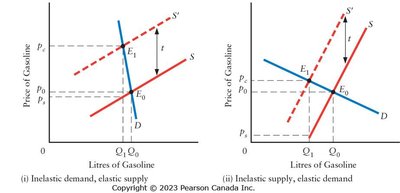
If demand is inelastic relative to supply, consumers bear most of the tax burden.
If supply is inelastic relative to demand, producers bear most of the tax burden.
Tax incidence is independent of whether the tax is collected from consumers or producers.
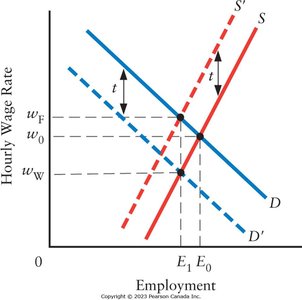
Application: Payroll Taxes
Payroll taxes, such as Employment Insurance (EI) and Canada Pension Plan (CPP), are shared between workers and firms. The allocation of the tax burden depends on the elasticities of labor supply and demand.
The more inelastic labor supply is, the higher the burden on workers.
Distribution of burden is independent of whether tax is collected from workers or firms.
Other Demand Elasticities
Income Elasticity of Demand
Income elasticity of demand measures how quantity demanded changes in response to changes in income.
Formula:
If , the good is a normal good.
If , the good is an inferior good.
Necessities have income elasticity between 0 and 1; luxuries have income elasticity greater than 1.
Cross Price Elasticity of Demand
Cross price elasticity of demand measures the responsiveness of quantity demanded for one good to changes in the price of another good.
Formula:
If , goods X and Y are substitutes.
If , goods X and Y are complements.
High cross elasticity indicates strong competition between products.
