 Back
BackElasticity: The Responsiveness of Demand and Supply
Study Guide - Smart Notes
 Tailored notes based on your materials, expanded with key definitions, examples, and context.
Chapter 6: Elasticity – The Responsiveness of Demand and Supply
Price Elasticity of Demand
The price elasticity of demand measures how much the quantity demanded of a good responds to a change in its price. It is a crucial concept for understanding consumer behavior and for firms making pricing decisions.
Definition: The percentage change in quantity demanded divided by the percentage change in price.
Midpoint Formula: Used to calculate elasticity between two points on a demand curve, ensuring a consistent value regardless of direction.
Formula:
Percent Change (Midpoint Method):
Price Elasticity and Total Revenue
Total revenue (TR) is the total amount received by sellers of a good, calculated as price times quantity sold. The relationship between price elasticity and total revenue is essential for business pricing strategies.
Formula:
If demand is inelastic (elasticity < 1), lowering price decreases total revenue.
If demand is elastic (elasticity > 1), lowering price increases total revenue.
If demand is unit elastic (elasticity = 1), total revenue remains unchanged when price changes.
Example: If a firm lowers the price and total revenue does not change, demand is unit elastic.
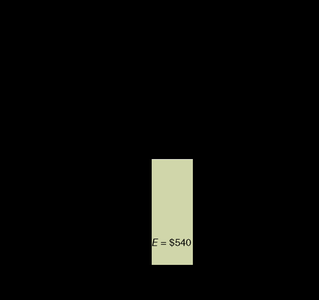
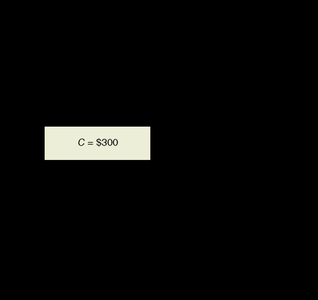
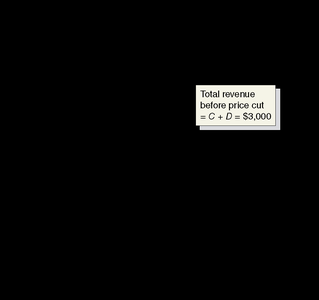
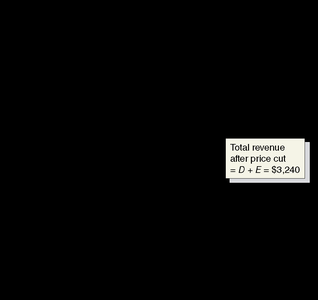
Interpretation: The decrease in price generates enough extra customers (area E) to more than offset the revenue loss (area C), so total revenue increases.
Types of Elasticity
Elastic: Elasticity > 1 (quantity demanded changes more than price)
Inelastic: Elasticity < 1 (quantity demanded changes less than price)
Unit Elastic: Elasticity = 1 (quantity demanded changes exactly as price)
Perfectly Elastic: Elasticity = ∞ (horizontal demand curve)
Perfectly Inelastic: Elasticity = 0 (vertical demand curve)
Cross-Price Elasticity of Demand
The cross-price elasticity of demand measures how the quantity demanded of one good responds to a change in the price of another good.
Formula:
Use the midpoint formula for percentage changes.
Type of Products | Value of Cross-Price Elasticity |
|---|---|
Substitutes | Positive |
Complements | Negative |
Unrelated | Zero |
Example: If the price of tortilla chips rises and the sale of dips falls, the cross-price elasticity is negative, indicating the goods are complements.
Income Elasticity of Demand
The income elasticity of demand measures how the quantity demanded of a good responds to a change in consumer income.
Formula:
Use the midpoint formula for percentage changes.
If the income elasticity is... | Then the good is... | Example |
|---|---|---|
Positive but less than 1 | Normal and a necessity | Bread |
Positive and greater than 1 | Normal and a luxury | Caviar |
Negative | Inferior | High-fat meat |
Example: If income falls and quantity demanded rises (e.g., potatoes), the good is inferior (negative income elasticity).
Price Elasticity of Supply
The price elasticity of supply measures how much the quantity supplied of a good responds to a change in its price. The same terminology applies as for demand elasticity.
Formula:
Elastic, inelastic, unit elastic, perfectly elastic, and perfectly inelastic supply curves exist.
If the supply is... | Value of Price Elasticity |
|---|---|
Elastic | Greater than 1 |
Inelastic | Less than 1 |
Unit Elastic | Equal to 1 |
Perfectly Elastic | Infinity |
Perfectly Inelastic | Zero |
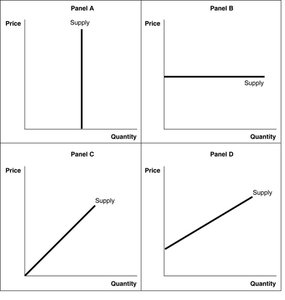
Example: Panel A shows a perfectly inelastic supply curve (vertical line), while Panel B shows a perfectly elastic supply curve (horizontal line).
Applications and Practice Problems
If the price of a CD player falls from \frac{10/100}{-10/25} = 0.25$ (inelastic).
If demand is inelastic, a price decrease reduces total revenue.
If income elasticity is negative, the good is inferior (e.g., potatoes when income falls and quantity demanded rises).
If price elasticity of beer is -0.30 and income elasticity is 0.09, beer is a normal good and a necessity; a price increase raises revenue due to inelastic demand.
If the price of tortilla chips rises by 10% and the sale of dips falls by 8%, the cross-price elasticity is -0.8, indicating complements.
Summary Table: Elasticity Types and Interpretation
Elasticity Type | Formula | Interpretation |
|---|---|---|
Price Elasticity of Demand | Responsiveness of quantity demanded to price changes | |
Cross-Price Elasticity | Relationship between two goods (substitutes/complements) | |
Income Elasticity | Normal, luxury, or inferior good | |
Price Elasticity of Supply | Responsiveness of quantity supplied to price changes |
Additional info: Elasticity concepts are foundational for understanding market dynamics, consumer and producer behavior, and for making informed business and policy decisions.
