 Back
Backchapter 6 microecon
Study Guide - Smart Notes
 Tailored notes based on your materials, expanded with key definitions, examples, and context.
Elasticity: The Responsiveness of Demand and Supply
Introduction to Elasticity
Elasticity is a fundamental concept in microeconomics that measures how much one economic variable responds to changes in another. Most commonly, it is used to analyze how quantity demanded or supplied responds to changes in price. Understanding elasticity is crucial for firms making pricing decisions and for predicting market outcomes.
Elasticity: A measure of how much one economic variable responds to changes in another economic variable.
Helps determine the effect of price changes on quantity demanded or supplied.
Allows managers to make informed decisions rather than relying on guesswork.
Price Elasticity of Demand
The price elasticity of demand quantifies the responsiveness of quantity demanded to a change in price. It is calculated as the percentage change in quantity demanded divided by the percentage change in price.
Price Elasticity of Demand:
Formula using actual values:
Elasticity is typically negative for normal goods due to the law of demand.
For inferior goods, elasticity can be positive.
Elasticity vs. Slope
While slope measures the rate of change between two variables, elasticity uses percentage changes, making it independent of units of measurement. This ensures comparability across different goods and markets.
Slope depends on units (e.g., dollars vs. cents).
Elasticity uses percentage changes, which are unit-free.
Always use percentage changes to calculate elasticity.
Midpoint Formula for Elasticity
The midpoint formula resolves discrepancies when calculating elasticity between two points on a demand curve. It uses averages to ensure consistency.
Midpoint formula:
Provides the same elasticity value regardless of direction between points.
Types of Elasticity
Elasticity values are classified as follows:
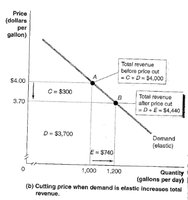
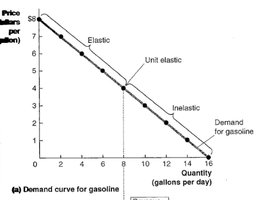
Elastic Demand: Absolute value of elasticity > 1. Quantity demanded is very responsive to price changes.
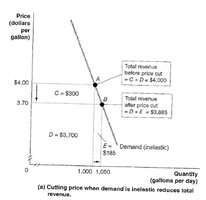
Inelastic Demand: Absolute value of elasticity < 1. Quantity demanded is not very responsive to price changes.
Unit Elastic: Absolute value of elasticity = 1. Percentage change in quantity equals percentage change in price.
Special Cases of Elasticity
Perfectly Inelastic Demand: Elasticity = 0. Quantity demanded does not change with price (vertical demand curve).
Perfectly Elastic Demand: Elasticity = ∞. Quantity demanded is infinitely responsive to price (horizontal demand curve).
Determinants of Price Elasticity of Demand
Five main factors influence the price elasticity of demand:
Availability of Close Substitutes: More substitutes make demand more elastic.
Passage of Time: Demand becomes more elastic as consumers adjust over time.
Luxuries vs. Necessities: Luxuries have more elastic demand; necessities are more inelastic.
Definition of the Market: Narrowly defined markets are more elastic.
Share of Good in Consumer's Budget: Goods taking a larger share of the budget are more elastic.
Elasticity and Total Revenue
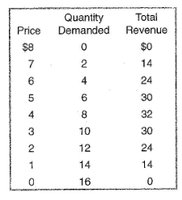
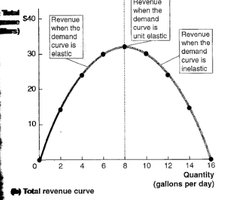
Total revenue (TR) is the product of price and quantity sold. The relationship between elasticity and total revenue is crucial for pricing decisions.
When demand is inelastic, price and total revenue move in the same direction.
When demand is elastic, price and total revenue move in opposite directions.
When demand is unit elastic, changes in price do not affect total revenue.
Other Demand Elasticities
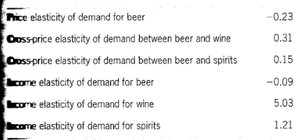
Beyond price elasticity, economists analyze cross-price and income elasticities.
Cross-Price Elasticity of Demand: Measures the responsiveness of quantity demanded for one good to changes in the price of another good.
Formula:
Positive for substitutes, negative for complements, zero for unrelated goods.
Income Elasticity of Demand: Measures the responsiveness of quantity demanded to changes in income.
Formula:
Positive for normal goods, negative for inferior goods.
Normal goods can be subdivided into necessities (inelastic) and luxuries (elastic).
Price Elasticity of Supply
Price elasticity of supply measures the responsiveness of quantity supplied to a change in price. It is always positive due to the law of supply.
Elasticity > 1: Supply is elastic.
Elasticity < 1: Supply is inelastic.
Elasticity = 1: Supply is unit elastic.
Determinant: Time is the main determinant. Supply is more elastic in the long run as firms can adjust resources.
Elasticity of Supply and Price Changes
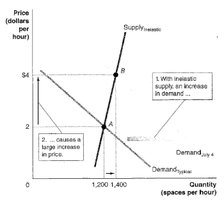
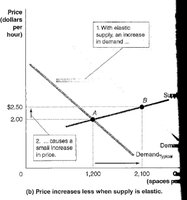
The price elasticity of supply affects how much prices change when demand shifts.
With inelastic supply, an increase in demand causes a large increase in price.
With elastic supply, an increase in demand causes a small increase in price.
Summary Table: Types of Elasticity
Type | Definition | Elasticity Value |
|---|---|---|
Elastic Demand | QD changes more than price | |E| > 1 |
Inelastic Demand | QD changes less than price | |E| < 1 |
Unit Elastic | QD changes equal to price | |E| = 1 |
Perfectly Elastic | QD changes infinitely | E = ∞ |
Perfectly Inelastic | QD does not change | E = 0 |
Key Takeaways
Elasticity is a powerful tool for understanding market behavior and making business decisions.
Always use percentage changes to calculate elasticity.
Elasticity affects total revenue and pricing strategies.
Determinants of elasticity help predict consumer and producer responses to price changes.
