 Back
BackElasticity: The Responsiveness of Demand and Supply
Study Guide - Smart Notes
 Tailored notes based on your materials, expanded with key definitions, examples, and context.
Elasticity: The Responsiveness of Demand and Supply
Introduction
Elasticity is a central concept in microeconomics, measuring how much one economic variable responds to changes in another. This chapter focuses on the price elasticity of demand and supply, their determinants, and their implications for total revenue and market outcomes.
Price Elasticity of Demand and Its Measurement
Definition and Calculation
The price elasticity of demand measures the responsiveness of the quantity demanded to a change in price, using percentage changes to avoid issues with units. It is calculated as:
Elasticity is negative due to the inverse relationship between price and quantity demanded, but we often refer to its absolute value.
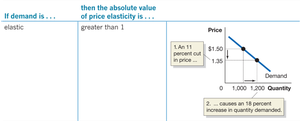
Elastic demand: Absolute value greater than 1 (quantity demanded changes more than price).
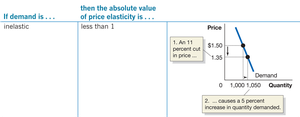
Inelastic demand: Absolute value less than 1 (quantity demanded changes less than price).
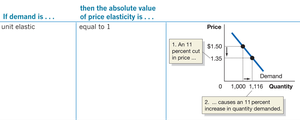
Unit-elastic demand: Absolute value equals 1 (quantity and price change by the same percentage).
The midpoint formula is used to calculate elasticity between two points, ensuring consistency regardless of direction:
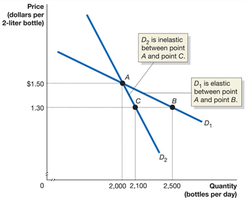
Price Elasticity of Demand Terminology
Elastic:
Inelastic:
Unit-elastic:
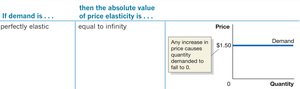
Perfectly elastic:
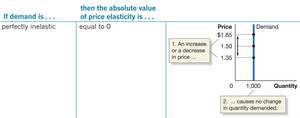
Perfectly inelastic:
Summary Table: Price Elasticity of Demand
If demand is... | then the absolute value of price elasticity is... | Example/Graph |
|---|---|---|
Elastic | Greater than 1 |
|
Inelastic | Less than 1 |
|
Unit elastic | Equal to 1 |
|
Perfectly elastic | Equal to infinity |
|
Perfectly inelastic | Equal to 0 |
|
The Determinants of the Price Elasticity of Demand
Key Determinants
Availability of close substitutes: More substitutes make demand more elastic.
Passage of time: Demand is more elastic in the long run as consumers adjust.
Luxury vs. necessity: Luxuries have more elastic demand; necessities are inelastic.
Definition of the market: Narrowly defined markets have more elastic demand.
Share of a good in the consumer’s budget: Goods that take a larger share of the budget have more elastic demand.
Example: Gasoline is inelastic due to few substitutes and necessity, while branded jeans are more elastic due to many alternatives.
The Relationship between Price Elasticity of Demand and Total Revenue
Total Revenue and Elasticity
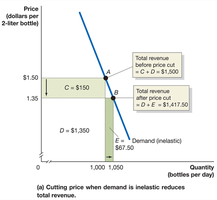
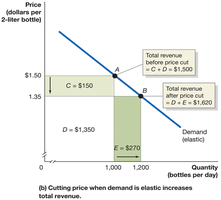
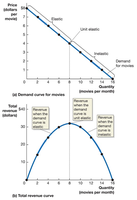
Total revenue is calculated as price times quantity sold. The effect of a price change on total revenue depends on the elasticity of demand:
If demand is inelastic, a price decrease reduces total revenue.
If demand is elastic, a price decrease increases total revenue.
If demand is unit elastic, total revenue remains unchanged when price changes.
Elasticity Along a Linear Demand Curve
Elasticity is not constant along a straight-line demand curve. At higher prices, demand is more elastic; at lower prices, it becomes inelastic. Total revenue is maximized where demand is unit elastic.
Other Demand Elasticities
Cross-Price Elasticity of Demand
The cross-price elasticity of demand measures the responsiveness of the quantity demanded for one good to a change in the price of another good:
Positive value: Goods are substitutes.
Negative value: Goods are complements.
Income Elasticity of Demand
The income elasticity of demand measures the responsiveness of quantity demanded to changes in income:
Positive value: Normal good (demand increases as income rises).
Negative value: Inferior good (demand decreases as income rises).
Price Elasticity of Supply and Its Measurement
Definition and Calculation
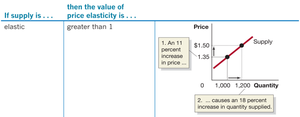
The price elasticity of supply measures the responsiveness of the quantity supplied to a change in price:
Calculated using the midpoint formula, similar to demand elasticity.
Determinants of Price Elasticity of Supply
Time period: Supply is more elastic in the long run as firms can adjust production.
Flexibility of production: The easier it is to change output, the more elastic supply is.
Example: Agricultural products have inelastic supply in the short run but more elastic supply in the long run.
Polar Cases: Perfectly Elastic and Perfectly Inelastic Supply
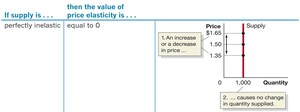
Perfectly inelastic supply: Vertical supply curve; quantity supplied does not change with price ().
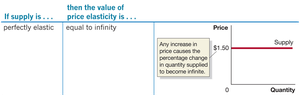
Perfectly elastic supply: Horizontal supply curve; any price change leads to infinite change in quantity supplied ().
Summary Table: Price Elasticity of Supply
If supply is... | then the value of price elasticity is... | Example/Graph |
|---|---|---|
Elastic | Greater than 1 |
|
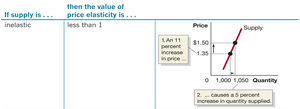
Inelastic | Less than 1 |
|
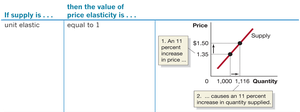
Unit elastic | Equal to 1 |
|
Perfectly elastic | Equal to infinity |
|
Perfectly inelastic | Equal to 0 |
|
Using Price Elasticity of Supply to Predict Changes in Price
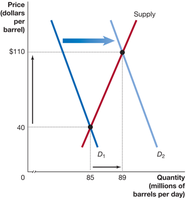
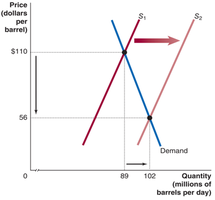
When demand increases, the effect on equilibrium price depends on the elasticity of supply:
If supply is inelastic, price rises significantly.
If supply is elastic, price rises only slightly.
Conclusion
Understanding elasticity is crucial for predicting how changes in market conditions affect prices, quantities, and total revenue. Both consumers and producers use elasticity concepts to make informed decisions in response to economic changes.
