 Back
BackElasticity: The Responsiveness of Supply and Demand
Study Guide - Smart Notes
 Tailored notes based on your materials, expanded with key definitions, examples, and context.
Elasticity: The Responsiveness of Supply and Demand
Introduction to Elasticity
Elasticity is a fundamental concept in microeconomics that measures how much one economic variable responds to changes in another. It is crucial for understanding consumer and producer behavior, as well as for government policy decisions such as taxation and regulation.
Elasticity: A measure of how much one economic variable responds to changes in another economic variable.
Price Elasticity of Demand: The responsiveness of the quantity demanded of a good to changes in its price.
Price Elasticity of Supply: The responsiveness of the quantity supplied of a good to changes in its price.
6.1 The Price Elasticity of Demand and Its Measurement
Definition and Calculation
The price elasticity of demand quantifies how much the quantity demanded of a good changes in response to a change in its price. It is calculated as the percentage change in quantity demanded divided by the percentage change in price.
Formula:
Elasticity is unit-free, making it comparable across goods and markets.
Elasticity is always negative due to the law of demand, but we use the absolute value for comparison.
The Midpoint Formula
To avoid discrepancies in elasticity calculations between two points, economists use the midpoint formula, which averages the starting and ending values.
Elastic, Inelastic, and Unit Elastic Demand
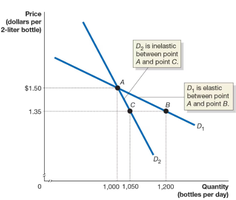
Elastic Demand: Absolute value of elasticity > 1. Quantity demanded is very responsive to price changes.
Inelastic Demand: Absolute value of elasticity < 1. Quantity demanded is not very responsive to price changes.
Unit Elastic Demand: Absolute value of elasticity = 1. Percentage change in quantity demanded equals percentage change in price.
Graphical Illustration and Examples
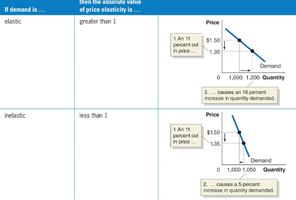
Elastic demand: A 10% decrease in price leads to a 20% increase in quantity demanded (elasticity = 2).
Inelastic demand: A 10% decrease in price leads to a 5% increase in quantity demanded (elasticity = 0.5).
Unit elastic: Percentage changes are equal (elasticity = 1).
Perfectly Elastic and Perfectly Inelastic Demand
Perfectly Inelastic Demand: Quantity demanded does not change as price changes (vertical demand curve, elasticity = 0).
Perfectly Elastic Demand: Quantity demanded drops to zero with any price increase (horizontal demand curve, elasticity = ∞).
Summary Table: Price Elasticity of Demand
6.2 The Determinants of the Price Elasticity of Demand
Key Determinants
Availability of Close Substitutes: More substitutes make demand more elastic.
Passage of Time: Demand becomes more elastic over time as consumers adjust their behavior.
Luxuries vs. Necessities: Luxuries have more elastic demand; necessities are more inelastic.
Definition of the Market: Narrowly defined markets have more elastic demand.
Share of the Good in the Consumer’s Budget: Goods that take a larger share of the budget have more elastic demand.
Estimated Price Elasticities of Demand
Different goods have different elasticities based on the above determinants. For example, gasoline and milk are inelastic, while luxury goods and products with many substitutes are elastic.
6.3 The Relationship between Price Elasticity of Demand and Total Revenue
Total Revenue and Elasticity
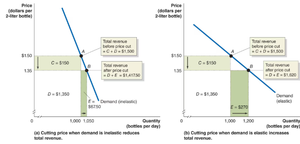
Total revenue is the total amount received from selling a good, calculated as price times quantity sold. The effect of a price change on total revenue depends on the price elasticity of demand:
Inelastic Demand: Price and total revenue move in the same direction.
Elastic Demand: Price and total revenue move in opposite directions.
Elasticity and Revenue with a Linear Demand Curve
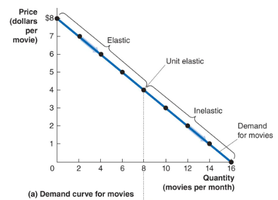
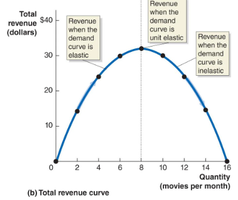
Along a linear demand curve, elasticity is not constant. Revenue is maximized where demand is unit elastic.
6.4 Other Demand Elasticities
Cross-Price Elasticity of Demand
The cross-price elasticity of demand measures how the quantity demanded of one good responds to a change in the price of another good.
Positive for substitutes (e.g., Coke and Pepsi).
Negative for complements (e.g., coffee and cream).
Zero for unrelated goods.
Income Elasticity of Demand
The income elasticity of demand measures how the quantity demanded of a good responds to changes in consumer income.
Positive for normal goods (further divided into luxuries and necessities).
Negative for inferior goods.
6.5 Using Elasticity to Analyze the Disappearing Family Farm
Increases in farm productivity have led to large increases in supply, but because the demand for many agricultural products is inelastic and has low income elasticity, prices have fallen sharply, making it difficult for family farms to remain profitable.
6.6 The Price Elasticity of Supply and Its Measurement
Definition and Calculation
The price elasticity of supply measures how much the quantity supplied of a good changes in response to a change in its price. It is always positive due to the law of supply.
Elastic supply: elasticity > 1
Inelastic supply: elasticity < 1
Unit elastic supply: elasticity = 1
Determinants of the Price Elasticity of Supply
Time Period: Supply is more elastic in the long run as firms can adjust production.
Resource Flexibility: If resources are easily available, supply is more elastic.
Perfectly Elastic and Perfectly Inelastic Supply
Perfectly Inelastic Supply: Quantity supplied does not change as price changes (vertical supply curve, elasticity = 0).
Perfectly Elastic Supply: Quantity supplied is infinitely responsive to price (horizontal supply curve, elasticity = ∞).
Using Price Elasticity of Supply to Predict Price Changes
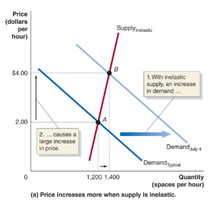
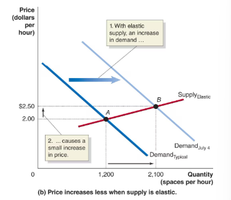
The price elasticity of supply determines how much price will change when demand increases. If supply is inelastic, price rises sharply with increased demand; if supply is elastic, price rises only slightly.
Additional info: These notes provide a comprehensive overview of elasticity, including definitions, determinants, graphical analysis, and real-world applications. All equations are provided in LaTeX format for clarity. Images are included only where they directly reinforce the explanation of the adjacent paragraph.
