 Back
BackExternalities, Public Goods, and Economic Efficiency
Study Guide - Smart Notes
 Tailored notes based on your materials, expanded with key definitions, examples, and context.
Externalities and Economic Efficiency
Definition and Impact of Externalities
Externalities are unintended side effects of economic activities that affect third parties who are not directly involved in the transaction. They can be either positive or negative and are a primary cause of market failure, where the market equilibrium does not result in the most efficient allocation of resources.
Negative Externality: Occurs when the social cost of production exceeds the private cost borne by producers. Example: Pollution from electricity production.
Positive Externality: Occurs when the social benefit of consumption exceeds the private benefit received by consumers. Example: Education.
Externalities create a divergence between private and social costs or benefits, leading to inefficiency in market outcomes.
Private vs. Social Costs and Benefits
Private Cost: Cost borne by the producer of a good or service.
Social Cost: Total cost to society, including both private and external costs.
Private Benefit: Benefit received by the consumer of a good or service.
Social Benefit: Total benefit to society, including both private and external benefits.
Graphical Representation of Negative Externalities
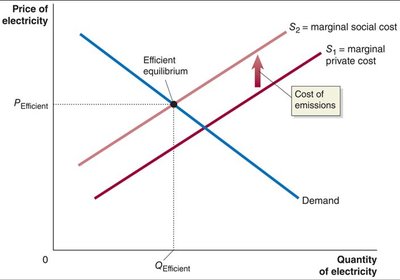
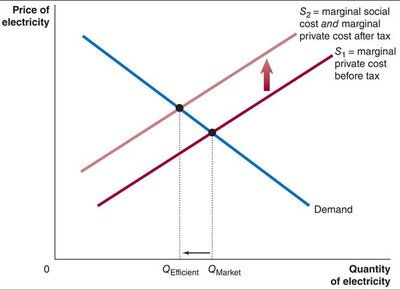
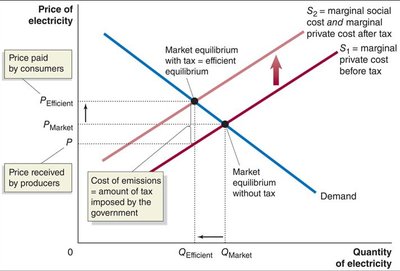
When negative externalities are present, the marginal social cost (MSC) curve lies above the marginal private cost (MPC) curve. The efficient equilibrium occurs where the demand curve intersects the MSC curve, not the MPC curve.
Market Failure Due to Externalities
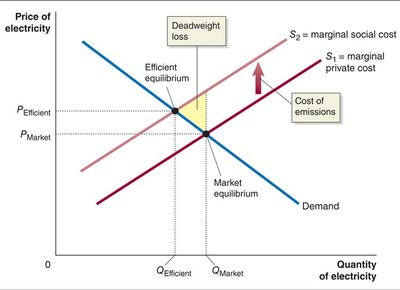
Market equilibrium, determined by private costs and benefits, leads to overproduction in the case of negative externalities and underproduction in the case of positive externalities. This results in deadweight loss, representing the loss of economic efficiency.
Types of Externalities
Negative and Positive Externalities
Negative Externalities in Production: Pollution, noise, and resource depletion.
Negative Externalities in Consumption: Second-hand smoke, congestion.
Positive Externalities in Consumption: Vaccinations, education.
Graphical Representation of Positive Externalities
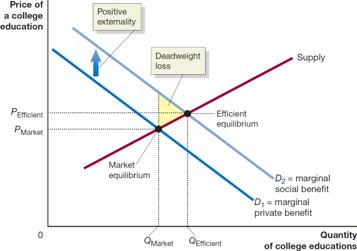
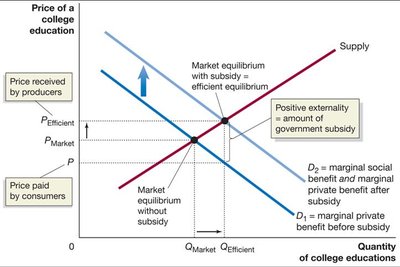
With positive externalities, the marginal social benefit (MSB) curve lies above the marginal private benefit (MPB) curve. The efficient equilibrium is at the intersection of the supply curve and the MSB curve.
Private Solutions to Externalities: The Coase Theorem
Property Rights and Bargaining
The Coase Theorem states that if property rights are well-defined and transaction costs are low, private parties can negotiate to solve the externality problem and achieve an efficient outcome, regardless of the initial allocation of rights.
Property Rights: Legal rights to use and transfer resources.
Transaction Costs: Costs of negotiating and enforcing agreements.
Example: A farmer and a paper mill sharing a stream can negotiate pollution reduction if property rights are clear.
Optimal Pollution Reduction
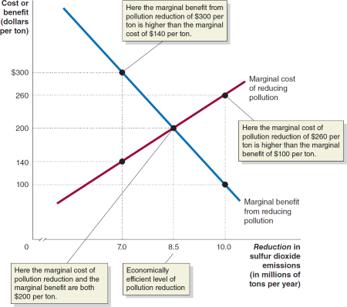
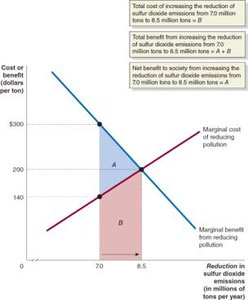
The efficient level of pollution reduction is where the marginal benefit of reduction equals the marginal cost.
If marginal benefit > marginal cost: More reduction is efficient.
If marginal cost > marginal benefit: Less reduction is efficient.
Benefits of Optimal Pollution Reduction
The net benefit to society from reducing pollution to the optimal level is the area between the marginal benefit and marginal cost curves.
Government Policies to Address Externalities
Corrective Taxes and Subsidies (Pigovian Taxes/Subsidies)
Governments can use taxes and subsidies to internalize externalities and restore efficiency:
Pigovian Tax: A tax imposed on activities that generate negative externalities, equal to the external cost.
Pigovian Subsidy: A subsidy provided for activities that generate positive externalities, equal to the external benefit.
These policies align private incentives with social efficiency.
Command-and-Control vs. Market-Based Approaches
Command-and-Control: Government sets limits or requires specific technologies to reduce pollution. May not be cost-effective if firms have different abatement costs.
Market-Based Approaches: Tradable emissions permits (cap-and-trade) allow firms to buy and sell the right to pollute, achieving pollution reduction at the lowest cost.
Public Goods and Common Resources
Four Categories of Goods
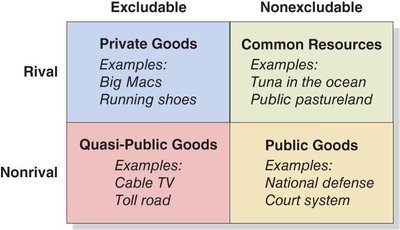
Goods can be classified based on rivalry and excludability:
Excludable | Nonexcludable | |
|---|---|---|
Rival | Private Goods Examples: Big Macs, Running shoes | Common Resources Examples: Tuna in the ocean, Public pastureland |
Nonrival | Quasi-Public Goods Examples: Cable TV, Toll road | Public Goods Examples: National defense, Court system |
Efficient Provision and Market Demand for Goods
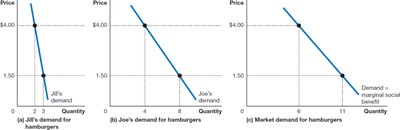
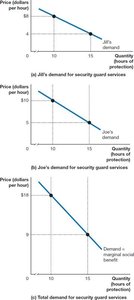
Private Goods: Market demand is found by horizontally summing individual demands.
Public Goods: Market demand is found by vertically summing individual willingness to pay for each quantity.
Tragedy of the Commons
Common resources tend to be overused because individuals do not bear the full social cost of their consumption. This leads to depletion of the resource, a phenomenon known as the tragedy of the commons. Solutions include property rights, community management, or government intervention through taxes, quotas, or permits.
Summary Table: Key Concepts
Concept | Definition | Example |
|---|---|---|
Negative Externality | External cost imposed on others | Air pollution from factories |
Positive Externality | External benefit conferred on others | Vaccination, education |
Pigovian Tax | Tax equal to external cost | Carbon tax |
Pigovian Subsidy | Subsidy equal to external benefit | Subsidy for renewable energy |
Coase Theorem | Private bargaining can solve externalities if property rights are clear and transaction costs are low | Negotiation between a farmer and a polluting factory |
