 Back
BackFirm Organization and Market Structure: Microeconomics Study Notes
Study Guide - Smart Notes
 Tailored notes based on your materials, expanded with key definitions, examples, and context.
Firm Organization and Market Structure
Ownership and Governance of Firms
Firms differ in their ownership and organizational structure, which affects their decision-making and market behavior. Understanding these differences is essential for analyzing firm strategies and market outcomes.
Types of Firms:
Private: Includes sole proprietorships (owned by one individual), partnerships (owned by two or more), and corporations (owned by shareholders).
Public (State-Owned Enterprises): Owned and operated by the government.
Nonprofit: Organizations that operate for purposes other than profit.
Ownership Structures:
Sole Proprietorship: Single owner, full control, unlimited liability.
Partnership: Multiple owners, shared control, joint liability.
Corporation: Owned by shareholders, limited liability, governance by board of directors.
Firm Size: Larger firms are typically corporations; smaller firms are often sole proprietorships.
Governance: Small firms are managed directly by owners; corporations are governed by boards elected by shareholders.
Profit Maximization
Profit maximization is a central goal for firms, involving decisions about output and whether to continue operations. Firms must consider both explicit and implicit costs when calculating profit.
Key Terms:
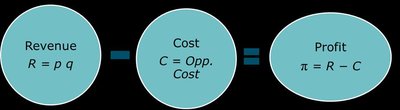
Revenue (R): Total income from sales, calculated as price times quantity ().
Cost (C): Opportunity cost, including explicit and implicit costs.
Profit (\pi): Difference between revenue and cost ().
Steps to Maximizing Profit:
Output Decision: Choose the output level (q) that maximizes profit.
Shutdown Decision: Decide whether to operate or shut down based on profitability.
Output Rules:
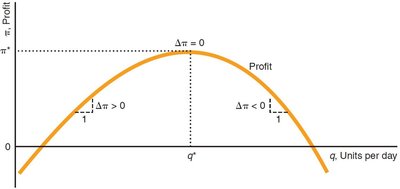
Set output where profit is maximized (q*).
Set output where marginal profit is zero ().
Set output where marginal revenue equals marginal cost ().
Shutdown Rules:
Short run: Firm shuts down if revenue is less than avoidable (variable) cost.
Long run: Firm shuts down if revenue is less than total cost.
Fixed costs are sunk in the short run and should not affect shutdown decisions.
Example: If weekly revenue is $2,000, variable cost is $1,000, and fixed cost is $3,000, the firm should continue operating if revenue covers variable costs, even if total profit is negative.
Profits Over Time
Firms often evaluate investments and profit streams over time, using present value calculations to account for the time value of money.
Interest Rate (i): The cost of borrowing money, used to discount future profits.
Present Value (PV): The current value of a future sum, calculated as , where FV is future value and t is the number of periods.
Compounding: Interest is earned on both the principal and accumulated interest.
Perpetual Income Flow: For an income flow Y per period, .
Profit Streams: Present value of a stream of profits is .
The Make or Buy Decision
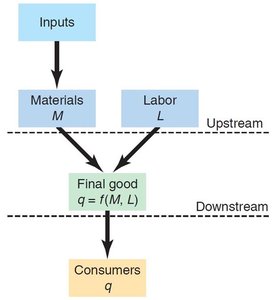
Firms must decide whether to produce goods and services internally (vertical integration) or purchase them from external suppliers (market transactions). This decision affects cost, flexibility, and control.
Vertical Integration: Firm participates in multiple stages of production or distribution.
Quasi-Vertical Integration: Firm controls suppliers or distributors through contracts.
Spot Markets: Buying commodities in organized markets without long-term contracts.
Benefits of Integration:
Reduces transaction costs.
Increases supply security and flexibility.
Helps avoid opportunistic behavior by other firms.
May circumvent government regulations or price controls.
Market Structure
Market structure describes how firms interact and compete in a market. The four main market structures are perfect competition, monopoly, oligopoly, and monopolistic competition.
Perfect Competition: Many firms, price takers, free entry, undifferentiated products.
Monopoly: Single firm, price setter, no entry, unique product.
Oligopoly: Few firms, price setters, limited entry, may be differentiated products.
Monopolistic Competition: Many firms, price setters, free entry, differentiated products.
Property | Monopoly | Oligopoly | Monopolistic Competition | Perfect Competition |
|---|---|---|---|---|
Ability to set price | Price setter | Price setter | Price setter | Price taker |
Price level | Very high | High | High | Low |
Entry conditions | No entry | Limited entry | Free entry | Free entry |
Number of firms | 1 | Few | Few or many | Many |
Long-run profit | ≥ 0 | ≥ 0 | 0 | 0 |
Strategy dependent on rivals | No | Yes | Yes | No |
Products | Single product | May be differentiated | May be differentiated | Undifferentiated |
Example | Patented drug producer | Automobile manufacturers | Plumbers in a small town | Apple farmers |
Disruptive Innovations and Market Structure Evolution
Technological and organizational innovations can change market structure, sometimes making markets more competitive or concentrated. This process is known as creative destruction or disruptive innovation.
Disruptive Innovation: New technologies or business models that change industry structure.
Creative Destruction: Old firms and structures are replaced by new, more efficient ones.
Examples: Apple, Walmart, Netflix.
Managerial Application: Amazon’s Delivery Services
Amazon’s decision to develop its own delivery system illustrates the make-or-buy decision and vertical integration. The firm weighed the costs and benefits of relying on external providers versus investing in its own capabilities, considering transaction costs, flexibility, and the present value of future profits.
Vertical Integration: Amazon’s in-house delivery system reduced costs and increased flexibility.
Investment Decision: The investment is worthwhile if the present value of future profits exceeds the initial investment ().
Additional info: These notes expand on brief lecture points to provide a comprehensive overview of firm organization, profit maximization, vertical integration, and market structure, suitable for microeconomics exam preparation.
