 Back
BackFirms, the Stock Market, and Corporate Governance: Microeconomics Study Guide
Study Guide - Smart Notes
 Tailored notes based on your materials, expanded with key definitions, examples, and context.
Firms, the Stock Market, and Corporate Governance
Types of Firms
Firms in the United States are legally categorized into three main types, each with distinct characteristics regarding ownership, liability, and organizational structure.
Sole Proprietorship: Owned by a single individual, not organized as a corporation. The owner has unlimited liability, meaning personal assets are at risk if the firm fails.
Partnership: Owned jointly by two or more persons, not organized as a corporation. Partners share unlimited liability.
Corporation: A legal entity separate from its owners, providing limited liability protection. Owners (shareholders) are not personally liable beyond their investment.
Limited liability makes corporations attractive for raising funds and investing, but corporations face higher organizational costs and potential double taxation (corporate profits and dividends).
Asset: Anything of value owned by a person or firm.
Liability: Anything owed by a person or firm.
Most firms are sole proprietorships, but corporations account for the majority of economic activity due to their larger size.

Recent Trends in Business Formation
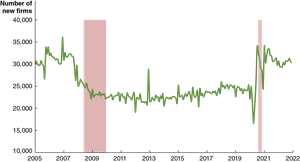
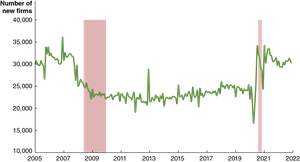
Business formation rates fluctuate with economic conditions. After the Great Recession, new firm formation slowed, but surged following the Covid-19 pandemic as displaced workers started new businesses.
Corporate Structure and Governance
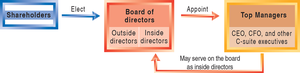
Corporations feature a separation of ownership from control, where shareholders (owners) elect a board of directors, who appoint top managers (e.g., CEO) to run day-to-day operations. This structure can lead to conflicts of interest known as the principal-agent problem.
Principal-agent problem: Occurs when managers (agents) pursue their own interests rather than those of shareholders (principals).
Remedies include aligning incentives, such as paying managers with stock or stock options.
Multinational Corporations
Many corporations operate internationally to avoid tariffs, access resources, reduce labor costs, manage exchange rate risks, and respond to competition.
How Firms Raise Funds
Methods of Raising Funds
Firms need capital to operate and expand. Small businesses typically use:
Retained earnings: Profits reinvested in the firm.
Recruit additional owners: Increases financial capital.
Borrowing: From financial institutions or individuals.
Larger firms rely on external funds through the financial system, which facilitates indirect and direct finance.
Indirect Finance
Funds flow from savers to borrowers via financial intermediaries (e.g., banks). This is called indirect finance.
Banks collect deposits from savers and lend to firms.
Direct Finance
Firms raise funds directly from investors through financial markets by issuing securities:
Bonds: Promise to repay a fixed amount (principal) plus periodic interest (coupon payments).
Stocks: Represent partial ownership; shareholders may receive dividends.
Bonds are less risky than stocks because bondholders are repaid before shareholders.
Bonds and Default Risk
Bonds are rated by agencies (Moody’s, S&P, Fitch) to assess default risk. Higher risk requires higher coupon payments.
Mutual Funds and Exchange-Traded Funds (ETFs)
Mutual funds: Actively managed portfolios; shares sold back to management company.
ETFs: Passively managed; shares traded among investors.
Stock and Bond Markets
After issuance, stocks and bonds are traded in secondary markets. Prices reflect investor confidence in future profits and payments.
Stock Market Indexes
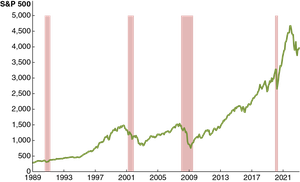
Indexes (e.g., S&P 500) track average stock prices. Changes indicate overall market trends and investor expectations.
Risk and Return
Higher returns are generally associated with higher risk. Stocks are riskier than bonds, and small companies are riskier than large ones.
Asset Type | Average Return | Risk Level |
|---|---|---|
Stocks | High | High |
Bonds | Moderate | Moderate |
Treasury Bills/CDs | Low | Low |
Additional info: Returns are based on historical data from 1928-2022. |
Stock Valuation and Expectations
Stock prices fluctuate based on expectations about future profits. Firms may have high market capitalization even if they are not currently profitable, as investors anticipate future gains.


Using Financial Statements to Evaluate a Corporation
Financial Statements
Corporations must release financial statements using generally accepted accounting principles (GAAP). These statements help investors make informed decisions.
Income Statement: Shows revenues, costs, and profit over a period (usually a fiscal year).
Balance Sheet: Summarizes assets, liabilities, and net worth at a specific point in time.
Accounting Profit vs. Economic Profit
Accounting profit: Net income calculated as revenue minus explicit costs (actual expenditures).
Economic profit: Considers both explicit and implicit costs (opportunity costs).
Implicit cost: Nonmonetary opportunity cost, such as the owner’s time or alternative uses of funds.
Corporate Governance and Regulation
Accurate financial statements are essential for efficient resource allocation and investor confidence. Regulations like the Sarbanes-Oxley Act and Dodd-Frank Act aim to improve transparency and reduce risk.
Case Study: Lyft Corporate Governance
Lyft’s IPO allowed investors to purchase only Class A shares, while founders retained significant voting rights. This practice can affect long-term versus short-term goals and investor confidence.

Appendix: Using Present Value
Present Value Concept
Present value (PV) is the value in today’s dollars of funds to be received in the future. It accounts for the time value of money, where funds received sooner are worth more.
The general formula for present value is:
Future: Amount to be received in n years
i: Interest rate
n: Number of years
Present Value of a Series of Payments
To calculate the present value of multiple payments, sum the present values of each payment:
Asset Pricing Using Present Value
The price of a financial asset (bond or stock) equals the present value of expected future payments:
Bonds: Present value of coupon payments and principal repayment.
Stocks: Present value of expected dividend payments (often an infinite stream).
Bond Price Example
For a $1,000 bond with $80 coupon payments in 2025 and 2026, and a maturity date in 2026:
Stock Price Example (Constant Growth)
If dividends grow at a constant rate, the stock price formula is:
D_0: Current dividend
g: Growth rate of dividends
i: Required rate of return
Appendix: Income Statements and Balance Sheets
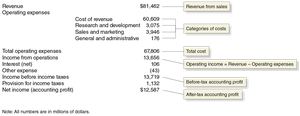
Income Statement
Shows revenue, costs, and profit for a given year. The bottom line is net income (after-tax accounting profit).
Balance Sheet
Summarizes assets, liabilities, and stockholders’ equity at a specific date. The balance sheet equation is:
Net worth is assets minus liabilities, often listed as stockholders’ equity.
Uses of Financial Statements
Financial statements allow comparison across firms, evaluation of profitability, and benchmarking. They are used by investors, lenders, regulators, and managers.
