 Back
BackGame Theory and Oligopolistic Competition: Microeconomics Study Notes
Study Guide - Smart Notes
 Tailored notes based on your materials, expanded with key definitions, examples, and context.
Game Theory and Oligopolistic Competition
Introduction to Game Theory in Economics
Game theory is a fundamental tool in microeconomics for analyzing strategic interactions among rational agents, especially in markets where a few firms dominate (oligopoly). Unlike perfect competition or monopoly, oligopoly requires firms to consider the actions and reactions of competitors when making decisions.
Strategic Decision Making: In oligopoly, firms' optimal choices depend on competitors’ actions.
Examples: Pepsi vs. Coke, Uber vs. Lyft.
Game Theory: The study of mathematical models of strategic interaction among rational decision-makers.
The Elements of a Game
Defining a Game
A game is a strategic setting involving multiple agents (players), where the outcome depends on the actions chosen by each agent, and each outcome generates payoffs for the agents involved.
Players: The decision-makers in the game (e.g., firms, individuals).
Actions (Ai): The set of possible moves each player can make.
Payoffs (ui): The utility or benefit each player receives from an outcome.
Strategies: A complete plan of action for a player, specifying what to do in every possible situation.
Simultaneous Move Games
The Prisoners’ Dilemma
The Prisoners’ Dilemma is a classic example of a simultaneous move game, where each player chooses an action without knowing the other’s choice. The outcome demonstrates the conflict between individual rationality and collective welfare.
Players: You and Josie
Actions: Quiet or Snitch
Payoff Matrix: (Yours jail time, Josie’s jail time)
You \ Josie | Quiet | Snitch |
|---|---|---|
Quiet | (-1, -1) | (-12, 0) |
Snitch | (0, -12) | (-6, -6) |
Dominant Strategy: Snitching is the best response for both players, regardless of the other’s action.
Dominant Strategy Equilibrium: Both snitch, resulting in (-6, -6).
Pareto Efficiency: The equilibrium is not Pareto efficient; both would be better off staying quiet, but individual incentives prevent this.
Dominant and Best Response Strategies
A dominant strategy is a strategy that is the best for a player, no matter what the opponents do. A best response is a strategy that maximizes a player’s payoff, given the strategies chosen by the other players.
Dominant Strategy: Always the best, regardless of others’ actions.
Best Response: Best given the specific actions of others.
Nash Equilibrium
A Nash Equilibrium is a set of strategies where each player is best responding to the strategies of the others. No player has an incentive to unilaterally deviate.
Definition: Each player’s strategy is a best response to the others’ strategies.
Dominant Strategy Equilibrium: A special case of Nash Equilibrium.
Assumptions: Complete information and mutual recognition of rationality.

Games with Multiple Nash Equilibria
Some games have more than one Nash Equilibrium. For example, the Hawk-Dove game and coordination games like the Battle of the Couple.
Maor \ Tomer | Movie | Ballet |
|---|---|---|
Movie | (3, 2) | (1, 4) |
Ballet | (0, 0) | (2, 3) |
Multiple Equilibria: Both (Movie, Movie) and (Ballet, Ballet) can be Nash Equilibria.
Zero-Sum and Mixed Strategy Games
In zero-sum games, one player’s gain is another’s loss. Some games, like Rock-Paper-Scissors, have no Nash Equilibrium in pure strategies but do in mixed strategies.
Mixed Strategy: Randomizing over possible actions to prevent predictability.
Payoff Calculation Example: If each action is chosen with probability 1/3, the expected payoff is zero.
Sequential Move Games
Game Trees and Extensive Form
Sequential games are represented by game trees, where players move in a specific order. Each node represents a decision point, and each branch represents an action.
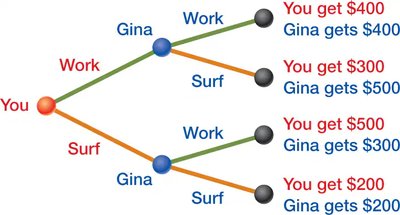
Strategies: A complete plan specifying actions after every possible history.
Backward Induction: Solving the game by analyzing from the end backward to the beginning.
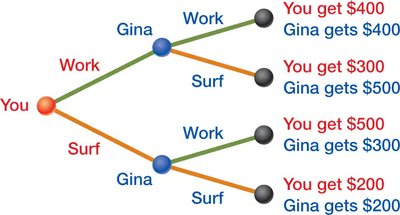
Subgame Perfect Nash Equilibrium (SPNE)
SPNE refines Nash Equilibrium for sequential games by requiring that players’ strategies constitute a Nash Equilibrium in every subgame.
Definition: A strategy profile that represents a Nash Equilibrium in every subgame.
Non-Credible Threats: SPNE eliminates strategies that involve threats that would not be rational to carry out.
First-Mover and Last-Mover Advantage
In some sequential games, the player who moves first or last can have an advantage, depending on the structure of the game and the ability to commit to strategies.
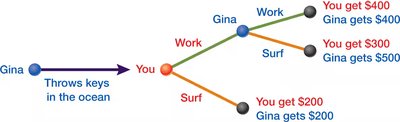
Oligopolistic Competition
Market Structure and Strategic Interaction
Oligopoly is a market structure characterized by a small number of firms whose decisions affect each other. Game theory is essential for analyzing such markets.
Homogeneous Goods: Identical products, little pricing power.
Differentiated Goods: Similar but not identical products, more pricing power.
Barriers to Entry: Economies of scale, first-mover advantages, and strategic deterrence.
Types of Oligopoly Competition
Price (Bertrand) Competition: Firms set prices; with homogeneous goods, this can drive prices down to marginal cost.
Quantity (Cournot) Competition: Firms set quantities; prices are determined by market demand.

Bertrand Paradox and Price Duopoly
In the Bertrand model with homogeneous goods, even with only two firms, competition can drive prices down to marginal cost, eliminating market power. This is known as the Bertrand Paradox.
Price Duopoly Example: Two sellers, 10 buyers, each buyer willing to pay up to $5.
Nash Equilibrium: Both set price to zero, earning zero profit.
Step | Analysis | Conclusion |
|---|---|---|
1 | Both set same price p > 0 | One can undercut and capture all buyers |
2 | Different positive prices | Lower price can increase profit |
3 | Both set price to 0 | No incentive to deviate |
Result: Price equals marginal cost, as in perfect competition.
Key Terms and Concepts
Game Theory: The study of strategic interaction among rational agents.
Nash Equilibrium: A set of strategies where no player can benefit by unilaterally changing their strategy.
Dominant Strategy: A strategy that is best regardless of what others do.
Subgame Perfect Nash Equilibrium: A refinement of Nash Equilibrium for sequential games.
Bertrand Paradox: The result that price competition with homogeneous goods leads to zero economic profit, even with only two firms.
Formulas and Equations
Payoff Function:
Mixed Strategy Expected Payoff (Rock-Paper-Scissors):
