 Back
BackGovernment Actions in Markets: Taxes, Subsidies, and Market Regulations
Study Guide - Smart Notes
 Tailored notes based on your materials, expanded with key definitions, examples, and context.
Government Actions in Markets
Introduction
Government interventions in markets—through taxes, subsidies, price controls, and quantity regulations—are central topics in microeconomics. These policies are designed to influence market outcomes, address market failures, and achieve social objectives. This guide explores the mechanisms, consequences, and efficiency implications of such interventions.
Taxes and Tax Incidence
Statutory vs. Economic Burden
Statutory burden refers to who is legally responsible for paying a tax to the government, while economic burden (or tax incidence) describes who actually bears the cost of the tax through changes in prices and quantities.
Statutory burden: Assigned by law (e.g., sellers or buyers).
Economic burden: Determined by market forces and elasticities.
Invariance of tax incidence: The economic burden does not depend on who is legally responsible for the tax; it depends on the relative elasticities of supply and demand.
Example: A $3 tax on cigarettes can be imposed on either buyers or sellers, but the division of the burden depends on elasticity, not legal assignment.
Elasticity and Tax Incidence
The division of the tax burden depends on the price elasticity of supply and demand:
If demand is more inelastic than supply, buyers bear more of the tax burden.
If supply is more inelastic than demand, sellers bear more of the tax burden.
Perfectly inelastic demand: Buyers bear all the burden.
Perfectly elastic supply: Sellers bear none of the burden.
Real-World Complications
Salience: Awareness of the tax can affect incidence.
Evasion: Some parties may evade taxes more easily.
Price rigidities: Policies like minimum wage can prevent price adjustments.
Political and administrative factors: Practicalities and political considerations may influence statutory assignment.
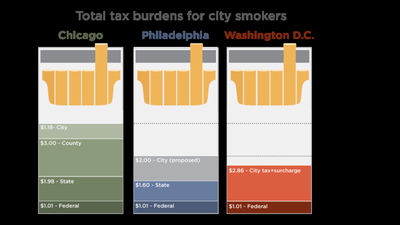
Example: Total Tax Burdens for City Smokers
This example illustrates how cigarette taxes are layered at federal, state, and local levels, resulting in different total tax burdens across cities.
Tax Collection Mechanism
Regardless of who pays the tax to the government, the economic effect is the same. The key is the reduction in market quantity and the division of the tax burden.

Taxes, Surplus, and Deadweight Loss
Consumer and Producer Surplus After Tax
Consumer Surplus (CS): The area between the demand curve and the price paid by buyers, up to the quantity sold.
Producer Surplus (PS): The area between the supply curve and the price received by sellers, up to the quantity sold.
Government Revenue: Tax per unit multiplied by the new quantity sold.
Deadweight Loss (DWL): The reduction in total economic surplus due to the tax, representing lost gains from trade.
Formulas:
Consumer Surplus:
Producer Surplus:
Government Revenue:
Deadweight Loss:
Subsidies
Definition and Effects
A subsidy is a payment made by the government to encourage the production or consumption of a good. It acts as a negative tax, increasing the quantity traded and lowering the price paid by buyers or raising the price received by sellers.
Examples: Public education, electric vehicles, agricultural subsidies.
Benefits are shared between buyers and sellers, with the more inelastic side receiving a larger share.
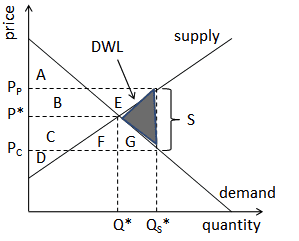
Subsidies can also create deadweight loss by encouraging overproduction.
Price Regulations: Ceilings and Floors
Price Ceilings
A price ceiling is a legal maximum price. If set below equilibrium, it is binding and causes shortages.
Examples: Rent control, anti-price gouging laws.
Effects: Lower prices, increased demand, decreased supply, shortages, black markets, inefficient allocation.
Price Floors
A price floor is a legal minimum price. If set above equilibrium, it is binding and causes surpluses.
Examples: Minimum wage, agricultural price supports.
Effects: Higher prices, increased supply, decreased demand, surpluses, inefficient production, government purchases of excess supply.
Quantity Regulations: Quotas and Mandates
Quotas
A quota sets a maximum quantity that can be bought or sold. If binding, it raises prices and reduces quantity, leading to inefficiency.
Examples: Zoning laws, environmental regulations.
Mandates
A mandate sets a minimum quantity that must be bought or sold. If binding, it increases prices and forces consumption or production beyond market equilibrium.
Examples: Insurance mandates, vaccination requirements.
Deadweight Loss and Economic Efficiency
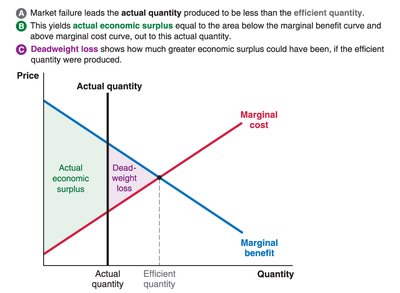
Deadweight Loss from Underproduction
When market interventions cause the actual quantity to fall below the efficient level, deadweight loss results from missed mutually beneficial trades.
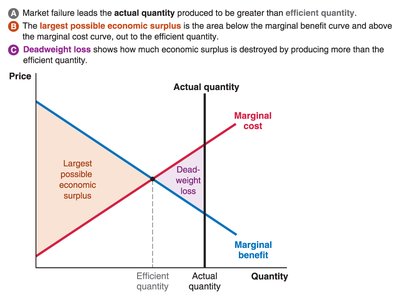
Deadweight Loss from Overproduction
When interventions cause overproduction, deadweight loss arises from producing goods whose cost exceeds their benefit.
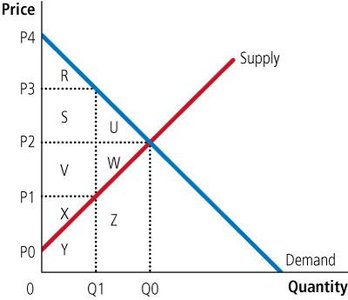
Summary Tables: Effects of Market Interventions
Market interventions can be summarized using diagrams that show changes in consumer surplus, producer surplus, government revenue, and deadweight loss under different policies.
Key Takeaways
Taxes, subsidies, price controls, and quantity regulations all affect market outcomes, but their distributional effects differ.
Elasticity determines who bears the burden or receives the benefit of taxes and subsidies.
Binding price ceilings cause shortages; binding price floors cause surpluses.
Quotas and mandates distort market quantities, leading to inefficiency and deadweight loss.
Deadweight loss measures the reduction in total economic surplus due to market interventions.
