 Back
BackInternational Trade and Production Costs: Microeconomics Exam Review
Study Guide - Smart Notes
 Tailored notes based on your materials, expanded with key definitions, examples, and context.
International Trade
Key Definitions
Tariffs: A tax imposed by a government on imports of goods into a country.
Imports: Goods and services bought domestically but produced in other countries.
Exports: Goods and services produced domestically but sold in other countries.
Globalization: The process of countries becoming more open to foreign trade and investment.
Protectionism: The use of trade barriers to shield domestic firms from foreign competition.
Growth of International Trade
International trade has expanded significantly over the past 50 years due to:
Decreasing costs of shipping and international travel
Spread of inexpensive and reliable communications
Changes in government policies
Trade constitutes a smaller share of GDP in large economies like the U.S. compared to smaller countries, primarily due to the relative size of their economies.
The U.S. and International Trade
Since 1970, U.S. exports and imports have increased as a fraction of GDP (from less than 6% to over 12% by 2022).
The U.S. is the second largest exporter globally, but trade is less central to its economy than in smaller countries.
Benefits of Eliminating Tariffs
Eliminating tariffs or trade restrictions generally benefits consumers by reducing prices.
Other effects (e.g., on jobs or wages) may benefit firms, not necessarily consumers.

Comparative and Absolute Advantage
Key Definitions
Opportunity Cost: The highest-valued alternative that must be given up to engage in an activity.
Comparative Advantage: The ability to produce a good or service at a lower opportunity cost than competitors.
Absolute Advantage: The ability to produce more of a good or service than competitors using the same amount of resources.
Autarky: A situation in which a country does not trade with other countries.
Specialization and Trade
Countries specialize in goods where they have a comparative advantage.
Both countries can consume more through trade than in autarky.
Exam Review Example
Absolute advantage: Producing more with the same resources.
Comparative advantage: Lower opportunity cost in production.


Terms of Trade
Terms of Trade: The ratio at which a country can trade its exports for imports from other countries.
No country will accept terms worse than its opportunity cost.
Winners and Losers from Trade
Winners: Overall, countries gain from trade (higher standard of living).
Losers: Some firms and workers in import-competing industries may lose and seek protectionist policies.

Government Policies Restricting Trade
Key Definitions
Quotas: Quantity limits on imports, imposed unilaterally.
Voluntary Export Restraints (VERs): Mutually agreed quantity limits between countries.
Tariff: A tax on imported goods.
Free Trade: Trade without government restrictions.
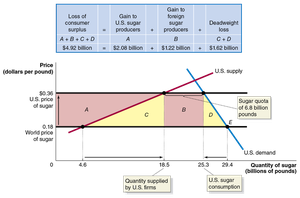
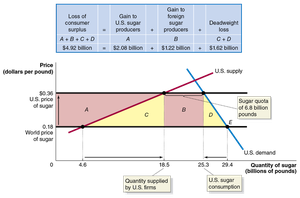
Economic Effects of Quotas
Quotas restrict imports, raise domestic prices, and increase producer surplus for domestic firms.
Consumer surplus falls, and deadweight loss occurs due to inefficiency.
Unilateral Elimination of Tariffs and Quotas
Economists argue that removing trade barriers benefits the economy, even if other countries do not reciprocate.
Exam Review Questions
Main purpose of tariffs and quotas: Reduce foreign competition for domestic firms.
Tariffs make domestic consumers worse off by raising prices.
Quotas benefit domestic producers but harm consumers.





The Debate over Trade Policies and Globalization
Arguments for and Against Free Trade
Free trade generally increases national welfare, but some oppose it due to concerns about job losses, wage reductions, and cultural changes.
Protectionism is often justified by arguments about saving jobs, protecting infant industries, and national security.
Dumping
Dumping: Selling a product below its cost of production, often targeted by trade policy.
It is difficult to determine true dumping due to varying production costs and pricing strategies.


Technology, Production, and Costs
Technology in Economics
Technology: The processes a firm uses to turn inputs into outputs.
Technological Change: Improvements that allow more output from the same inputs.
Short Run vs. Long Run
Short Run: At least one input is fixed; firms have both fixed and variable costs.
Long Run: All inputs can be varied; all costs are variable.
Types of Costs
Variable Costs (VC): Change with output.
Fixed Costs (FC): Remain constant as output changes.
Total Cost (TC):
Average Total Cost (ATC):
Average Fixed Cost (AFC):
Average Variable Cost (AVC):
Production Function
Production Function: Relationship between inputs and maximum output.
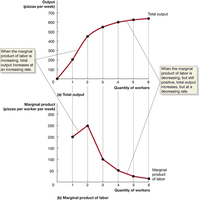
Shows how output changes as more inputs (e.g., labor) are added.
Marginal Product of Labor and Law of Diminishing Returns
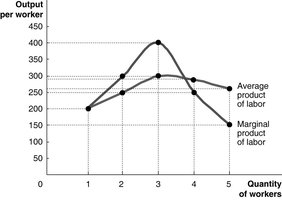
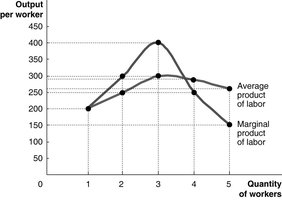
Marginal Product of Labor (MPL): Additional output from hiring one more worker.
Law of Diminishing Returns: Adding more of a variable input to a fixed input eventually causes the marginal product to decline.

Short-Run Cost Curves
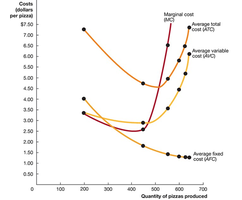
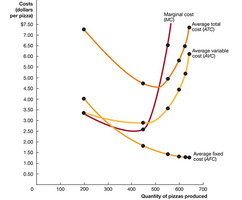
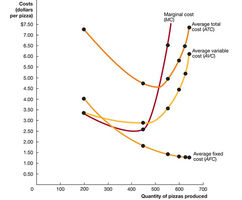
Marginal Cost (MC): The change in total cost from producing one more unit:
MC curve is typically U-shaped due to the law of diminishing returns.
ATC and AVC curves are also U-shaped; AFC declines as output increases.
Long-Run Costs and Economies of Scale
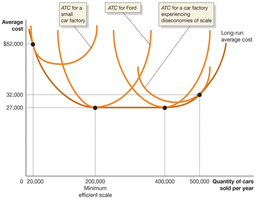
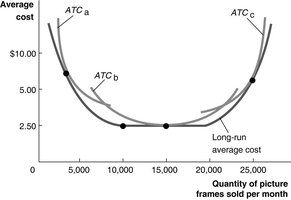
Long-Run Average Cost Curve (LRAC): Shows the lowest cost at which a firm can produce any given output when all inputs are variable.
Economies of Scale: LRAC falls as output increases (downward sloping).
Constant Returns to Scale: LRAC remains unchanged as output increases (flat).
Diseconomies of Scale: LRAC rises as output increases (upward sloping).

Concept | Definition | Formula |
|---|---|---|
Total Cost (TC) | Sum of all costs (fixed + variable) | |
Average Total Cost (ATC) | Total cost per unit of output | |
Average Fixed Cost (AFC) | Fixed cost per unit of output | |
Average Variable Cost (AVC) | Variable cost per unit of output | |
Marginal Cost (MC) | Change in total cost from producing one more unit |
Example: If a firm produces 30 units at a total cost of ATC = AFC + AVCATC = 900/30 = 30$).
Additional info: These notes cover core concepts from Chapters 9 and 11 of a typical microeconomics course, focusing on international trade, comparative advantage, protectionism, and the theory of production and costs.
