Back
BackInternational Trade, Comparative Advantage, and Government Trade Policies
Study Guide - Smart Notes
 Tailored notes based on your materials, expanded with key definitions, examples, and context.
International Trade and Comparative Advantage
Trade and Specialization
International trade allows countries to specialize in producing goods for which they have a comparative advantage, meaning they can produce at the lowest opportunity cost. This specialization increases overall economic efficiency and welfare. However, in practice, countries sometimes produce goods for which they do not have a comparative advantage due to various economic and political factors.
Comparative Advantage: The ability of a country to produce a good at a lower opportunity cost than another country.
Specialization: Focusing production on goods where a country has comparative advantage.
Example: If the U.S. can produce ethanol more efficiently than other countries, it should specialize in ethanol production and trade for other goods.
Market Outcomes Under Autarky
The U.S. Market for Ethanol Without Trade
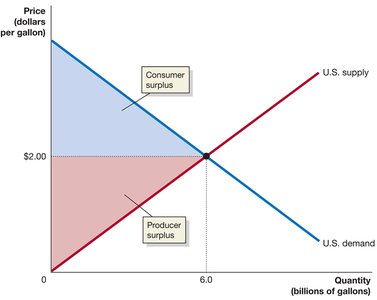
When trade is not allowed (autarky), domestic consumption is met entirely by domestic production. The equilibrium price and quantity are determined by the intersection of domestic supply and demand. Consumer and producer surplus are maximized within the domestic market.
Consumer Surplus: The area above the equilibrium price and below the demand curve.
Producer Surplus: The area below the equilibrium price and above the supply curve.
Example: At a price of $2.00 per gallon and a quantity of 6.0 billion gallons, consumer and producer surplus are illustrated below.
Effects of Free Trade
Opening the Market to Imports
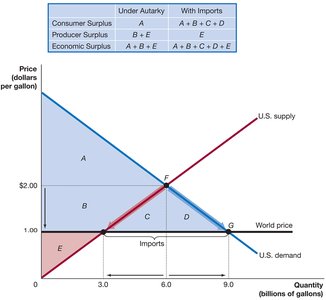
When the U.S. allows imports, the domestic price falls to the world price, increasing consumer surplus and decreasing producer surplus. The overall economic surplus rises, as the gains to consumers outweigh the losses to producers.
Free Trade: Trade without government restrictions.
Economic Surplus: The sum of consumer and producer surplus.
Example: With a world price of $1.00 per gallon, U.S. production falls, consumption rises, and imports fill the gap. Consumer surplus increases to A+B+C+D, producer surplus falls to E, and economic surplus rises.
Government Policies Restricting Trade
Tariffs, Quotas, and Voluntary Export Restraints (VERs)
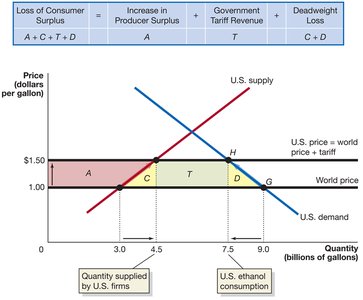
Governments may restrict trade to protect domestic industries using tariffs, quotas, or VERs. These policies raise domestic prices, increase producer surplus, generate government revenue, but reduce consumer surplus and create deadweight loss.
Tariff: A tax on imports, raising domestic prices.
Quota: A numerical limit on imports.
VER: A negotiated limit on imports between countries.
Deadweight Loss: The reduction in economic surplus due to inefficiency.
Example: A $0.50 per gallon tariff raises the U.S. price to $1.50, increasing producer surplus and government revenue, but reducing consumer surplus and causing deadweight loss (C+D).
Import Quotas: The U.S. Sugar Market
Effects of Sugar Quotas
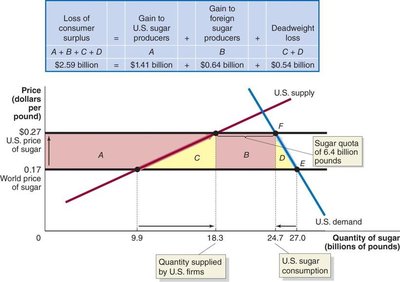
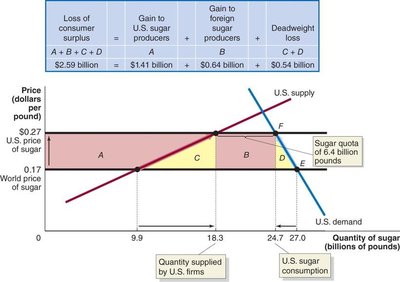
The U.S. imposes a quota on sugar imports, keeping domestic prices above world prices. This benefits domestic producers and foreign producers who can sell at the higher price, but harms consumers and creates deadweight loss.
Quota: Restricts imports to 6.4 billion pounds, raising U.S. price to $0.27 per pound.
Consumer Surplus: Falls by A+B+C+D.
Producer Surplus: Increases for U.S. firms.
Foreign Producer Surplus: Gains for foreign producers able to sell at the U.S. price.
Deadweight Loss: C+D, due to reduced consumption and higher prices.
Example: If unlimited imports were allowed, U.S. would import twice as much sugar as produced domestically.
Costs to Society From Import Restrictions
Job Preservation and Economic Costs
Import restrictions are often justified as a way to preserve domestic jobs. However, the cost per job saved is extremely high, and these policies can reduce jobs in other industries by raising prices and reducing consumer spending.
Example: Sugar quotas cost U.S. consumers $2.59 billion to save 3,000 jobs, or $863,333 per job.
Other Examples: Shoe tariffs cost $300,000 per job per year; tire tariffs cost $900,000 per job per year.
Additional info: Higher prices from tariffs and quotas can reduce demand for other goods, causing job losses in unrelated industries.
Gains From Unilateral Elimination of Tariffs and Quotas
Economic Benefits of Removing Trade Barriers
Even if other countries do not reciprocate, unilateral removal of tariffs and quotas can benefit the domestic economy by increasing economic surplus and lowering prices for consumers.
Example: Analysis of the sugar quota shows that the U.S. would gain from eliminating restrictions, regardless of other countries' actions.
Other Barriers to Trade
Health, Safety, and National Security Restrictions
Governments may restrict imports based on health, safety, or national security concerns. These restrictions can sometimes be self-serving or protectionist in nature.
Example: Higher standards for imported goods, "Buy American" programs, and restrictions on goods critical for national security.
The Debate Over Trade Policies and Globalization
Arguments For and Against Free Trade
Economists generally favor free trade due to its positive effects on economic welfare. However, opposition exists due to concerns about job losses, wage protection, cultural impacts, and national security.
Globalization: The process of countries becoming more open to foreign trade and investment.
Protectionism: The use of trade barriers to shield domestic firms from foreign competition.
Infant Industry Argument: New industries may need temporary protection to become competitive.
Normative vs. Positive Analysis: Positive analysis describes "what is," while normative analysis considers "what ought to be." Trade policy debates often involve value judgments.
Trade Agreements and the WTO
History and Role of International Trade Agreements
Trade agreements such as GATT and the WTO have played a significant role in reducing trade barriers and resolving disputes. The WTO oversees international trade agreements and provides a forum for dispute resolution.
GATT: General Agreement on Tariffs and Trade, established in 1948.
WTO: World Trade Organization, established in 1995, with 159 member states as of 2021.
Opposition to WTO and Trade in General
Anti-Globalization and Protectionist Arguments
Opposition to free trade and the WTO comes from anti-globalization forces and traditional protectionists. Concerns include worker protections, cultural impacts, job losses, and national security.
Dumping: Selling a product below its cost of production. WTO allows countries to impose restrictions if dumping is suspected, though determining true costs is difficult.
Special Interest Groups: Domestic industries often lobby for trade restrictions to protect their interests, even when the overall economy would benefit from freer trade.
Summary Table: Effects of Trade Policies
Comparison of Surplus Changes Under Different Policies
The following table summarizes the effects of quotas on the U.S. sugar market, showing changes in consumer surplus, producer surplus, foreign producer surplus, and deadweight loss.
Loss of Consumer Surplus | Gain to U.S. Sugar Producers | Gain to Foreign Sugar Producers | Deadweight Loss |
|---|---|---|---|
$2.59 billion | $1.41 billion | $0.64 billion | $0.54 billion |