 Back
BackMicroeconomic Theory: Cost Minimization, Short-Run Supply, and Isoquants
Study Guide - Smart Notes
 Tailored notes based on your materials, expanded with key definitions, examples, and context.
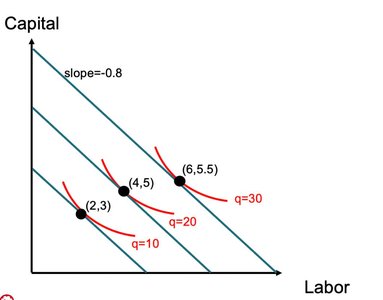
Q1. If the firm plans to produce 20 units of output (per hour), its minimized cost is ____.
Background
Topic: Cost Minimization with Isoquants and Isocosts
This question tests your understanding of how firms choose the optimal combination of labor and capital to minimize costs for a given output, using isoquants (curves showing equal output) and isocost lines (lines showing equal cost).
Key Terms and Formulas:
Isoquant: Curve representing all combinations of labor and capital that yield the same output.
Isocost Line: Line representing all combinations of labor and capital that cost the same amount, given input prices.
Cost Function:
Where is the rental rate of capital, is the quantity of capital, is the wage rate of labor, and is the quantity of labor.
Step-by-Step Guidance
Identify the wage rate () and the rental rate of capital () from the problem statement.
Locate the isoquant for on the graph. Find the point where this isoquant is tangent to the lowest possible isocost line (this is the cost-minimizing input combination).
Read off the values of labor () and capital () at this tangency point. For example, if the tangency occurs at and , use these values in the cost formula.
Plug the values of and into the cost function: .
Try solving on your own before revealing the answer!
Final Answer:
We used the cost-minimizing combination of and for units, and plugged them into the cost function with the given input prices.
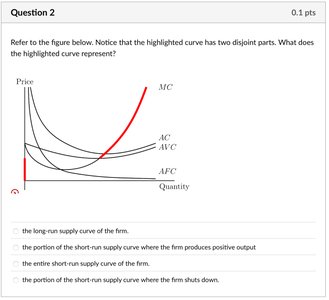
Q2. Refer to the figure below. Notice that the highlighted curve has two disjoint parts. What does the highlighted curve represent?
Background
Topic: Short-Run Supply Curve of a Competitive Firm
This question tests your understanding of the short-run supply curve for a perfectly competitive firm, and how it relates to marginal cost (MC), average variable cost (AVC), and average total cost (AC).
Key Terms and Formulas:
Marginal Cost (MC): The additional cost of producing one more unit of output.
Average Variable Cost (AVC): Variable cost per unit of output.
Short-Run Supply Curve: The portion of the MC curve above the minimum AVC, plus a vertical segment at zero output when price is below minimum AVC.
Step-by-Step Guidance
Observe that the highlighted curve consists of two parts: a vertical segment at zero output and a segment of the MC curve above the AVC curve.
Recall that in the short run, a competitive firm's supply curve is the portion of the MC curve that lies above the minimum AVC. If the market price falls below the minimum AVC, the firm shuts down and produces zero output.
The vertical segment at zero output represents the firm's decision to shut down when price is below minimum AVC.
The upward-sloping segment represents the firm's supply when price is above minimum AVC.
Try solving on your own before revealing the answer!
Final Answer: The highlighted curve represents the short-run supply curve of the firm, including both the shutdown portion (vertical at zero output) and the portion where the firm produces positive output (MC above AVC).
This is because the short-run supply curve is defined as the MC curve above AVC, plus zero output when price is below minimum AVC.
