 Back
BackMicroeconomics ECS2601: Core Study Notes
Study Guide - Smart Notes
 Tailored notes based on your materials, expanded with key definitions, examples, and context.
Introduction to Microeconomics
Microeconomics studies the behavior of individual consumers, firms, and markets. It focuses on how resources are allocated, how prices are determined, and how economic agents interact within various market structures. The ECS2601 module covers foundational and intermediate topics essential for understanding microeconomic theory and its applications.
Elasticity
Types of Elasticity
Elasticity measures the responsiveness of one variable to changes in another variable, commonly price or income. It is a critical tool for analyzing demand and supply.
Price Elasticity of Demand (Ep): Measures the percentage change in quantity demanded resulting from a 1% change in price. Typically negative, but the absolute value is used for interpretation.
Income Elasticity of Demand: Measures the responsiveness of quantity demanded to changes in consumer income. Positive for normal goods, negative for inferior goods.
Cross-Price Elasticity of Demand: Measures the responsiveness of demand for one good to changes in the price of another good. Positive for substitutes, negative for complements.
Price Elasticity of Supply: Measures the responsiveness of quantity supplied to changes in price, usually positive.
Formulas:
Point Elasticity:
Arc Elasticity:
Applications: Elasticity helps predict the effects of price changes, taxation, and government interventions such as price floors and ceilings.
Consumer Behaviour
Consumer Preferences and Utility
Consumers make choices to maximize their satisfaction (utility) given their preferences and budget constraints. Preferences are assumed to be complete, transitive, and that more is preferred to less. Utility can be represented by indifference curves, which show combinations of goods yielding the same satisfaction.
Indifference Curve: Downward sloping and convex to the origin, representing diminishing marginal rate of substitution (MRS).
Marginal Rate of Substitution (MRS): The rate at which a consumer is willing to trade one good for another, holding utility constant. along an indifference curve.
Budget Constraints
The budget line represents all combinations of goods a consumer can afford given their income and the prices of goods.
Equation:
Slope:
Consumer Equilibrium
Equilibrium is reached where the highest attainable indifference curve is tangent to the budget line, i.e., where .
Marginal Utility and Consumer Choice
Consumers allocate their budget so that the marginal utility per rand spent is equalized across all goods:
Example Table:
Bundle | MU of peanut butter | MU of tuna | Marginal Rate of Substitution |
|---|---|---|---|
A | 0.25 | 2.41 | |
B | 0.31 | 1.50 | |
C | 0.42 | 0.84 | |
D | 0.66 | 0.33 |
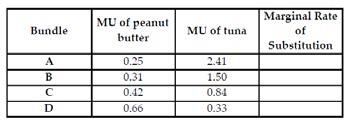
Additional info: The marginal rate of substitution (MRS) between peanut butter and tuna at each bundle can be calculated as .
Production Theory
Production Functions
The production function shows the maximum output that can be produced with given inputs and technology. For two inputs (capital K and labour L):
Short run: At least one input is fixed (usually capital). Long run: All inputs are variable.
Isoquants
Isoquants are curves showing all combinations of inputs that yield the same output, analogous to indifference curves in consumer theory.
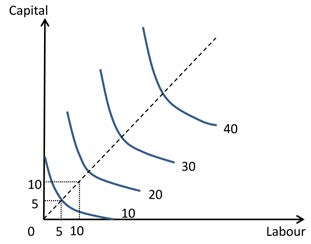
Marginal Rate of Technical Substitution (MRTS): The rate at which one input can be substituted for another, holding output constant.
Returns to Scale
Increasing Returns to Scale: Output increases by a greater proportion than inputs.
Constant Returns to Scale: Output increases in the same proportion as inputs.
Decreasing Returns to Scale: Output increases by a smaller proportion than inputs.
The Cost of Production
Short-Run and Long-Run Costs
Cost curves describe the relationship between output and the costs of production. In the short run, some inputs are fixed; in the long run, all inputs are variable.
Total Cost (TC):
Average Cost (AC):
Marginal Cost (MC):
Average Variable Cost (AVC):
Average Fixed Cost (AFC):
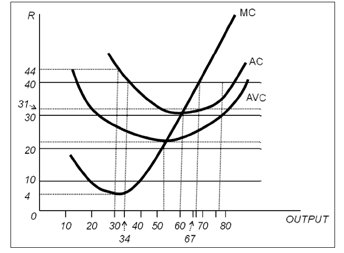
Key relationships: MC intersects AC and AVC at their minimum points. As output increases, AFC declines.
Long-Run Costs
In the long run, firms can adjust all inputs. The long-run average cost curve (LRAC) is typically U-shaped and is the envelope of all possible short-run average cost curves (SRAC).
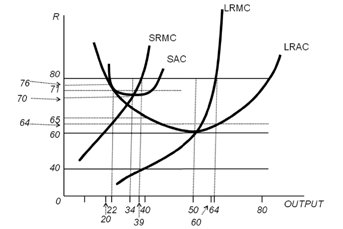
Economies of Scale: LRAC decreases as output increases. Diseconomies of Scale: LRAC increases as output increases.
Summary Table: Key Cost Concepts
Cost Concept | Definition |
|---|---|
Economic Cost | Explicit + implicit (opportunity) costs |
Accounting Cost | Explicit costs only |
Sunk Cost | Past expenditure that cannot be recovered |
Marginal Cost (MC) | Change in total cost from producing one more unit |
Average Cost (AC) | Total cost divided by output |
Conclusion
This guide covers the foundational concepts of microeconomics, including elasticity, consumer behavior, production, and cost theory. Mastery of these topics is essential for analyzing market outcomes, firm decisions, and the effects of government intervention. For further study, refer to the recommended textbook and additional readings provided in the course materials.
