 Back
BackMicroeconomics Final Exam Study Guidance – Multiple Choice, Short Answer, and Free Response
Study Guide - Smart Notes
 Tailored notes based on your materials, expanded with key definitions, examples, and context.
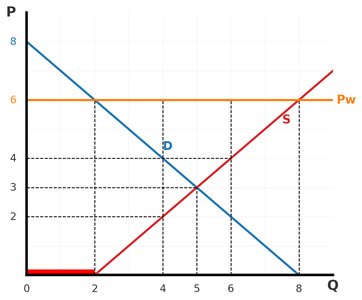
Q9. Can the deadweight loss be equal to $15 after a price floor is imposed in this market? Justify your answer with appropriate calculations.
Background
Topic: Price Floors, Deadweight Loss, and Market Surplus
This question tests your understanding of how government-imposed price floors affect market outcomes, including consumer surplus, producer surplus, and deadweight loss. You are asked to use the provided supply and demand graph to analyze the effects of a price floor and calculate the resulting deadweight loss.
Key Terms and Formulas
Price Floor: A minimum price set by the government above the equilibrium price.
Deadweight Loss (DWL): The loss in total surplus that occurs when the market is not in equilibrium due to intervention (such as a price floor).
Consumer Surplus (CS): The area between the demand curve and the price, up to the quantity traded.
Producer Surplus (PS): The area between the price and the supply curve, up to the quantity traded.
Total Surplus (TS):
Deadweight Loss Formula:
Step-by-Step Guidance
Identify the equilibrium price and quantity in the absence of a price floor by finding where the supply and demand curves intersect.
Calculate the total surplus (sum of consumer and producer surplus) at equilibrium. This is typically the area between the supply and demand curves up to the equilibrium quantity.
Determine the new quantity traded after the price floor is imposed at . This will be the lesser of the quantity demanded and quantity supplied at the price floor.
Calculate the new consumer surplus and producer surplus at the price floor, using the areas under the demand and above the supply curve up to the new quantity traded.
Set up the calculation for deadweight loss as the difference between the total surplus before and after the price floor. Do not compute the final value yet.
Try solving on your own before revealing the answer!
Final Answer: Yes, the deadweight loss can be $15.
By calculating the total surplus before and after the price floor, and using the areas under the curves, you find that the deadweight loss can indeed be $15, as shown by the difference in total surplus values.
This is possible because the price floor reduces the quantity traded and creates inefficiency in the market, leading to a loss in total surplus.
