 Back
BackMonopoly Output Decisions and Pricing with Market Power
Study Guide - Smart Notes
 Tailored notes based on your materials, expanded with key definitions, examples, and context.
Monopoly Output Decisions
Short Run Output Decision
In the short run, a monopolist determines whether to produce a positive output by comparing marginal revenue and marginal cost, and ensuring price covers average variable cost.
Profit Maximization Condition: The monopolist produces where .
No Shut Down Condition: The monopolist only produces if .
Shut Down: If no such exists, the monopolist shuts down production.
Long Run Output Decision
In the long run, the monopolist must cover all costs, including fixed costs, and chooses output accordingly.
Profit Maximization Condition: .
No Shut Down Condition: .
Shut Down: If , the monopolist shuts down.
Worked Example: Short Run Monopoly
Given market demand and cost :
Inverse Demand:
Total Revenue:
Marginal Revenue:
Marginal Cost:
Profit Maximizing Output: Set
Price:
No Shut Down Condition: (usually satisfied)
Profit:
Worked Example: Long Run Monopoly
Given market demand , , and no fixed cost:
Inverse Demand:
Total Revenue:
Marginal Revenue:
Profit Maximizing Output:
Price:
No Shut Down Condition:
Profit:
Pricing with Market Power
Welfare Analysis in Monopoly vs. Competitive Markets
Monopolists affect welfare differently than competitive firms, leading to changes in consumer surplus, producer surplus, and deadweight loss.
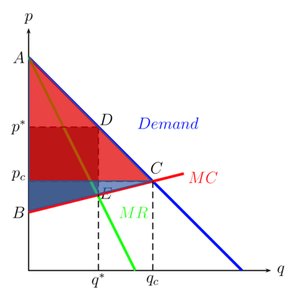
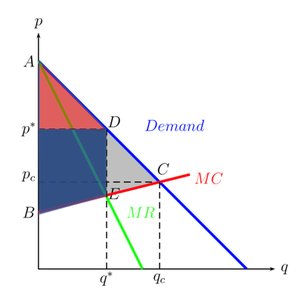
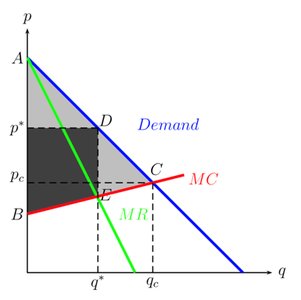
Competitive Equilibrium: Output , price ; consumer surplus is the red triangle, producer surplus is the blue triangle, total welfare is the sum.
Monopoly Equilibrium: Output , price ; consumer surplus shrinks, producer surplus increases, and deadweight loss appears.
Key Differences Between Monopoly and Competition
Monopolists charge a higher price than competitive price level.
Monopolists charge a price higher than marginal cost.
Monopolists produce less than competitive equilibrium output.
Monopolists earn higher profit than competitive firms.
Monopoly leads to deadweight loss (loss of total welfare).
Price Discrimination
Definition and Types
Price discrimination occurs when a firm charges different prices to different consumers or for different units of a good, aiming to capture more consumer surplus and increase producer surplus.
First-degree price discrimination: Each consumer is charged their maximum willingness to pay.
Second-degree price discrimination: Different prices are charged for different quantities (e.g., quantity discounts).
Third-degree price discrimination: Different prices are charged to different groups (e.g., student rates, gender-based pricing).
First-Degree Price Discrimination
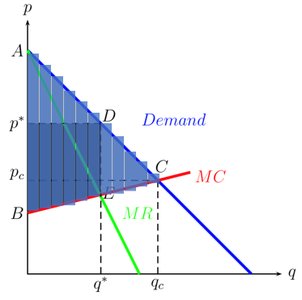
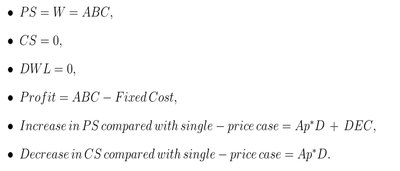
Under first-degree price discrimination, the monopolist captures all consumer surplus, making output efficient but leaving consumers with no surplus.
Producer Surplus:
Consumer Surplus:
Deadweight Loss:
Profit:
Increase in Producer Surplus: Compared to single-price case,
Decrease in Consumer Surplus: Compared to single-price case,
Examples: Personalized discounts for cars, tax services.
Additional info: First-degree price discrimination is rare in practice due to information constraints.
Second-Degree Price Discrimination
Second-degree price discrimination involves charging different prices for different quantities, benefiting from consumers' diminishing marginal utility.
Examples: Buy one get one 50% off, loyalty cards, family size discounts, group discounts.
Third-Degree Price Discrimination
Third-degree price discrimination divides consumers into groups with separate demand curves and charges different prices to each group.
Examples: Hotel rates (weekends vs weekdays), economy vs business class, coupons, gender-based pricing, student rates.
