 Back
BackOptimization in Microeconomics: Principles, Applications, and Marginal Analysis
Study Guide - Smart Notes
 Tailored notes based on your materials, expanded with key definitions, examples, and context.
Optimization: Doing the Best You Can
Introduction to Optimization
Optimization is a fundamental concept in microeconomics, referring to the process by which economic agents choose the best feasible option given their constraints and preferences. It involves comparing alternatives and selecting the one that maximizes utility or minimizes cost.
Optimization: The process of making the best possible choice from a set of feasible alternatives.
Constraints: Limitations such as budget, time, or information that restrict available choices.
Utility: A measure of satisfaction or benefit derived from a choice.
Cost: The value of resources sacrificed to obtain a good or service.
Comparing Alternatives: The Apartment Example
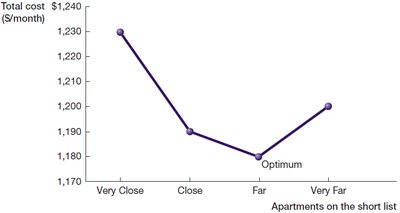
When choosing between apartments, individuals must weigh factors such as rent and commuting time. The optimal choice depends on how much one values time and the associated opportunity cost.
Opportunity Cost: The value of the next best alternative foregone. For example, time spent commuting could be used for work or leisure.
Trade-offs: Lower rent may mean a longer commute, and vice versa.

Calculating Total Cost: Rent and Commuting
To optimize apartment choice, one must calculate the total cost, which includes both rent and the monetary value of commuting time. The opportunity cost of time is often expressed as an hourly wage or value.
Total Cost Formula:
Example: If commuting takes 20 hours/month and the opportunity cost is $10/hour, then the commuting cost is $200/month.
Effect of Opportunity Cost on Optimization
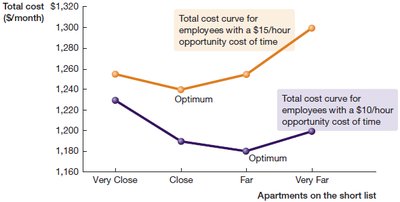
The optimal apartment choice changes as the opportunity cost of time changes. Higher opportunity costs make closer apartments more attractive despite higher rent.
For $10/hour opportunity cost, the optimal apartment may be farther from the city center.
For $15/hour opportunity cost, the optimal apartment is likely closer to the city center.
Why Don't People Always Optimize?
Optimization is not always achieved due to uncertainty, limited information, complexity, and inexperience. Behavioral economics studies why people sometimes fail to optimize, including self-control problems and domain-specific risk preferences.
Uncertainty/Risk: Future events may change the optimal choice.
Limited Information: Not all relevant data is available.
Complexity: Sorting through information can be difficult.
Inexperience: New situations may lead to suboptimal choices.
Marginal Analysis: An Alternate Way of Analyzing
Principle of Marginal Analysis
Marginal analysis focuses on the incremental changes in costs and benefits when moving from one alternative to another. It is often faster and more practical than total value analysis.
Marginal Effect: The change in total value as quantity changes by one unit.
Marginal Cost: The additional cost incurred by moving to the next alternative.
Marginal Benefit: The additional benefit gained by moving to the next alternative.
Steps in Marginal Analysis
Translate all costs and benefits into common units (e.g., dollars per month).
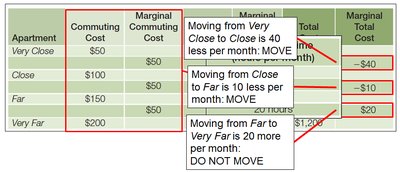
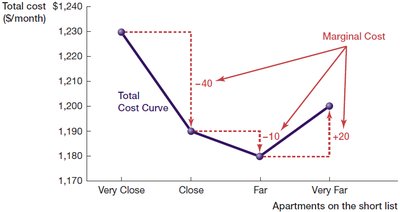
Calculate the marginal consequences of moving between alternatives.
Choose the alternative where moving to it makes you better off and moving away makes you worse off.
Optimization at the Margin
The principle of optimization at the margin states that the optimal feasible alternative is the one where moving to it improves your situation, but moving away makes it worse.
Marginal analysis helps identify the point where the marginal cost equals the marginal benefit.
Both total value and marginal analysis yield the same optimal choice.
Evidence-Based Economics: Location and Rental Costs
How Location Affects Rental Cost
Empirical studies show that rental costs generally decrease as distance from the city center increases, holding apartment quality constant. This relationship is observed in cities like Portland, Oregon.
Rents fall by approximately 33% as you move 6 miles from the city center.
Price per square foot varies by location, as seen in Boston's Red Line stops.

Application: Consulting Example
Marginal analysis can be applied to business decisions, such as determining whether a restaurant should stay open an extra hour. The decision depends on comparing marginal revenue and marginal cost.
If marginal revenue ($250) exceeds marginal cost ($200), stay open.
If marginal revenue ($100) is less than marginal cost ($200), close earlier.
Profit change is the difference between marginal revenue and marginal cost.
Optimization in Study Time Allocation
Allocating Study Hours Between Courses
Students can use optimization and marginal analysis to allocate study time between courses to maximize their average grade. The optimal allocation depends on the marginal improvement in grades per hour spent on each subject.
Hours of Study | Chemistry | Biology |
|---|---|---|
0 | 70 | 60 |
1 | 77 | 68 |
2 | 82 | 74 |
3 | 85 | 78 |
With 1 hour, allocate to the subject with the highest marginal grade increase.
With 2 or 3 hours, compare marginal improvements and allocate accordingly.
Optimization Summary
Optimization is central to microeconomic decision-making. It can be approached through total value or marginal analysis, both yielding the same result. Marginal analysis is often more practical, focusing on incremental changes. Empirical evidence supports the importance of location in rental costs, and optimization principles apply broadly, from apartment selection to business and study decisions.
Optimization using total value: Calculate total value for each option and choose the highest.
Optimization using marginal analysis: Compare incremental changes and choose the best alternative.
Both methods are valid and yield identical answers.
