Back
BackPrice Controls, Market Efficiency, and Tax Incidence in Microeconomics
Study Guide - Smart Notes
 Tailored notes based on your materials, expanded with key definitions, examples, and context.
Price Controls and Market Efficiency
Government Intervention in the Free Market
Government intervention in markets often takes the form of price controls, which can affect both allocative and productive efficiency. The free market, guided by the 'invisible hand' (Adam Smith), aims to allocate resources to their highest valued uses and minimise production costs.
Allocative Efficiency: Achieved when goods are distributed to those who value them most.
Productive Efficiency: Achieved when goods are produced at the lowest possible cost.
Types of Price Controls
Price Ceiling: A maximum price set below the equilibrium price (e.g., rent controls, milk prices).
Price Floor: A minimum price set above the equilibrium price (e.g., minimum wage, agricultural price supports).
Setting prices above or below equilibrium creates excess supply or demand, leading to market disequilibrium.
Burden and Incidence of a Tax
Effects of Sales Tax on Market Equilibrium
An increase in sales tax raises the cost of production, shifting the supply curve upward. The tax burden is shared between consumers and producers, depending on the relative price elasticity of demand and supply.
Indirect Tax: A tax that is not directly paid by the consumer but is included in the price of goods.
Tax Incidence: The division of the tax burden between buyers and sellers.
Elasticity: The more elastic the demand, the smaller the share paid by consumers; the more inelastic, the larger the share paid by consumers.
Example: If a $300 TV is subject to a 10% sales tax, the price may not rise to $330, as the burden is shared.
Tax Incidence Formula
The share of tax paid by consumers and producers can be calculated using elasticity:
where is the price elasticity of supply and is the price elasticity of demand.
Market Efficiency and Economic Surplus
Economic Surplus
Economic surplus is created when the price consumers are willing to pay exceeds the cost of production. It is a measure of market efficiency.
Consumer Surplus: The difference between what consumers are willing to pay and what they actually pay.
Producer Surplus: The difference between the price received by producers and their cost of production.
Total Surplus: The sum of consumer and producer surplus.
Price controls reduce economic surplus by preventing the market from reaching equilibrium.
Price Ceilings: Rent Controls
Short-Run and Long-Run Effects
Rent controls set a maximum price for apartments, often below the equilibrium. In markets with inelastic demand and supply (e.g., Vancouver), this leads to shortages and alternative allocation methods.
Short-Run Effects: Increased search activity, black markets, and non-price discrimination by suppliers.
Long-Run Effects: Disincentive for developers to supply new housing, slow adjustment to shortages.
Price Floors: Agricultural Markets and Minimum Wage
Agricultural Price Supports
Technological improvements increase supply, but demand is price and income-inelastic, leading to falling prices and volatile incomes for farmers.
Solution 1: The government purchases surplus at a minimum price above the equilibrium.
Solution 2: Production quotas restrict supply, allowing farmers to sell at higher prices.
Solution 3: Subsidies enable producers to lower prices for consumers while maintaining income.
Agricultural Price Support Table
Solution | Mechanism | Effect |
|---|---|---|
Purchase Surplus | The government buys the excess supply | Supports price, reduces surplus |
Production Quotas | Limits output | Maintains a higher price, restricts supply |
Subsidies | Direct payments to producers | Allows lower consumer prices, supports income |
Minimum Wage
Minimum wage laws set a floor above the equilibrium wage. While theory suggests this creates excess supply (unemployment), empirical evidence shows that unemployment may not rise as expected. Increased wages can lead to higher worker productivity and increased demand for labour.
Minimum Wage Examples: Federal minimum wage is $17.75/hour; it varies by province and territory.
Research: David Card's work showsthat minimum wage increases do not necessarily lead to higher unemployment.
Minimum Wage Table (January 2026)
Region | Minimum Wage |
|---|---|
Federal | $17.75/hour |
Nunavut | $19.75/hour |
Yukon | $17.94/hour |
Northwest Territories | $16.95/hour |
B.C. | $17.85/hour |
Ontario | $17.60/hour |
P.E.I. | $16.50/hour |
Nova Scotia | $16.50/hour |
Quebec | $16.10/hour |
Manitoba | $16.00/hour |
Newfoundland | $16.00/hour |
New Brunswick | $15.65/hour |
Saskatchewan | $15.35/hour |
Alberta | $15.00/hour |
Consumer Surplus, Producer Surplus, and Total Surplus
Definitions and Calculation
Consumer surplus, producer surplus, and total surplus are key measures of market efficiency. They are maximised in a free market and reduced by price controls and taxes.
Consumer Surplus: Area above the price and below the demand curve.
Producer Surplus: Area below the price and above the supply curve.
Total Surplus: Sum of consumer and producer surplus.
Summary Table: Effects of Government Policy
Policy | Effect on Market | Efficiency Impact |
|---|---|---|
Price Ceiling | Shortage, alternative allocation | Reduces surplus |
Price Floor | Surplus, unemployment | Reduces surplus |
Sales Tax | Shared burden, higher prices | Reduces surplus |
Relevant Study Topics
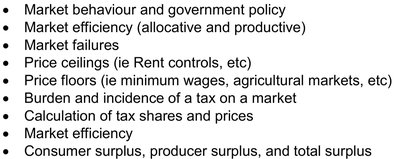
Market behaviour and government policy
Market efficiency (allocative and productive)
Market failures
Price ceilings (rent controls, etc.)
Price floors (minimum wages, agricultural markets, etc.)
Burden and incidence of a tax on a market
Calculation of tax shares and prices
Consumer surplus, producer surplus, and total surplus