 Back
BackProducers in the Long Run: Cost, Efficiency, and Technological Change
Study Guide - Smart Notes
 Tailored notes based on your materials, expanded with key definitions, examples, and context.
Producers in the Long Run
The Long Run: No Fixed Factors
In microeconomics, the long run is defined as a period in which all factors of production are variable, allowing firms to adjust their input combinations freely. This flexibility enables firms to explore various production methods to maximize output and minimize costs.
Technical Efficiency: Achieved when a given set of inputs produces the maximum possible output.
Profit Maximization: Requires not only technical efficiency but also cost minimization. Firms select the technically efficient method with the lowest cost.
Cost Minimization: Firms choose the combination of labour and capital that minimizes total cost for a given output.
Profit Maximization and Cost Minimization
Profit-maximizing firms must minimize costs by choosing the optimal mix of inputs. If one input can be substituted for another to reduce costs while maintaining output, the firm is not yet minimizing costs.
Marginal Product per Dollar: Cost minimization occurs when the ratio of each input's marginal product to its price is equal across all inputs.
Principle of Substitution: Firms respond to changes in input prices by substituting towards cheaper inputs and away from more expensive ones.
Formula: For two inputs, capital (K) and labour (L), cost minimization requires:
where MP is marginal product and P is price.
Long-Run Cost Curves
Long-Run Average Cost (LRAC)
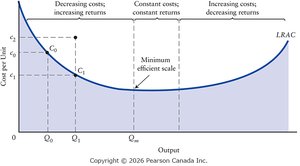
The long-run average cost (LRAC) curve shows the lowest possible cost per unit of output when all inputs are variable. It serves as the boundary between attainable and unattainable cost levels for a given technology and input prices.
Unlike the short run, there is only one LRAC curve for a given set of input prices.
Short-run cost curves (AVC, AFC, ATC) are not distinguished in the long run.
A "Saucer-Shaped" LRAC Curve: Economies and Diseconomies of Scale
The LRAC curve typically has a "saucer" shape, reflecting economies and diseconomies of scale as output changes.
Economies of Scale: LRAC falls as output increases, indicating increasing returns to scale.
Minimum Efficient Scale: The smallest output at which LRAC is minimized and constant returns to scale are achieved.
Diseconomies of Scale: LRAC rises as output increases beyond the minimum efficient scale, indicating decreasing returns to scale.
Example: A factory may experience lower average costs as it expands production up to a certain point, after which further expansion leads to higher average costs due to inefficiencies.
Relationship Between LRAC and SRATC Curves
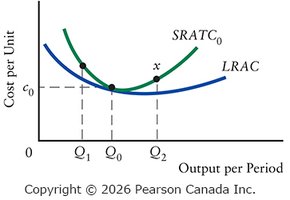
The LRAC curve represents the lowest attainable cost for each output level when all inputs are variable, while the short-run average total cost (SRATC) curves reflect costs when some inputs are fixed.
No SRATC curve can fall below the LRAC curve.
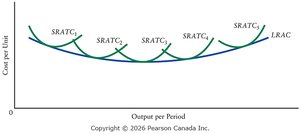
Each SRATC curve is tangent to the LRAC curve at the output level where the fixed input is optimally chosen.
Historical Lesson: The Lower Envelope Curve
Jacob Viner's historical mistake was to connect the minimum points of SRATC curves, rather than constructing the lower envelope (LRAC curve) tangent to each SRATC curve. The LRAC curve is the true boundary of minimum attainable costs.
The Very Long Run: Changes in Technology
Technological Change and Productivity
In the very long run, technological change can shift the LRAC curve, allowing firms to produce at lower costs or higher output levels. Technological change includes new techniques, improved inputs, and new products.
Productivity: Measured as output per unit of input (e.g., per worker or per hour).
Endogenous Technological Change: Firms actively invent and innovate to seek profits, making technological change a result of economic incentives.
Firms' Choices in the Very Long Run
When input prices rise, firms may substitute away from the expensive input or innovate to reduce reliance on it. Successful invention and innovation are uncertain but can yield large profits, incentivizing firms to invest in new technologies.
Significance of Productivity Growth
Productivity growth is crucial for economic progress. Historical predictions of stagnation, such as those by Thomas Malthus, were proven wrong due to slower population growth and technological advancements that increased output.
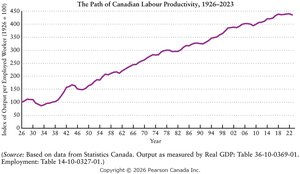
Example: The steady rise in Canadian labour productivity over the past century demonstrates the impact of technological change and innovation on economic growth.
Additional info: Productivity growth enables higher living standards and economic expansion, counteracting the effects of limited resources.
