 Back
BackProducers in the Long Run: Cost Minimization, Long-Run Costs, and Technological Change
Study Guide - Smart Notes
 Tailored notes based on your materials, expanded with key definitions, examples, and context.
Producers in the Long Run
The Long Run: No Fixed Factors
In microeconomics, the long run is a period in which all factors of production are variable, allowing firms to adjust all inputs to find the most efficient production method. Unlike the short run, where at least one input is fixed, the long run provides firms with flexibility to choose among various production techniques.
Technical efficiency: Achieved when a firm uses a combination of inputs that maximizes output for a given set of resources.
Profit maximization requires not just technical efficiency, but also cost minimization—choosing the lowest-cost combination of inputs.
Profit Maximization and Cost Minimization
Firms aim to maximize profit by minimizing the cost of producing a given output. This involves choosing the optimal mix of inputs (e.g., labour and capital) based on their prices and productivity.
Cost minimization: The process of selecting the combination of inputs that produces a given output at the lowest possible cost.
If it is possible to substitute one input for another and reduce total cost while keeping output constant, the firm is not minimizing costs.
The necessary condition for cost minimization is:
Where MPL and MPK are the marginal products of labour and capital, and pL and pK are their respective prices.
If the ratio is not equal, firms can substitute towards the input with the higher marginal product per dollar spent.
Principle of substitution: Firms will use more of the cheaper input and less of the more expensive input when relative prices change.
Long-Run Cost Curves
Definition and Properties
The long-run average cost (LRAC) curve shows the lowest possible cost of producing each level of output when all inputs are variable. It represents the boundary between attainable and unattainable cost levels, given current technology and input prices.
In the long run, all costs are variable; there is no need to distinguish between average variable cost (AVC), average fixed cost (AFC), and average total cost (ATC).
There is only one LRAC for any given set of input prices.
Economies and Diseconomies of Scale
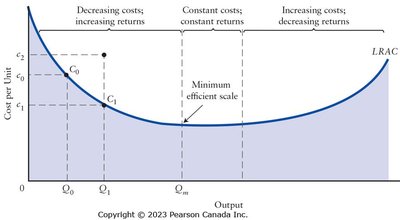
The LRAC curve is typically "saucer-shaped", reflecting different returns to scale as output increases:
Economies of scale: LRAC falls as output increases (increasing returns to scale).
Minimum efficient scale (MES): The smallest output at which LRAC reaches its minimum; all available economies of scale have been realized.
Constant returns to scale: LRAC is flat; output increases in proportion to inputs.
Diseconomies of scale: LRAC rises as output increases (decreasing returns to scale).
Relationship Between LRAC and SRATC Curves
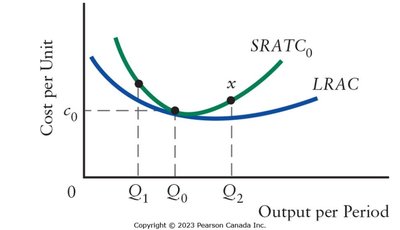
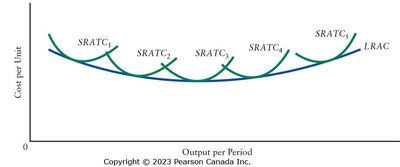
The short-run average total cost (SRATC) curve shows the lowest cost of producing any output when at least one factor is fixed. The LRAC curve is the lower envelope of all possible SRATC curves, each corresponding to a different level of fixed inputs.
No SRATC curve can fall below the LRAC curve, as the LRAC represents the lowest attainable cost for each output level.
Each SRATC curve is tangent to the LRAC at the output level where the fixed factor is optimally chosen.
The Very Long Run: Changes in Technology
Technological Change and Productivity
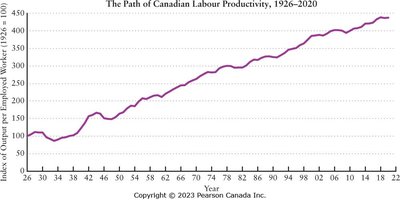
In the very long run, the available techniques and resources change, causing shifts in the LRAC curve. Technological change refers to any improvement in the methods of production, which can increase productivity and lower costs.
Productivity: Output produced per unit of input (e.g., output per worker or per hour).
Technological change is considered endogenous—driven by firms seeking profit through invention and innovation.
Three aspects of technological change:
New techniques
Improved inputs
New products
Firms' Choices in the Very Long Run
When input prices rise, firms may substitute away from the expensive input or innovate to reduce reliance on it. Invention and innovation are risky but can yield large profits, incentivizing firms to pursue them.
The Significance of Productivity Growth
Productivity growth is crucial for economic progress. Historical predictions of stagnation (e.g., by Thomas Malthus) were proven wrong due to slower-than-expected population growth and rapid technological advancement, which increased output per worker.
Summary Table: Types of Returns to Scale
Type | Definition | Effect on LRAC |
|---|---|---|
Increasing Returns (Economies of Scale) | Output increases more than in proportion to inputs | LRAC falls as output increases |
Constant Returns | Output increases in proportion to inputs | LRAC is flat |
Decreasing Returns (Diseconomies of Scale) | Output increases less than in proportion to inputs | LRAC rises as output increases |
Key Formulas
Cost minimization condition:
Productivity:
