 Back
Back2. Production Possibilities, Opportunity Cost, and Gains from Trade
Study Guide - Smart Notes
 Tailored notes based on your materials, expanded with key definitions, examples, and context.
Production Possibilities Frontier (PPF) Model
Definition and Basic Concepts
The Production Possibilities Frontier (PPF) is a fundamental model in microeconomics that illustrates the maximum combinations of two goods or services that an economy can produce given its available resources and technology. The PPF demonstrates concepts such as scarcity, trade-offs, and opportunity cost.
Scarcity: Limited resources restrict the amount of goods that can be produced.
Trade-offs: Producing more of one good requires sacrificing production of another.
Opportunity Cost: The value of the next best alternative forgone when making a choice.
Graphical Representation of the PPF
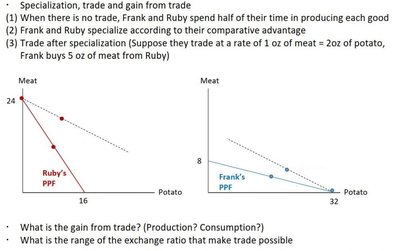
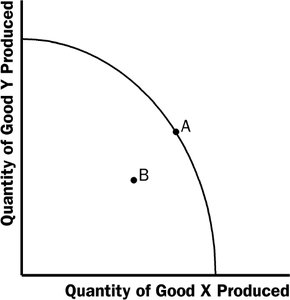
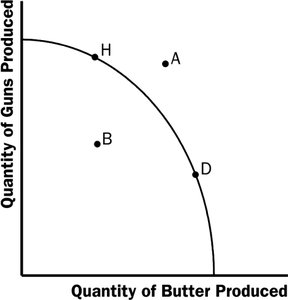
The PPF is typically shown as a curve or straight line on a graph, with each axis representing the quantity of a different good. Points on the curve represent efficient production combinations, while points inside the curve are inefficient, and points outside are unattainable.
Efficient Points: On the PPF curve.
Inefficient Points: Inside the PPF curve.
Unattainable Points: Outside the PPF curve.
Shape of the PPF
The shape of the PPF reflects opportunity costs:
Straight Line: Constant opportunity cost.
Bowed Outward: Increasing opportunity cost, due to resources not being equally productive in all activities.
Opportunity Cost
Definition and Calculation
Opportunity cost is what must be given up to obtain something else. It is calculated as the slope of the PPF.
Formula:
Example: If Liz produces 1 smoothie instead of 1 salad, her opportunity cost of 1 smoothie is 1 salad.
Production Possibilities Tables
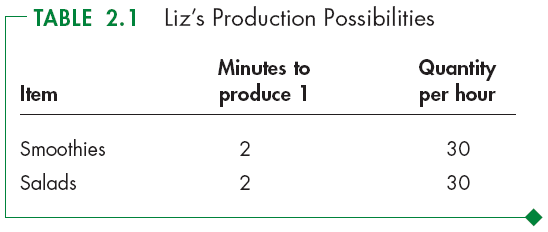
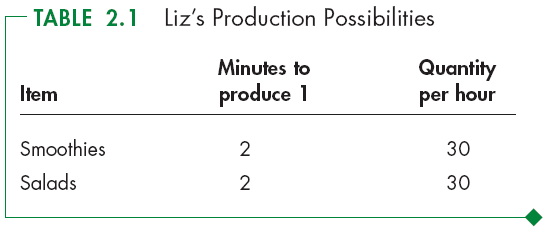
Tables summarize the production capabilities of individuals:
Item | Minutes to produce 1 | Quantity per hour |
|---|---|---|
Smoothies | 2 | 30 |
Salads | 2 | 30 |
Liz's Production Possibilities
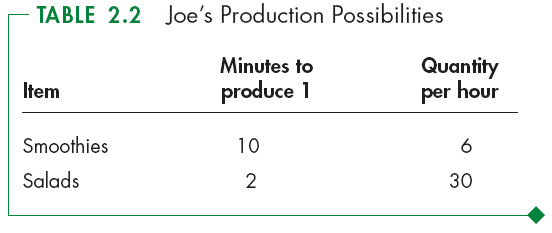
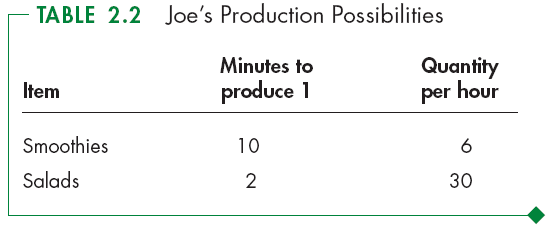
Item | Minutes to produce 1 | Quantity per hour |
|---|---|---|
Smoothies | 10 | 6 |
Salads | 2 | 30 |
Joe's Production Possibilities
Graphical Comparison of PPFs
PPF graphs for Liz and Joe show their production trade-offs and opportunity costs.
Efficiency: Productive and Allocative
Productive Efficiency
Productive efficiency is achieved when it is impossible to produce more of one good without producing less of another. All points on the PPF are productively efficient.
Allocative Efficiency
Allocative efficiency occurs when resources are used to produce the combination of goods most preferred by society. This depends on preferences, which are not explicitly modeled in the PPF.
Gains from Trade
Specialization and Comparative Advantage
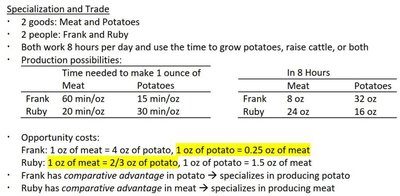
Trade allows individuals or economies to specialize in the production of goods for which they have a comparative advantage—the ability to produce a good at a lower opportunity cost than others. This increases overall efficiency and expands production possibilities.
Absolute Advantage: Ability to produce more output with the same resources.
Comparative Advantage: Ability to produce at a lower opportunity cost.
Numerical Example: Liz and Joe
Liz and Joe can both produce smoothies and salads, but Liz is more efficient at smoothies, while Joe is more efficient at salads. By specializing and trading, they can both consume more than they could alone.
Trade Price: The exchange rate must fall between their opportunity costs.
Example: If Liz's opportunity cost for 1 smoothie is 1 salad, and Joe's is 5 salads, a trade price of 1 smoothie = 2 salads benefits both.
Principles Illustrated
Principle 1: People face trade-offs.
Principle 2: The cost of something is what you give up to get it.
Principle 5: Trade can make everyone better off.
Review Questions and Applications
Opportunity Cost in Everyday Life
Example: The opportunity cost of going to a movie includes the ticket price, other expenses, and the value of time spent.
Formula:
Efficiency on the PPF
Efficient Outcome: All resources are fully utilized; represented by points on the PPF.
Inefficient Outcome: Some resources are underutilized; represented by points inside the PPF.
Specialization and Trade: Comparative Advantage Example
Example: In the US, producing an aircraft takes 10,000 hours; a shirt takes 2 hours. In China, an aircraft takes 40,000 hours; a shirt takes 4 hours. The US has a comparative advantage in aircraft, China in shirts. Thus, the US exports aircraft and China exports shirts.
Summary Table: Liz and Joe's Production Possibilities
Person | Item | Minutes to produce 1 | Quantity per hour |
|---|---|---|---|
Liz | Smoothies | 2 | 30 |
Liz | Salads | 2 | 30 |
Joe | Smoothies | 10 | 6 |
Joe | Salads | 2 | 30 |
Key Takeaways
The PPF model illustrates fundamental economic concepts: scarcity, trade-offs, opportunity cost, and efficiency.
Specialization and trade based on comparative advantage allow for gains from trade, expanding consumption possibilities.
Efficiency is achieved when resources are fully utilized, and allocative efficiency depends on societal preferences.
Additional info: The notes include inferred context and expanded explanations to ensure completeness and academic quality for microeconomics students.
