 Back
BackRents, Profits, and the Financial Environment of Business: Microeconomics Study Notes
Study Guide - Smart Notes
 Tailored notes based on your materials, expanded with key definitions, examples, and context.
Economic Rent
Definition and Importance
Economic rent is defined as a payment for the use of any resource over and above its opportunity cost. In economics, this concept is broader than the everyday use of the term "rent," which typically refers only to payments for land or property. Economic rent can apply to any factor of production, including labor and capital.
Origin: The concept is closely associated with the British economist David Ricardo, who initially applied it to land.
Modern Application: Economic rent now applies to unique talents or resources, such as professional athletes, entertainers, and inventors, whose earnings far exceed what would be necessary to retain their services.
Resource Allocation: Economic rent helps allocate resources to their highest-valued use, as firms and individuals seek the greatest possible returns.
Example: A world-class singer earns much more than the minimum required to keep them in the profession, due to their unique, non-replicable talent.
Firms and Profits
Types of Business Organizations
Firms are organizations that employ resources to produce goods or services for profit. The main legal forms of business organization are:
Proprietorship: Owned by one individual, easy to form and dissolve, but subject to unlimited liability and limited fundraising ability.
Partnership: Owned by two or more individuals, allows for specialization and shared decision-making, but each partner has unlimited liability and the business may dissolve if a partner leaves.
Corporation: A legal entity separate from its owners (shareholders), offers limited liability, can raise large amounts of capital, but faces double taxation and separation of ownership and control.
Limited Liability Company (LLC): Combines the limited liability of a corporation with the tax advantages of a partnership.
Accounting Profit vs. Economic Profit
Understanding the difference between accounting profit and economic profit is crucial for analyzing firm behavior:
Accounting Profit: Total revenue minus explicit costs (e.g., wages, rent, taxes).
Economic Profit: Total revenue minus both explicit and implicit costs (including opportunity costs of owner-provided resources).
Implicit Costs: Non-cash costs such as the opportunity cost of the owner's time and capital.
Normal Rate of Return: The minimum return required to keep resources in their current use; considered an implicit cost.
Formula for Economic Profit:
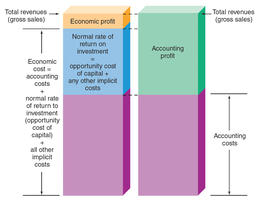
Additional info: The diagram visually compares accounting profit (which only subtracts explicit costs) and economic profit (which also subtracts implicit costs, including the normal rate of return on investment).
Profit Maximization
The primary goal of firms is to maximize profit. Firms that achieve higher risk-adjusted returns are more likely to survive and grow, as they can attract more financial resources for expansion.
Interest and Present Value
Role of Interest
Interest is the price paid for the use of loanable funds. It serves as a mechanism for allocating financial capital to its most productive uses. The interest rate influences investment decisions by linking present costs to future benefits.
Nominal Interest Rate: The market rate expressed in current dollars.
Real Interest Rate: The nominal rate minus the anticipated rate of inflation.
Relationship:
Present Value and Discounting
Present value (PV) is the value today of a sum of money to be received in the future, discounted by the interest rate. Discounting is the process of determining the present value of future cash flows.
Formula for Present Value:
Where FV is the future value, r is the interest rate, and n is the number of periods.
Example: The present value of $105 to be received in one year at a 5% interest rate is $100.
Additional info: Discounting is essential for investment decisions, pension planning, and comparing costs and benefits over time.
Corporate Financing Methods
Main Sources of Corporate Funds
Corporations finance their operations and growth through several main sources:
Stocks: Shares of ownership in a corporation. Common stock provides voting rights; preferred stock offers priority in dividends but no voting rights.
Bonds: Legal claims against a firm, typically with fixed annual payments (coupons) and repayment at maturity.
Reinvestment: Using retained profits or depreciation reserves to fund new capital investments.
Stock and Bond Markets
Stocks and bonds are traded in organized markets such as the New York Stock Exchange (NYSE), NASDAQ, and others worldwide. These markets facilitate the allocation of financial resources and provide liquidity for investors.
Theory of Efficient Markets
The efficient markets hypothesis states that all available information is quickly incorporated into stock prices, making it impossible to consistently achieve higher returns than the overall market through prediction or timing. Stock prices follow a "random walk," meaning future movements are unpredictable based on past trends.
Inside Information
Trading on inside information—non-public knowledge about a corporation—is illegal and subject to severe penalties, as it undermines market fairness and efficiency.
Summary Table: Comparison of Business Organizations
Form | Ownership | Liability | Taxation | Fundraising Ability |
|---|---|---|---|---|
Proprietorship | Single owner | Unlimited | Single | Limited |
Partnership | Two or more owners | Unlimited | Single | Moderate |
Corporation | Shareholders | Limited | Double | High |
LLC | Members | Limited | Single | Moderate |
Additional info: This table summarizes the main characteristics of each business form, aiding in comparison for exam preparation.
