 Back
BackThe Economic Impact of Unions: Wage Advantage, Efficiency, and Distributional Effects
Study Guide - Smart Notes
 Tailored notes based on your materials, expanded with key definitions, examples, and context.
The Economic Impact of Unions
The Union Wage Advantage
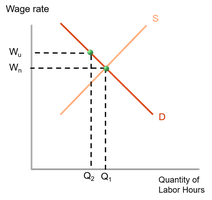
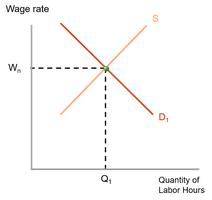
Unions play a significant role in shaping wage structures within labor markets. The union wage advantage refers to the percentage by which union wages exceed nonunion wages, holding other factors constant. Accurately measuring this advantage is complex due to various market effects and worker characteristics.
Pure Union Wage Advantage: Defined as , where is the union wage and is the nonunion wage. This calculation assumes all other factors are equal.
Measurement Complications: Factors such as plant size, worker skills, and industry characteristics can confound simple wage comparisons.
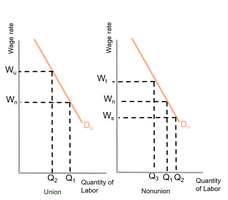
Spillover Effect: When unions raise wages, some workers are displaced and seek jobs in the nonunion sector, depressing nonunion wages and overstating the measured advantage.
Threat Effect: Nonunion employers may raise wages to avoid unionization, causing the measured advantage to understate the pure advantage.
Product Market Effect: Higher union wages increase costs and prices, shifting demand toward nonunion products and labor, which can also understate the measured advantage.
Wait Unemployment Effect: Some displaced workers may wait for union jobs rather than accept nonunion positions, reducing the spillover effect.
Superior-Worker Effect: Higher union wages attract more skilled workers, which can overstate the measured wage advantage.
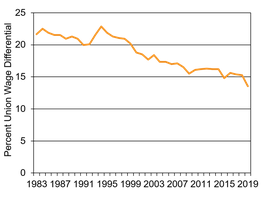
Trends: The union wage advantage increased in the late 1970s, stabilized in the 1980s and 1990s, and has declined since the mid-1990s.
Variations: The advantage is greater during recessions, for construction workers, Black males, blue-collar, and less-educated workers.
Total Compensation: Union workers typically receive more fringe benefits, reflecting both higher wages and greater job tenure.
Efficiency and Productivity
Unions can affect both the efficiency and productivity of firms and the broader economy. These effects can be negative or positive, depending on the context and mechanisms involved.
Negative Effects:
Restrictive Work Rules: Unions may impose rules that limit output, require unnecessary work, or restrict job assignments, reducing efficiency.
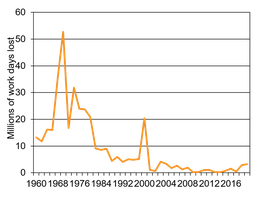
Strikes: Although rare, strikes can disrupt production and cause output losses, especially in service industries. The number of workdays lost to strikes has declined significantly since the 1970s.
Labor Misallocation: Higher union wages can displace workers to less productive nonunion sectors, causing efficiency losses. If displaced workers are not reemployed or face high search costs, losses are greater.
Investment Behavior: If unions capture a large share of returns to capital, firms may reduce investment, slowing productivity growth.
Positive Effects:
Capital Substitution: Higher wages may incentivize firms to invest in labor-saving technology, increasing productivity.
Collective Voice: Unions can improve workplace conditions and resolve disputes, boosting morale and productivity.
Lower Turnover: Union workers have lower turnover rates, leading to higher average experience and productivity.
Training: Union firms may invest more in worker training, and senior workers often mentor juniors.
Shock Effect: Facing higher wages, managers may seek efficiency improvements to offset costs.
Empirical Evidence: The overall impact of unions on productivity is mixed, with both positive and negative findings.
Firm Profitability
Unions generally reduce firm profitability, but the implications differ by market structure.
Monopolistic Industries: Profit reductions do not necessarily cause efficiency losses, as excess profits are reduced.
Competitive Industries: Lower profits may force firms to exit, reducing output and raising prices, which can lead to efficiency losses.
Empirical Evidence: The evidence is mixed regarding the magnitude of efficiency losses from union activity.
Distribution of Earnings
Unions influence income inequality in both increasing and decreasing directions, depending on the mechanisms at play.
Increasing Inequality:
Raise union wages while lowering nonunion wages (spillover effect).
Increase skilled blue-collar wages relative to unskilled workers.
Increase demand for skilled labor within unionized firms.
Decreasing Inequality:
Equalize wages within firms by tying pay to jobs rather than individuals.
Standardize wages across firms, protecting the union wage advantage.
Reduce the wage gap between white-collar and blue-collar workers.
Net Effect: Empirical evidence suggests unions reduce income inequality overall.
Other Issues: Inflation, Unemployment, and Income Shares
Unions also affect macroeconomic variables such as inflation, unemployment, and the distribution of national income.
Inflation: Unions are not a primary cause of inflation; monetary policy plays a larger role.
Unemployment: Unions may increase unemployment by reducing wage flexibility and attracting new entrants, but the effect is generally small. They can also reduce turnover-related unemployment.
Labor’s Share of Income: Unions have not significantly increased labor’s share of national income. Higher union wages often come at the expense of nonunion wages, and firms may substitute capital for labor or offset costs through productivity and price increases.
Key Formulas
Pure Union Wage Advantage:
Summary Table: Effects of Unions
Effect | Direction | Explanation |
|---|---|---|
Wages | Increase (union); decrease (nonunion) | Union wage advantage, spillover, and threat effects |
Productivity | Mixed | Restrictive rules (−), collective voice/training (+) |
Profitability | Decrease | Higher labor costs reduce profits |
Inequality | Decrease (net) | Wage equalization within/across firms |
Unemployment | Slight increase | Reduced wage flexibility, higher entry |
Labor’s Share | No significant change | Offset by capital substitution and price increases |
