 Back
BackUtility Maximization and Consumer Choice: Indifference Curves, Perfect Complements, and Perfect Substitutes
Study Guide - Smart Notes
 Tailored notes based on your materials, expanded with key definitions, examples, and context.
Utility Maximization and Consumer Choice
Utility, Budget Constraints, and Optimal Choice
In microeconomics, consumers aim to maximize their utility (satisfaction) given their budget constraints. Utility functions, marginal utility, and indifference curves are key tools for analyzing consumer behavior and optimal choices between two goods.
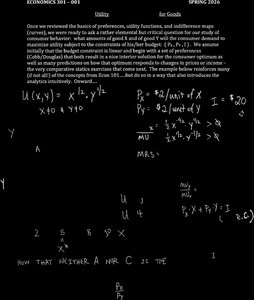
Utility Function (U): Represents the satisfaction a consumer derives from consuming quantities of goods X and Y. Example:
Budget Constraint: The consumer's total spending on goods cannot exceed their income.
Marginal Utility (MU): The additional utility from consuming one more unit of a good. ,
Marginal Rate of Substitution (MRS): The rate at which a consumer is willing to trade one good for another while maintaining the same utility.
Optimal Choice Condition: The consumer maximizes utility where the MRS equals the price ratio:
Subject to the budget constraint:
Perfect Complements
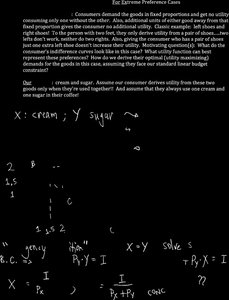
Perfect complements are goods that are always consumed together in fixed proportions. The consumer derives no additional utility from having more of one good without the other. The utility function for perfect complements is typically:
Indifference Curves: L-shaped, reflecting that utility only increases when both goods are increased together.
Consumer Optimum: Always occurs at the 'kink' of the indifference curve, where (or the fixed proportion).
Optimal Demand: The consumer spends their income to buy the goods in the required ratio, subject to the budget constraint.
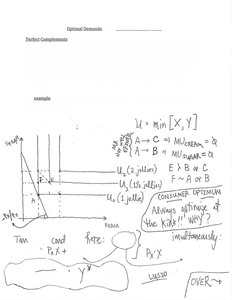
Example: If a consumer always uses one cream and one sugar in their coffee, their utility is . The optimal bundle is where the number of creams equals the number of sugars, given their prices and the consumer's income.
Perfect Substitutes
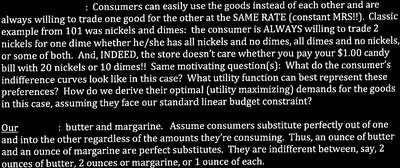
Perfect substitutes are goods that a consumer is always willing to trade for one another at a constant rate (constant MRS). The utility function for perfect substitutes is typically:
Indifference Curves: Straight lines, reflecting a constant willingness to substitute one good for the other.
Consumer Optimum: The consumer will spend all their income on the good that gives the highest utility per dollar, unless the price ratio equals the marginal rate of substitution.
Optimal Demand: If , buy only good X; if , buy only good Y; if equal, any combination on the budget line is optimal.
Example: If a consumer is indifferent between butter and margarine, their utility function could be . If butter and margarine have the same price, the consumer is happy with any combination that exhausts their budget.
Summary Table: Key Differences Between Perfect Complements and Perfect Substitutes
Property | Perfect Complements | Perfect Substitutes |
|---|---|---|
Utility Function | ||
Indifference Curves | L-shaped (right angles) | Straight lines |
Optimal Bundle | At the kink (fixed ratio) | All of one good or any mix if price ratio equals MRS |
MRS | Undefined at kink, zero or infinity elsewhere | Constant |
Additional info: These cases represent the two extremes of consumer preferences. Most real-world preferences lie between these extremes, with indifference curves that are convex to the origin and a diminishing marginal rate of substitution.
