Back

Other Vitamin-Like Nutrients quiz #1

Control buttons has been changed to "navigation" mode.
1/10
  • Are there any vitamins that are neither fat-soluble nor water-soluble?

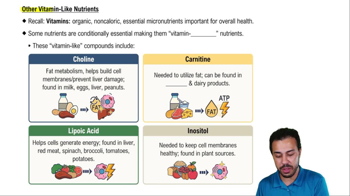
    All true vitamins are classified as either fat-soluble or water-soluble. However, there are vitamin-like nutrients such as choline, carnitine, lipoic acid, and inositol that are not technically vitamins and do not fit into either category.
  • What are some examples of vitamin-like nutrients that are not classified as either fat-soluble or water-soluble vitamins?

    Examples of vitamin-like nutrients that are not classified as either fat-soluble or water-soluble vitamins include choline, carnitine, lipoic acid, and inositol.
  • Why are choline, carnitine, lipoic acid, and inositol considered vitamin-like nutrients rather than true vitamins?

    Choline, carnitine, lipoic acid, and inositol are considered vitamin-like nutrients because, under most circumstances, the body can synthesize enough of them, making them conditionally essential rather than strictly essential like true vitamins.
  • What is the main difference between vitamins and vitamin-like nutrients such as choline and carnitine?

    The main difference is that vitamins are essential micronutrients that must be obtained from the diet, while vitamin-like nutrients such as choline and carnitine are conditionally essential because the body can usually synthesize enough of them except under certain conditions.
  • What is the main reason vitamin-like nutrients are not classified as true vitamins?

    Vitamin-like nutrients are not classified as true vitamins because the body can usually synthesize enough of them under normal conditions. They only become essential in the diet under specific circumstances.
  • Which vitamin-like nutrient helps prevent liver damage and is found in milk, eggs, liver, and peanuts?

    Choline helps prevent liver damage and is found in milk, eggs, liver, and peanuts. It also aids in fat metabolism and cell membrane structure.
  • What is the primary dietary source of inositol, and what is its main function?

    Inositol is primarily found in plant sources. Its main function is to keep cell membranes healthy.
  • Which vitamin-like nutrient is required for proper fat utilization and is found in meats and dairy products?

    Carnitine is required for proper fat utilization and is found in meats and dairy products. It helps the body use fat efficiently.
  • What role does lipoic acid play in cellular function, and where can it be found in the diet?

    Lipoic acid helps cells generate energy. It can be found in foods such as liver, red meat, spinach, broccoli, tomatoes, and potatoes.
  • Why are vitamin-like nutrients described as conditionally essential?

    They are described as conditionally essential because the body can usually make enough of them, but under certain conditions, dietary intake becomes necessary. This distinguishes them from strictly essential vitamins.