 Back
BackCarbohydrate Digestion, Absorption, and Blood Glucose Regulation
Study Guide - Smart Notes
 Tailored notes based on your materials, expanded with key definitions, examples, and context.
Carbohydrates: Plant-Derived Energy Nutrients
Overview of Carbohydrate Digestion and Absorption
Carbohydrates (CHO) are a primary source of energy in the human diet, especially those derived from plants. The body processes carbohydrates through a series of digestive and absorptive steps, ultimately converting them into usable energy for cells.
Digestion begins in the mouth with the enzyme salivary amylase, which starts breaking down starches into smaller polysaccharides and maltose.
Majority of carbohydrate digestion occurs in the small intestine via pancreatic amylase, which further breaks down polysaccharides.
Disaccharidases (maltase, sucrase, lactase) located in the microvilli of the small intestine convert disaccharides into monosaccharides (glucose, fructose, galactose).
Monosaccharides are absorbed into enterocytes (intestinal cells) and then transported into the bloodstream.
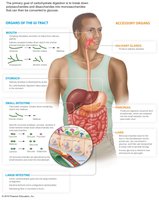
Fate of Absorbed Monosaccharides
Once absorbed, monosaccharides are processed by the liver and distributed throughout the body to meet energy needs.
Most monosaccharides are converted to glucose by the liver.
Glucose is released into the bloodstream to provide immediate energy to cells.
Excess glucose is stored as glycogen in the liver and muscles through a process called glycogenesis.
Glycogenolysis is the breakdown of glycogen back into glucose when energy is needed.
Regulation of Blood Glucose Levels
The body maintains blood glucose within a narrow range using hormonal regulation, primarily involving insulin and glucagon.
Insulin is released by beta cells of the pancreas in response to elevated blood glucose. It is an anabolic hormone that facilitates the uptake of glucose into cells, lowering blood glucose levels.
Glucagon is released by alpha cells of the pancreas when blood glucose declines. It is a catabolic hormone that stimulates glycogenolysis (breakdown of glycogen) and gluconeogenesis (production of glucose from non-carbohydrate sources).
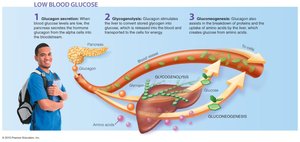
Summary Table: Hormonal Regulation of Blood Glucose
Hormone | Source | Trigger | Main Action |
|---|---|---|---|
Insulin | Beta cells (pancreas) | High blood glucose | Promotes glucose uptake, glycogenesis |
Glucagon | Alpha cells (pancreas) | Low blood glucose | Stimulates glycogenolysis, gluconeogenesis |
Fructose Metabolism
Fructose is metabolized differently from glucose. It does not stimulate insulin release and is absorbed farther down the small intestine. Its metabolism primarily occurs in the liver, where it can be converted to glucose or stored as fat.
Glycemic Index and Glycemic Load
The glycemic index (GI) is a value assigned to foods based on their potential to raise blood glucose and insulin levels. The glycemic load (GL) considers both the quality (GI) and quantity of carbohydrates in a food.
GI is influenced by: type of carbohydrate, food preparation, fat and fiber content.
GL is calculated as:
Foods with a lower glycemic load help prevent significant blood glucose fluctuations and are typically higher in fiber.
It is recommended to consume fiber-rich carbohydrates for better blood glucose control.
Summary Table: Glycemic Index and Glycemic Load
Term | Definition | Implications |
|---|---|---|
Glycemic Index (GI) | Rating of food's potential to raise blood glucose | High GI foods cause rapid spikes; low GI foods cause gradual increases |
Glycemic Load (GL) | GI multiplied by amount of carbohydrate, divided by 100 | Considers both quality and quantity of carbohydrate |
