Back
BackCarbohydrates in the Body: Digestion, Absorption, and Metabolism Study Guide
Study Guide - Smart Notes
 Tailored notes based on your materials, expanded with key definitions, examples, and context.
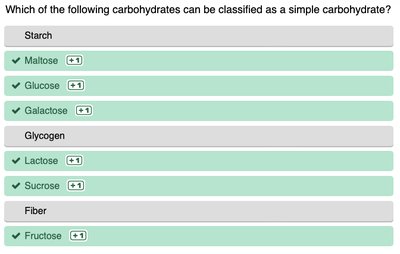
Q1. Which of the following carbohydrates can be classified as a simple carbohydrate?
Background
Topic: Carbohydrate Classification
This question tests your understanding of the difference between simple and complex carbohydrates, which is fundamental in nutrition for understanding digestion, absorption, and metabolic effects.
Key Terms:
Simple carbohydrates: Monosaccharides and disaccharides (e.g., glucose, fructose, sucrose, lactose, maltose, galactose).
Complex carbohydrates: Polysaccharides (e.g., starch, glycogen, fiber).
Step-by-Step Guidance
Review the definitions of monosaccharides (single sugar units) and disaccharides (two sugar units linked together).
Identify which options are monosaccharides (e.g., glucose, fructose, galactose) and which are disaccharides (e.g., sucrose, lactose, maltose).
Recall that complex carbohydrates (e.g., starch, glycogen, fiber) are made of many sugar units and are not classified as simple carbohydrates.
Try solving on your own before revealing the answer!
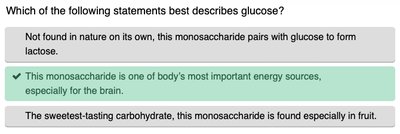
Q2. Which of the following statements best describes glucose?
Background
Topic: Glucose Function and Importance
This question assesses your knowledge of glucose's role in the body, especially as an energy source for the brain and other tissues.
Key Terms:
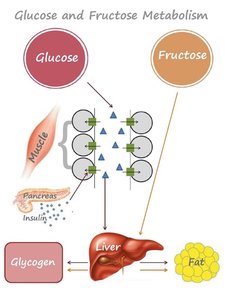
Glucose: A monosaccharide that is the primary energy source for most cells, especially the brain.
Step-by-Step Guidance
Recall the main functions of glucose in the body, particularly its importance for brain function.
Consider the options and eliminate those that do not accurately describe glucose's role or natural occurrence.
Try solving on your own before revealing the answer!
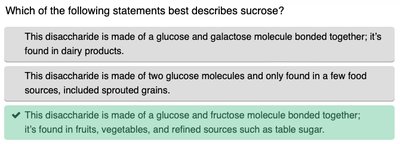
Q3. Which of the following statements best describes sucrose?
Background
Topic: Disaccharides and Food Sources
This question tests your understanding of the structure and dietary sources of sucrose, a common disaccharide.
Key Terms:
Sucrose: A disaccharide composed of glucose and fructose, commonly known as table sugar.
Step-by-Step Guidance
Recall the chemical structure of sucrose and its common sources in the diet.
Eliminate options that describe other disaccharides (e.g., lactose, maltose) or incorrect sources.
Try solving on your own before revealing the answer!
Q4. Match the following: Glycogen, Starch, Fiber
Background
Topic: Storage Forms of Carbohydrates
This question checks your understanding of how carbohydrates are stored in animals and plants, and the role of fiber.
Key Terms:
Glycogen: Storage form of glucose in animals.
Starch: Storage form of glucose in plants.
Fiber: Structural polysaccharide in plants, indigestible by humans.
Step-by-Step Guidance
Recall which carbohydrate is stored in animals and which in plants.
Identify which carbohydrate provides structural support and is not digestible by human enzymes.
Try solving on your own before revealing the answer!
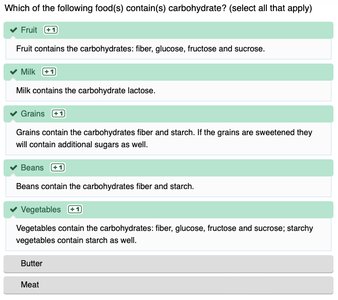
Q5. Which of the following food(s) contain(s) carbohydrate? (select all that apply)
Background
Topic: Dietary Sources of Carbohydrates
This question tests your ability to identify which foods are sources of carbohydrates, an essential macronutrient.
Key Terms:
Carbohydrates: Found in plant-based foods and some dairy products; not present in significant amounts in animal products like meat and butter.
Step-by-Step Guidance
Recall which food groups are rich in carbohydrates (fruits, grains, beans, vegetables, milk).
Eliminate foods that are primarily fat or protein (e.g., butter, meat).
Try solving on your own before revealing the answer!

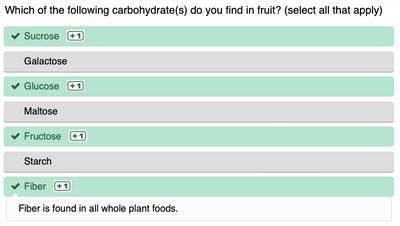
Q6. Which of the following carbohydrate(s) do you find in fruit? (select all that apply)
Background
Topic: Carbohydrate Types in Fruits
This question checks your knowledge of the types of carbohydrates present in fruits, which are important for dietary recommendations.
Key Terms:
Fruits: Contain simple sugars (glucose, fructose, sucrose) and fiber.
Step-by-Step Guidance
Recall which carbohydrates are naturally present in fruits (focus on sugars and fiber).
Eliminate carbohydrates that are not typically found in fruits (e.g., starch, maltose).
Try solving on your own before revealing the answer!
Q7. If you were to cut out all carbohydrates in your diet, you could still eat a balanced diet with a variety of foods. True or False?
Background
Topic: Importance of Carbohydrates in the Diet
This question tests your understanding of the necessity of carbohydrates for a balanced diet and overall health.
Key Terms:
Balanced diet: Includes all macronutrients (carbohydrates, proteins, fats) and micronutrients for optimal health.
Step-by-Step Guidance
Consider the role of carbohydrates in providing energy, especially for the brain and red blood cells.
Think about whether all essential nutrients can be obtained without carbohydrates.
Try solving on your own before revealing the answer!
Q8. Most Americans meet their daily recommendation of fiber. True or False?
Background
Topic: Fiber Intake in the U.S. Population
This question checks your awareness of dietary fiber intake trends and recommendations.
Key Terms:
Fiber: Indigestible carbohydrate important for digestive health; recommended intake is often not met in the U.S.
Step-by-Step Guidance
Recall the recommended daily intake for fiber and compare it to average consumption statistics.
Consider common dietary patterns in the U.S. (e.g., low intake of whole grains, fruits, and vegetables).
Try solving on your own before revealing the answer!

Q9. Each day, Joel consumes 2500 Calories, including 250 g of carbohydrate. True or False: Joel is meeting the AMDR for carbohydrates.
Background
Topic: Acceptable Macronutrient Distribution Range (AMDR)
This question tests your ability to calculate the percentage of calories from carbohydrates and compare it to the recommended range.
Key Formula:
1 gram carbohydrate = 4 Calories
AMDR for carbohydrates = 45-65% of total Calories
Step-by-Step Guidance
Calculate the total Calories from carbohydrates:
Calculate the percentage of total Calories from carbohydrates:
Compare your result to the AMDR range (45-65%).
Try solving on your own before revealing the answer!

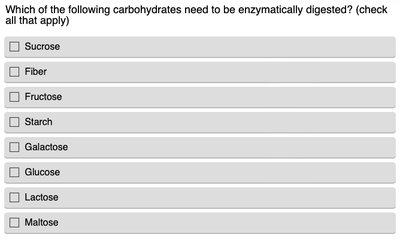
Q10. Which of the following carbohydrates need to be enzymatically digested? (check all that apply)
Background
Topic: Carbohydrate Digestion
This question tests your understanding of which carbohydrates require enzymatic breakdown before absorption.
Key Terms:
Enzymatic digestion: The process by which enzymes break down complex carbohydrates into absorbable units.
Step-by-Step Guidance
Recall which carbohydrates are already in absorbable form (monosaccharides) and which need to be broken down (disaccharides, polysaccharides).
Identify which carbohydrates are not digested by human enzymes (e.g., fiber).
Try solving on your own before revealing the answer!