Back
BackEssentials of Human Nutrition: Course Syllabus and Structure
Study Guide - Smart Notes
 Tailored notes based on your materials, expanded with key definitions, examples, and context.
Essentials of Human Nutrition: Course Syllabus and Structure
Course Overview
This course, Essentials of Human Nutrition (BIOL-1262), provides foundational knowledge in human nutrition, focusing on the physiological and biochemical roles of nutrients, their impact on health, and the application of nutritional principles across the lifespan. The course is designed to support students in health-related fields, particularly practical nursing, and emphasizes evidence-based dietary guidelines, metabolic processes, and nutrition-related disease prevention.
Main Topics Covered
The Science of Nutrition: Introduction to nutrition, health promotion, and understanding food choices.
Tools for Healthful Eating: Dietary guidelines (DRI, EAR, RDA, AI, UL, EER, AMDR), MyPlate, and food labels.
The Human Body & Digestion: Digestive system, metabolism, and common digestive problems.
Carbohydrates: Simple and complex carbohydrates, glucose metabolism, dietary fiber, sugar and health, hypoglycemia, and diabetes.
Lipids: Types of lipids (triglycerides, phospholipids, sterols), saturated/unsaturated/trans fats, essential fatty acids (omega-3, omega-6).
Proteins: Essential and nonessential amino acids, protein functions, digestion and absorption, protein quality, recommended intake, deficiency, and excess.
Vitamins: Fat-soluble and water-soluble vitamins, food sources.
Water and Minerals: Types and safety of drinking water, fluid balance, major and trace minerals, alcohol's impact on nutrition.
Energy Balance: Body Weight, Obesity, & Eating Disorders: Body weight vs. fatness, appetite control, weight gain/loss, causes and treatment of obesity, eating disorders.
Nutrition & Fitness: Benefits of fitness, energy for physical activity, fuel use, hydration, vitamins and minerals for activity.
Food Safety & Regulation: Microbes, pesticides, environmental contaminants, food additives, global food supply.
Food Insecurity in the US and the World: Addressed within food safety and global supply topics.
Nutrition: Pregnancy Through Infancy: Nutrition for pregnancy, lactation, infants.
Nutrition: Toddlers to Late Adulthood: Nutrition for childhood, adolescence, older adults, childhood obesity.
Student Learning Outcomes
Explain fundamental principles of nutritional science, including digestion, absorption, metabolism, and the functions of macronutrients and micronutrients.
Apply evidence-based nutritional knowledge to assess and improve health across the lifespan.
Analyze the impact of nutrition on health, wellness, disease prevention, weight management, exercise performance, and eating disorders.
Communicate nutrition concepts effectively to diverse audiences.
Course Structure and Assessment
Lecture Hours: 2 per week (no laboratory or clinical hours).
Exams: Five non-cumulative exams (100 points each), one cumulative final exam (100 points), delivered online with proctoring requirements.
Quizzes: Chapter quizzes, academic integrity quiz, syllabus quiz, and discussion assignments.
Homework and Projects: Assigned throughout the semester.
Grading Scale: A (90%+), B (80-89%), C (70-79%), D (60-69%), F (<60%).
Weekly Schedule and Chapter Topics
Week | Chapter | Topic | Assessment |
|---|---|---|---|
1 | 1 | The nutrients in foods | Quiz 1 |
2 | 2 | The ABCs of eating for health | Quiz 2 |
3 | 3 | The digestive system | Quiz 3 |
4 | 4 | Carbohydrates basics | Quiz 4 |
5 | 5 | Lipids | Quiz 5 |
6 | 6 | Proteins | Quiz 6 |
7 | 7 | Vitamins | Quiz 7 |
8 | 8 | Minerals, water, and beverages | Quiz 8 |
9 | 9 | Energy balance and weight | Quiz 9 |
10 | 10 | Nutrition for fitness and sport | Quiz 10 |
11 | 11 | Diet and cardiovascular disease | Quiz 11 |
12 | 12 | Food safety and global supply | Quiz 12 |
13 | 13 | Nutrition across the life cycle | Quiz 13 |
Recommended Textbook
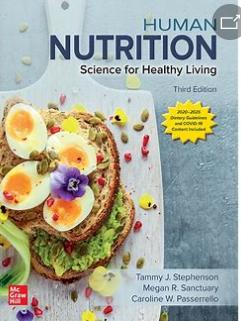
Human Nutrition: Science for Healthy Living (3rd Edition, Tammy Stephenson & Wendy Schiff, McGraw-Hill)
Free OER textbook: Human Nutrition OER
Other recommended resources: ChooseMyPlate.gov, USDA.gov, HealthyPeople.gov, FoodSafetyNews.com
Academic Integrity and Policies
Strict adherence to academic integrity: no cheating, plagiarism, or unauthorized collaboration.
Attendance is recommended but not graded; excused absences require documentation.
Make-up exams and assignments are allowed only for legitimate, documented reasons.
Students with disabilities should contact the Office of Disability Services for accommodations.
Keys to Success
Read the textbook and attend class regularly.
Take detailed notes and review chapter material daily.
Participate actively and ask questions.
Complete homework and quizzes on time.
Course Image
The recommended textbook cover visually represents the course focus on human nutrition and healthful eating.