 Back
BackEssentials of Human Nutrition: Course Syllabus and Structure
Study Guide - Smart Notes
 Tailored notes based on your materials, expanded with key definitions, examples, and context.
Essentials of Human Nutrition: Course Syllabus and Structure
Course Overview
This syllabus outlines the structure, objectives, and content for the "Essentials of Human Nutrition" course (BIOL-1262-L01) at South Louisiana Community College. The course provides foundational knowledge in nutritional science, focusing on the physiology and biochemistry of nutrients, their roles in health, and the application of nutritional principles across the lifespan.
Course Credit: 2 credits, traditional face-to-face delivery
Schedule: Monday and Wednesday, 11:00-11:50 am
Instructor: Alin Yigiter, M.D.
Location: Health and Science Building, Room HS 324
Student Learning Outcomes
Explain fundamental principles of nutritional science, including digestion, absorption, and metabolism of macronutrients and micronutrients.
Apply evidence-based nutritional knowledge to assess and improve health across the lifespan.
Analyze the impact of nutrition on health, disease prevention, weight management, exercise performance, and eating disorders.
Communicate nutrition concepts effectively to diverse audiences.
Course Content Structure
Main Topics
The nutrients in food: Nutrition and health promotion, food choices, science of nutrition
Tools for healthful eating: Dietary guidelines, MyPlate, food labels
The human body & digestion: Metabolism, digestive system, common digestive problems
Carbohydrates: Simple and complex carbohydrates, glucose, dietary fiber, sugar and health, diabetes
Lipids: Triglycerides, phospholipids, sterols, saturated/unsaturated/trans fats, essential fatty acids
Proteins: Essential/nonessential amino acids, protein function, digestion, absorption, protein quality, intake recommendations
Vitamins: Fat-soluble and water-soluble vitamins, food sources
Minerals & Water: Types, safety, sources, fluid balance, major/trace minerals, alcohol impact
Energy Balance: Body weight vs. fatness, appetite control, weight loss/gain, obesity, eating disorders
Nutrition & Fitness: Benefits of fitness, energy for activity, hydration, vitamins/minerals for activity
Diet & Cardiovascular Disease: Heart disease, hypertension
Food Safety & Regulation: Microbes, pesticides, contaminants, additives
Nutrition Across the Life Cycle: Pregnancy, lactation, infancy, childhood, adolescence, older adults
Food Insecurity: Global food supply
Assessment Structure
Exams: Five non-cumulative exams (100 points each), one cumulative final exam (100 points)
Quizzes: Chapter quizzes, academic integrity quiz, syllabus quiz, discussion posts
Homework & Projects: Assignments, video tasks, pop quizzes
Total Points: 610 points
Grading Scale
A: 90% and above
B: 80-89%
C: 70-79%
D: 60-69%
F: Below 60%
Course Policies
Attendance: Recommended, not graded; excused absences require documentation
Academic Integrity: Cheating and plagiarism are strictly prohibited; penalties include zero on assignments or course failure
Make-up Policy: Legitimate, documented excuses required for make-up exams/assignments
Disability Services: Accommodations available through the Office of Disability Services
Recommended Textbook
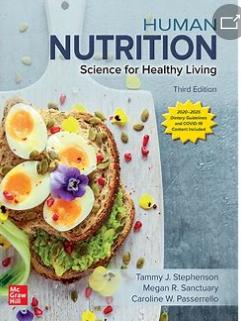
Human Nutrition: Science for Healthy Living (3rd Edition, Tammy Stephenson & Wendy Schiff, McGraw-Hill)
Free OER textbook: Human Nutrition OER
Weekly Schedule and Chapter Topics
Week | Chapter | Topic | Assessment |
|---|---|---|---|
Jan 12-14 | 1 | The nutrients in foods | Quiz 1 |
Jan 21-26 | 2 | The ABCs of eating for health | Quiz 2 |
Jan 28-Feb 2 | 3 | The digestive system | Quiz 3 |
Feb 4-9 | 4 | Carbohydrates basics | Quiz 4 |
Feb 18-23 | 5 | Lipids | Quiz 5 |
Feb 25-Mar 2 | 6 | Proteins | Quiz 6 |
Mar 9-11 | 7 | Vitamins | Quiz 7 |
Mar 16-18 | 8 | Minerals, water, beverages | Quiz 8 |
Mar 23-25 | 9 | Energy balance, weight | Quiz 9 |
Apr 6-8 | 10 | Nutrition for fitness and sport | Quiz 10 |
Apr 13-15 | 11 | Diet and cardiovascular disease | Quiz 11 |
Apr 20 | 12 | Food safety and global food supply | Quiz 12 |
Apr 22-27 | 13 | Life cycle nutrition | Quiz 13 |
Course Textbook Cover
The recommended textbook for this course is "Human Nutrition: Science for Healthy Living" (Third Edition), which provides comprehensive coverage of all major topics in human nutrition, including macronutrients, micronutrients, digestion, metabolism, dietary guidelines, and nutrition across the lifespan.
Keys to Success
Read the textbook and attend class regularly
Take detailed notes and review chapter material
Study vocabulary and end-of-chapter review questions
Participate actively and ask questions
Complete homework and assignments on time
Additional info: The syllabus content aligns directly with the core chapters and learning objectives of a college-level nutrition course, covering all major areas required for exam preparation and foundational understanding in human nutrition.
