 Back
BackLipids: Structure, Function, Digestion, and Health Implications
Study Guide - Smart Notes
 Tailored notes based on your materials, expanded with key definitions, examples, and context.
Types of Lipids
Overview of Lipids
Lipids are a structurally and functionally diverse group of substances that are insoluble in water but soluble in organic solvents. They are essential components of the human diet and play critical roles in cellular structure, energy storage, and signaling.
Fats: Solid at room temperature.
Oils: Liquid at room temperature.
Main types of lipids: Triglycerides, phospholipids, and sterols.

Triglycerides
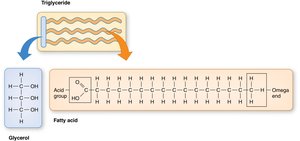
Triglycerides are the most abundant form of dietary fat, making up about 95% of the fats we consume. They are composed of three fatty acid molecules attached to a glycerol backbone.
Fatty acids: Long chains of carbon atoms surrounded by hydrogen atoms.
Glycerol: A three-carbon alcohol that serves as the backbone for triglycerides.
Phospholipids
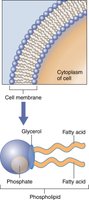
Phospholipids are essential structural components of cell membranes. They consist of a glycerol backbone, two fatty acids, and a phosphate group.
Amphiphilic nature: Soluble in both water (phosphate group) and fat (fatty acids).
Function: Emulsifiers, maintaining cell membrane integrity, and keeping lipids soluble in water.
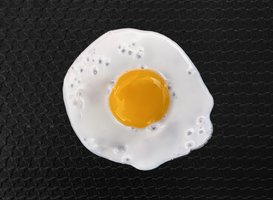
Example: Lecithin, found in egg yolks, wheat germ, peanuts, soybeans, and organ meats.
Sterols
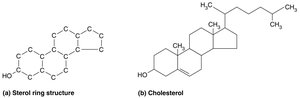
Sterols, such as cholesterol, have a multi-ring structure and are found in animal products and synthesized by the liver and intestine. Phytosterols are plant-derived sterols that can reduce cholesterol absorption.
Cholesterol functions: Structural component of cell membranes, precursor for hormone synthesis (e.g., estrogen), bile acid synthesis, and vitamin D synthesis.
Not used for energy.
Classification of Fatty Acids
Chain Length
Fatty acids are classified by the length of their carbon chains:
Short-chain: <6 carbons
Medium-chain: 6–12 carbons
Long-chain: >14 carbons
Degree of Saturation
Fatty acids are also classified by their degree of saturation:
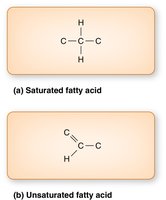
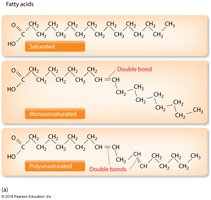
Saturated fatty acids (SFA): No double bonds; all carbons are saturated with hydrogen.
Monounsaturated fatty acids (MUFA): One double bond.
Polyunsaturated fatty acids (PUFA): Two or more double bonds.
Physical Properties and Food Sources
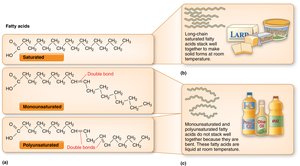
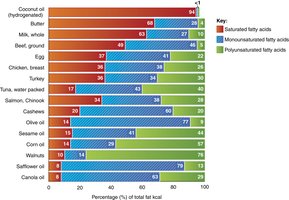
Saturated fats: Solid at room temperature, found in animal fats, butter, coconut oil, and palm oil.
Unsaturated fats: Liquid at room temperature, found in plant oils, nuts, and seeds.
Unsaturated Fatty Acids: Configuration
Cis and Trans Configurations
The arrangement of hydrogen atoms around the double bond in unsaturated fatty acids determines their configuration:
Cis: Hydrogens on the same side, causing a bent shape; most common in nature.
Trans: Hydrogens on opposite sides, resulting in a straighter chain; acts more like a saturated fat.
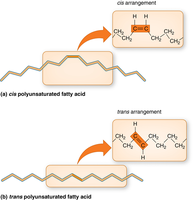
Health Implications of Trans Fats
Trans fats increase the risk of heart disease by raising LDL ("bad") cholesterol and lowering HDL ("good") cholesterol.
Most trans fats in the diet come from processed foods containing partially hydrogenated oils.
Essential Fatty Acids
Essential fatty acids cannot be synthesized by the body and must be obtained from the diet. The two main families are omega-6 and omega-3 fatty acids.
Omega-6 (Linoleic acid): Found in vegetable and nut oils (corn, sunflower, safflower, soybean oils).
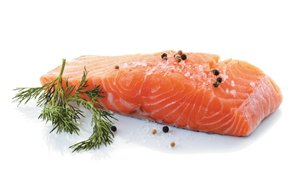
Omega-3 (Alpha-linolenic acid, EPA, DHA): Found in dark green leafy vegetables, flaxseeds, walnuts, canola oil, fish, and fish oils.
Precursors to eicosanoids, which regulate blood clotting, blood pressure, inflammation, and immune function.
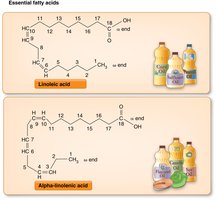
Dietary Recommendations and Food Sources
Fat Intake Recommendations
AMDR for fat: 20–35% of total energy intake.
Saturated fat: Less than 10% of total kcal (about 20g for a 2,000 kcal diet).
Trans fats and dietary cholesterol: As little as possible.
Essential fatty acids: Linoleic acid (omega-6): 14–17g/day (men), 11–12g/day (women); Alpha-linolenic acid (omega-3): 1.6g/day (men), 1.1g/day (women).
Visible and Hidden Fats
Visible fats: Easily seen in foods (e.g., oil, butter, chicken skin).
Hidden fats: Added to processed foods or naturally occurring, not easily seen.
Strategies for Selecting Beneficial Fats
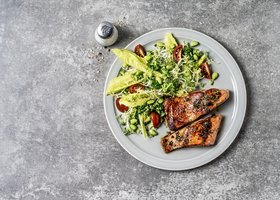
Eat fish at least twice a week, but be mindful of contaminants.
Replace animal-based foods with plant-based foods (plant oils, avocados, nuts, beans, peas, lentils).
Digestion and Absorption of Lipids
Overview of Lipid Digestion
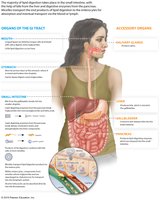
Lipid digestion begins in the mouth and stomach but primarily occurs in the small intestine with the help of bile and pancreatic lipases.
Mouth: Lingual lipase initiates minimal digestion.
Stomach: Gastric lipase continues limited digestion.
Liver: Produces bile, which emulsifies fats in the small intestine.
Pancreas: Secretes pancreatic lipases for further breakdown.
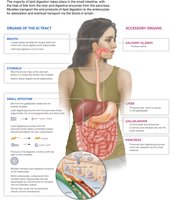
Small Intestine: Digestion and Micelle Formation
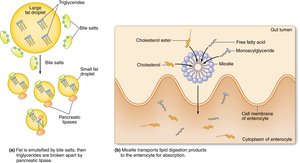
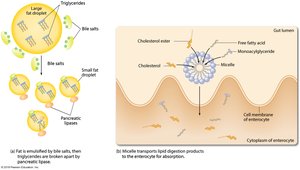
Bile emulsifies fats, increasing surface area for pancreatic lipase action.
Triglycerides are broken down into monoglycerides and fatty acids.
Micelles (spheres of bile and phospholipids) transport digestion products to enterocytes for absorption.
Absorption of Dietary Lipids
Long-chain fatty acids, monoglycerides, cholesterol, and phospholipids are absorbed into enterocytes via passive diffusion.
Inside enterocytes, fatty acids are reassembled into triglycerides and packaged into chylomicrons for transport.
Short- and medium-chain fatty acids are absorbed directly into the bloodstream.
Transport of Lipids
Lipoproteins
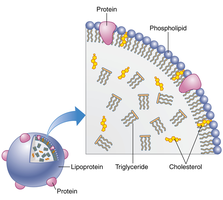
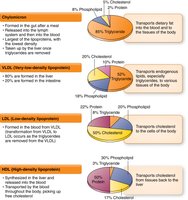
Lipoproteins are complexes of lipids and proteins that transport triglycerides and cholesterol in the bloodstream.
Chylomicrons: Transport dietary fats from the intestine to tissues via the lymphatic system.
VLDL (Very Low-Density Lipoproteins): Deliver triglycerides from the liver to cells.
LDL (Low-Density Lipoproteins): Deliver cholesterol to cells; high levels are associated with increased CVD risk ("bad cholesterol").
HDL (High-Density Lipoproteins): Remove cholesterol from cells and transport it to the liver; high levels are protective ("good cholesterol").
Cardiovascular Disease (CVD)
Overview and Pathophysiology
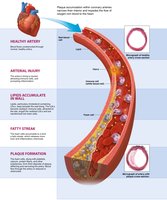
Cardiovascular disease refers to dysfunction of the heart or blood vessels, including coronary heart disease (CHD), stroke, and atherosclerosis.
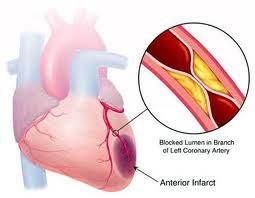
Atherosclerosis: Hardening of the arteries due to plaque buildup (oxidized cholesterol, protein, calcium).
Arteriosclerosis: Plaque buildup in smaller vessels (arterioles).
Angina pectoris: Chest pain from reduced blood flow to the heart.
Myocardial infarction: Heart attack due to blocked blood flow to heart tissue.
Risk Factors for CVD
Nonmodifiable: Age, sex, heredity.
Modifiable: Diet, physical activity, tobacco use, sleep, weight, cholesterol, blood sugar, blood pressure.
Dietary and Lifestyle Strategies for CVD Prevention
Reduce total fat to 20–35% of calories.
Limit saturated fat to <10% of calories; reduce animal fat and tropical oils.
Eliminate trans fats; avoid hydrogenated oils.
Increase omega-3 fatty acid intake (fish, nuts, plant oils).
Increase dietary fiber (25–38g/day, especially soluble fiber).
Maintain a healthy body weight, exercise regularly, and avoid smoking and excessive alcohol.
Blood Lipids and CVD
Blood lipid levels are important indicators of CVD risk. Maintaining healthy cholesterol and triglyceride levels is essential for cardiovascular health. 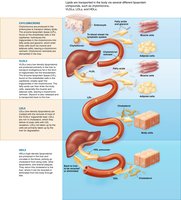
Summary Table: Types of Lipids
Type | Structure | Function | Food Sources |
|---|---|---|---|
Triglycerides | Glycerol + 3 fatty acids | Energy storage, insulation, protection | Animal fats, oils, nuts, seeds |
Phospholipids | Glycerol + 2 fatty acids + phosphate | Cell membrane structure, emulsification | Egg yolks, soybeans, peanuts |
Sterols (Cholesterol) | Multi-ring structure | Cell membranes, hormone precursor | Animal products |
