 Back
BackMetric and Household Systems of Measurement: Dosage Calculations for Nutrition and Health
Study Guide - Smart Notes
 Tailored notes based on your materials, expanded with key definitions, examples, and context.
Metric and Household Systems of Measurement
Introduction
Understanding measurement systems is essential for accurate dosage calculation, preparation, and administration in nutrition and health sciences. The metric and household systems are commonly used for measuring weight, volume, and temperature in clinical and home settings.
Metric System
The metric system is the standard for scientific and medical measurements. It is based on units of ten, making conversions straightforward.
Weight Equivalents:
1 kilogram (kg) = 1000 grams (g)
1 gram (g) = 1000 milligrams (mg)
1 milligram (mg) = 1000 micrograms (mcg)
Hierarchy: A kilogram is greater than a gram, a gram is greater than a milligram, and a milligram is greater than a microgram.
Converting Metric Units
Conversions between metric units involve moving the decimal point based on the relationship between units.
Grams to Milligrams: Move the decimal point three places to the right. Example: 0.4 g = 400 mg.
Milligrams to Micrograms: Move the decimal point three places to the right. Example: 4 mg = 4000 mcg.
Formula for Conversion:
To convert grams to milligrams:
To convert milligrams to micrograms:
Household Abbreviations
Household measurements are often used for medications administered at home. Understanding these abbreviations is important for practical applications.
Teaspoon: tsp
Tablespoon: tbsp
Ounce: oz (or fl oz = fluid ounce)
Pint: pt
Quart: qt
Pound: lb
Conversions Among Liquid Measures
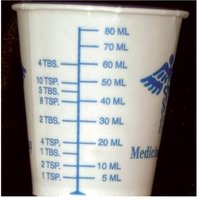
Liquid measures are commonly used in nutrition and medication administration. The following table shows the relationship between household and metric units.
Household Measure | Metric Equivalent (mL) |
|---|---|
1 tsp | 5 mL |
1 tbsp | 15 mL |
1 oz | 30 mL |
1 pt | 480 mL |
1 qt | 960 mL |
1 cup | 240 mL |
1 mL | 0.2 tsp |
1 mL | 0.067 tbsp |
1 mL | 0.033 oz |
Additional info: Some values inferred for completeness. |
Temperature Conversion
Temperature is measured in Celsius (°C) and Fahrenheit (°F). Conversion between these units is important for clinical practice.
Formula:
Example: 40°C = (40 × 9/5) + 32 = 104°F
Summary Table: Metric and Household Conversions
Conversion | Formula | Example |
|---|---|---|
Grams to Milligrams | 0.4 g = 400 mg | |
Milligrams to Micrograms | 4 mg = 4000 mcg | |
Celsius to Fahrenheit | 40°C = 104°F |
Applications in Nutrition and Health
Accurate measurement and conversion are critical for safe medication administration, dietary planning, and clinical assessment. Nutrition professionals must be proficient in both metric and household systems to ensure proper dosing and communication with patients.
