a. Draw a Lewis structure for each of the following: b. Draw a structure for each of the species that shows approximate bond angles. c. Which species have no dipole moment? 3. N3−
Verified step by step guidance
1
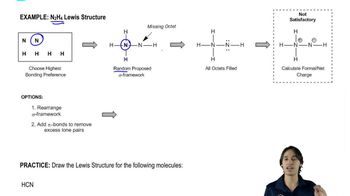
Step 1: For part A, start by determining the total number of valence electrons for the N₃⁻ ion. Nitrogen has 5 valence electrons, and there are three nitrogen atoms. Additionally, the negative charge adds one extra electron. Use the formula: \( \text{Total valence electrons} = 3(5) + 1 = 16 \).
Step 2: Arrange the three nitrogen atoms in a linear structure (as N₃⁻ is known to be linear). Place a single bond between each pair of nitrogen atoms. Distribute the remaining electrons as lone pairs to satisfy the octet rule for each atom, starting with the outer atoms.
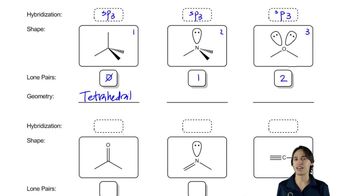
Step 3: For part B, determine the approximate bond angles in the N₃⁻ ion. Since the molecule is linear, the bond angle between the nitrogen atoms is approximately \( 180^\circ \). Draw the structure with this bond angle clearly indicated.
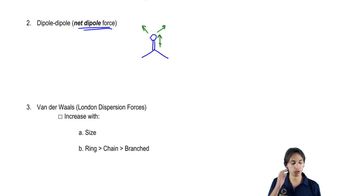
Step 4: For part C, analyze the dipole moment of the N₃⁻ ion. Since the molecule is linear and symmetric, the dipoles from the bonds cancel out, resulting in no net dipole moment. Conclude that N₃⁻ has no dipole moment.
Step 5: Summarize the findings: (1) Draw the Lewis structure with lone pairs and formal charges, (2) indicate the linear geometry with \( 180^\circ \) bond angles, and (3) confirm that N₃⁻ has no dipole moment due to its symmetry.
Verified video answer for a similar problem:
This video solution was recommended by our tutors as helpful for the problem above
Video duration:
1m
Play a video:
0 Comments
Key Concepts
Here are the essential concepts you must grasp in order to answer the question correctly.
Lewis Structures
Lewis structures are diagrams that represent the bonding between atoms in a molecule and the lone pairs of electrons that may exist. They help visualize the arrangement of electrons and the connectivity of atoms, which is crucial for understanding molecular geometry and reactivity. In the case of N3−, the Lewis structure will illustrate how the nitrogen atoms are bonded and how the negative charge is distributed.
Molecular geometry refers to the three-dimensional arrangement of atoms in a molecule, which influences its physical and chemical properties. The VSEPR (Valence Shell Electron Pair Repulsion) theory is often used to predict bond angles based on the repulsion between electron pairs. Understanding the geometry of species like N3− is essential for determining the approximate bond angles and the overall shape of the molecule.
A dipole moment is a measure of the separation of positive and negative charges in a molecule, indicating its polarity. Molecules with an uneven distribution of electron density exhibit a dipole moment, while symmetrical molecules may not. Identifying species with no dipole moment involves analyzing their symmetry and the arrangement of polar bonds, which is key to understanding their behavior in electric fields and interactions with other molecules.