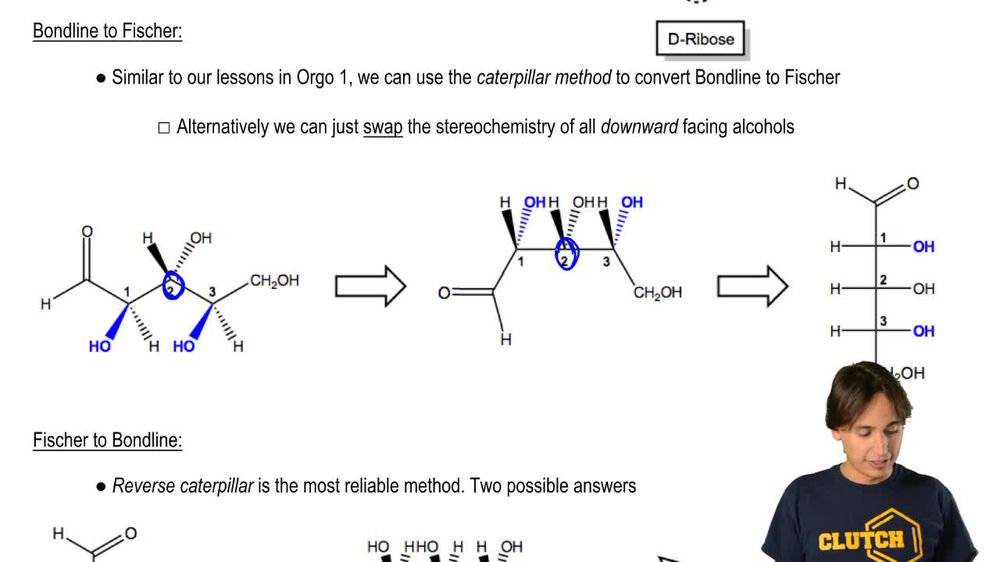
In this attempt to convert the line angle drawing of d-erythrose (shown) to the Fischer projection (shown), by viewing it from a certain direction (shown), a mistake was made. What was the mistake? <IMAGE>
Verified step by step guidance
1
Identify the structure of d-erythrose in the line-angle drawing and understand its stereochemistry. d-Erythrose is a four-carbon aldose sugar with two chiral centers, and its stereochemistry is defined by the 'd-' configuration, which refers to the orientation of the hydroxyl group on the highest-numbered chiral carbon in the Fischer projection.
Review the process of converting a line-angle drawing to a Fischer projection. This involves orienting the molecule such that the carbon chain is vertical, with the most oxidized carbon (the aldehyde group) at the top. The horizontal bonds in the Fischer projection represent groups coming out of the plane toward the viewer, while vertical bonds represent groups going behind the plane.
Examine the direction from which the molecule was viewed to create the Fischer projection. A common mistake occurs when the molecule is viewed from the wrong perspective, leading to an incorrect assignment of the stereochemistry of the chiral centers.
Compare the stereochemistry of the chiral centers in the Fischer projection with the original line-angle drawing. Verify whether the hydroxyl groups on the second and third carbons are correctly positioned (right or left) in the Fischer projection based on the original stereochemistry.
Determine the specific mistake made. If the Fischer projection does not match the stereochemistry of the line-angle drawing, the error likely lies in the perspective used to view the molecule or in the incorrect assignment of the horizontal and vertical bonds in the Fischer projection.
Verified video answer for a similar problem:
This video solution was recommended by our tutors as helpful for the problem above
Play a video:
0 Comments
Key Concepts
Here are the essential concepts you must grasp in order to answer the question correctly.
Line-Angle Drawings
Line-angle drawings are a simplified way to represent organic molecules, where lines represent bonds and vertices represent carbon atoms. This method allows chemists to visualize complex structures without drawing every atom explicitly. Understanding how to interpret these drawings is crucial for converting them into other representations, such as Fischer projections.
Fischer projections are a two-dimensional representation of three-dimensional organic molecules, particularly useful for depicting carbohydrates and amino acids. In this format, vertical lines represent bonds going behind the plane of the page, while horizontal lines represent bonds coming out of the page. Correctly converting a line-angle drawing to a Fischer projection requires careful attention to the orientation of substituents around the chiral centers.
Stereochemistry is the study of the spatial arrangement of atoms in molecules and how this affects their chemical behavior. In the context of converting structures, it is essential to maintain the correct stereochemical configuration, especially for chiral centers. A mistake in stereochemistry can lead to incorrect representations and misinterpretations of the molecule's properties and reactivity.

 Verified step by step guidance
 02:46
02:46