Draw Fischer projections of the following molecules. (a)
Verified step by step guidance
1
Step 1: Understand the Fischer projection. A Fischer projection is a 2D representation of a 3D molecule, where horizontal lines represent bonds projecting out of the plane (toward the viewer), and vertical lines represent bonds projecting behind the plane (away from the viewer). The carbon chain is typically arranged vertically, with the most oxidized carbon (e.g., aldehyde or ketone group) at the top.
Step 2: Identify the stereocenters in the molecule. Stereocenters are carbon atoms bonded to four different groups. Determine the configuration (R or S) of each stereocenter using the Cahn-Ingold-Prelog priority rules.
Step 3: Arrange the molecule in a way that aligns with the Fischer projection convention. Place the main carbon chain vertically, ensuring the highest-priority functional group (e.g., aldehyde or ketone) is at the top. Rotate the molecule if necessary to achieve this orientation.
Step 4: Assign the substituents to the horizontal and vertical positions. The horizontal substituents should represent groups projecting out of the plane (toward the viewer), while the vertical substituents represent groups projecting behind the plane (away from the viewer). Ensure the stereochemistry is preserved during this process.
Step 5: Draw the Fischer projection based on the arrangement from Step 4. Double-check the stereochemistry to ensure the configuration matches the original molecule. If there are multiple stereocenters, repeat the process for each one.
Verified video answer for a similar problem:
This video solution was recommended by our tutors as helpful for the problem above
Video duration:
6m
Play a video:
0 Comments
Key Concepts
Here are the essential concepts you must grasp in order to answer the question correctly.
Fischer Projections
Fischer projections are a two-dimensional representation of three-dimensional organic molecules, particularly useful for depicting carbohydrates and amino acids. In these projections, vertical lines represent bonds that extend away from the viewer, while horizontal lines indicate bonds that come towards the viewer. This format helps in visualizing stereochemistry and understanding the spatial arrangement of substituents around chiral centers.
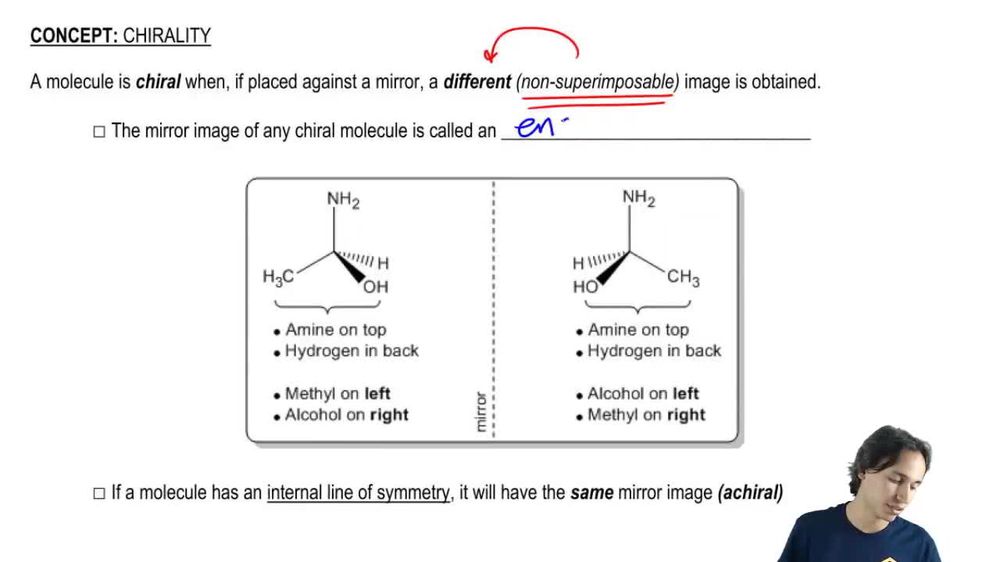
Chirality refers to the property of a molecule that has non-superimposable mirror images, much like left and right hands. Molecules that possess chirality typically have one or more chiral centers, usually carbon atoms bonded to four different substituents. Understanding chirality is essential for accurately drawing Fischer projections, as the orientation of substituents determines the molecule's stereoisomerism.
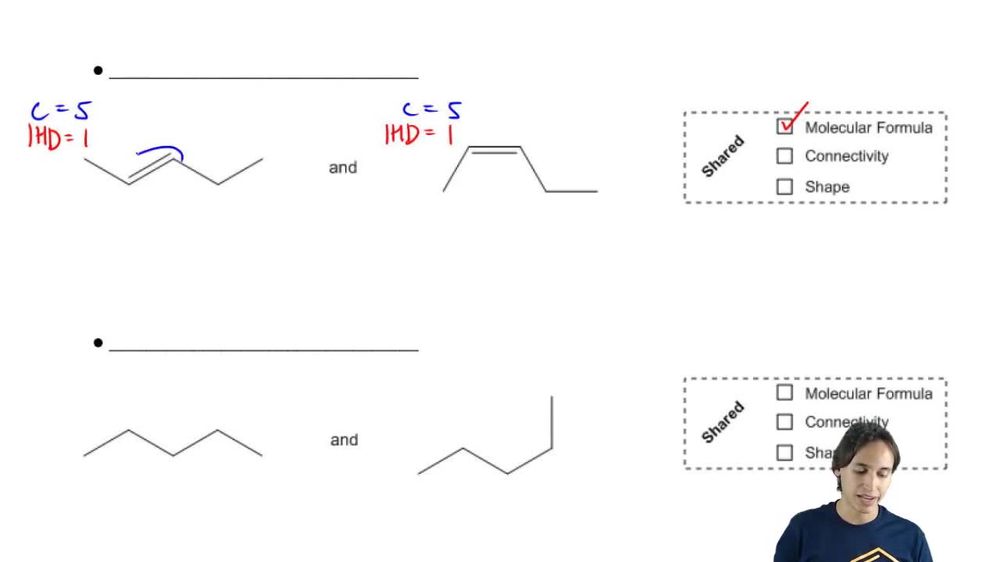
Stereoisomers are compounds that have the same molecular formula and connectivity of atoms but differ in the spatial arrangement of their atoms. This category includes enantiomers, which are mirror images of each other, and diastereomers, which are not. Recognizing the types of stereoisomers is crucial when drawing Fischer projections, as it influences the representation of the molecule's structure and its biological activity.

 6:31 minutes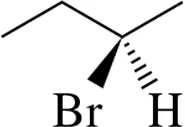
 Verified step by step guidance

 09:56
09:56