Draw a constitutional isomer for C4H11N containing a 1° amine at a (a) 1° carbon, (b) 2° carbon, and (c) 3° carbon.
Verified step by step guidance
1
Step 1: Understand the problem. A constitutional isomer has the same molecular formula (C₄H₁₁N) but differs in the connectivity of atoms. A 1° amine contains a nitrogen atom bonded to one alkyl group and two hydrogen atoms. The task is to place this amine group on a 1°, 2°, and 3° carbon in separate structures.
Step 2: For part (a), identify a 1° carbon. A 1° carbon is bonded to only one other carbon atom. Draw a structure where the nitrogen atom (as part of the 1° amine group) is bonded to a 1° carbon. For example, you can start with n-butylamine (CH₃-CH₂-CH₂-CH₂-NH₂).
Step 3: For part (b), identify a 2° carbon. A 2° carbon is bonded to two other carbon atoms. Modify the structure so that the nitrogen atom is bonded to a 2° carbon. For example, you can draw sec-butylamine (CH₃-CH-CH₂-NH₂ with the nitrogen attached to the second carbon).
Step 4: For part (c), identify a 3° carbon. A 3° carbon is bonded to three other carbon atoms. Modify the structure so that the nitrogen atom is bonded to a 3° carbon. For example, you can draw tert-butylamine ((CH₃)₃C-NH₂ with the nitrogen attached to the central carbon).
Step 5: Verify that each structure has the correct molecular formula (C₄H₁₁N) and that the nitrogen atom is bonded to the appropriate type of carbon (1°, 2°, or 3°) in each case. Ensure the connectivity is correct and consistent with the definition of constitutional isomers.
Verified video answer for a similar problem:
This video solution was recommended by our tutors as helpful for the problem above
Video duration:
6m
Play a video:
0 Comments
Key Concepts
Here are the essential concepts you must grasp in order to answer the question correctly.
Constitutional Isomers
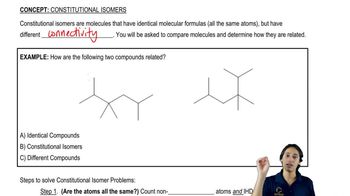
Constitutional isomers are compounds that have the same molecular formula but differ in the connectivity of their atoms. This means that while they share the same number of each type of atom, the arrangement of these atoms leads to different chemical structures and properties. Understanding how to draw and identify constitutional isomers is crucial for visualizing the diversity of organic compounds.
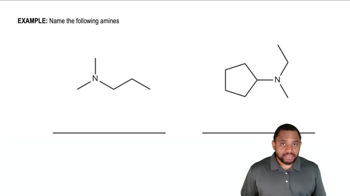
Amines are classified based on the number of carbon groups attached to the nitrogen atom. A primary (1°) amine has one carbon group attached to the nitrogen, a secondary (2°) amine has two, and a tertiary (3°) amine has three. This classification affects the reactivity and properties of the amine, making it essential to identify the correct type when drawing isomers.
The structure of carbon chains is fundamental in organic chemistry, as it determines the physical and chemical properties of the molecule. In the context of the question, identifying the position of the amine group on the carbon chain (1°, 2°, or 3°) is critical for drawing the correct constitutional isomers. The position of functional groups can significantly influence the behavior of the compound in reactions.