Ch.3 - Structure and Stereochemistry of Alkanes
Wade - Organic Chemistry 9th Edition
Wade9th EditionOrganic ChemistryISBN: 9780135213728Not the one you use?Change textbook
Chapter 3, Problem 16k,l

Draw the structure that corresponds with each name.
k. cyclobutylcyclohexane
l. cis-1-bromo-3-chlorocyclohexane

Verified step by step guidance
1
To draw cyclobutylcyclohexane, start by drawing a cyclohexane ring, which is a six-membered carbon ring. Each carbon in the ring is bonded to two other carbons and two hydrogens.
Next, draw a cyclobutyl group, which is a four-membered carbon ring, and attach it to one of the carbons in the cyclohexane ring. This forms the cyclobutylcyclohexane structure.
For cis-1-bromo-3-chlorocyclohexane, begin by drawing a cyclohexane ring. Number the carbons in the ring from 1 to 6.
Place a bromine atom on carbon 1 and a chlorine atom on carbon 3. Since the compound is 'cis', both substituents should be on the same side of the cyclohexane ring, either both above or both below the plane of the ring.
Ensure that the remaining valences of the carbon atoms in the cyclohexane ring are filled with hydrogen atoms to complete the structure.

Verified video answer for a similar problem:

This video solution was recommended by our tutors as helpful for the problem above.
Video duration:
5m
Was this helpful?

Key Concepts

Here are the essential concepts you must grasp in order to answer the question correctly.

Cycloalkanes

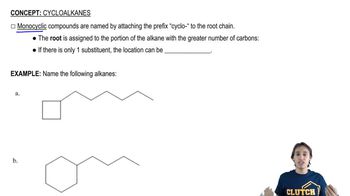
Cycloalkanes are saturated hydrocarbons with carbon atoms arranged in a ring structure. Understanding cycloalkanes involves recognizing the number of carbon atoms in the ring and their spatial arrangement, which affects the molecule's stability and reactivity. Cyclobutylcyclohexane involves a cyclobutane ring attached to a cyclohexane ring.
Recommended video:
Guided course
01:11
How to find the root name for cycloalkanes

Cis-Trans Isomerism

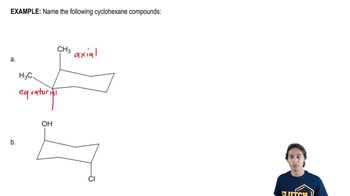
Cis-trans isomerism is a form of stereoisomerism where the relative orientation of functional groups differs across a double bond or ring structure. In cis-1-bromo-3-chlorocyclohexane, the 'cis' designation indicates that the bromo and chloro groups are on the same side of the cyclohexane ring, affecting the molecule's physical properties and reactivity.
Recommended video:
Guided course
00:44
Is the following cyclohexane cis or trans?

IUPAC Nomenclature

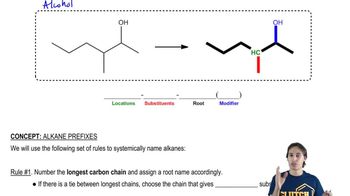
IUPAC nomenclature is a standardized system for naming chemical compounds. It involves identifying the longest carbon chain, numbering the carbon atoms, and naming substituents based on their position and type. For cycloalkanes, the ring size and substituents are crucial for accurate naming, as seen in cyclobutylcyclohexane and cis-1-bromo-3-chlorocyclohexane.
Recommended video:
Guided course
03:43
The different parts of an IUPAC name