a. How many alkenes could you treat with H2, Pd/C to prepare methylcyclopentane? b. Which of the alkenes is the most stable? c. Which of the alkenes has the smallest heat of hydrogenation?
Verified step by step guidance
1
Step 1: Understand the reaction. Treating an alkene with H₂ in the presence of a catalyst like Pd/C results in the addition of hydrogen atoms across the double bond, converting the alkene into an alkane. In this case, the product is methylcyclopentane, so we need to identify all possible alkenes that could lead to this product.
Step 2: Draw the structure of methylcyclopentane. It consists of a cyclopentane ring with a single methyl group attached. To determine the possible alkenes, consider all possible positions for a double bond within the cyclopentane ring and the placement of the methyl group.
Step 3: Enumerate the possible alkenes. For each possible position of the double bond in the cyclopentane ring, consider whether the methyl group is attached to a carbon atom in the ring or to a carbon atom involved in the double bond. Ensure you account for structural isomers and avoid duplicates.
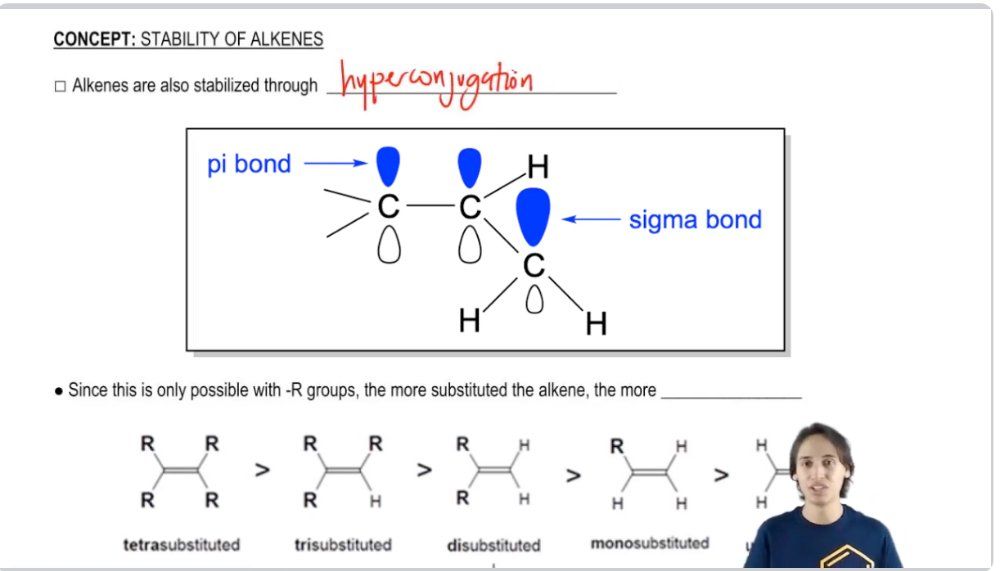
Step 4: To determine the most stable alkene, recall that alkene stability increases with the degree of substitution (more alkyl groups attached to the double-bonded carbons). Compare the substitution patterns of the possible alkenes to identify the most stable one.
Step 5: The heat of hydrogenation is inversely related to alkene stability. The more stable the alkene, the smaller the heat of hydrogenation. Use the stability information from Step 4 to identify the alkene with the smallest heat of hydrogenation.
Verified video answer for a similar problem:
This video solution was recommended by our tutors as helpful for the problem above
Video duration:
8m
Play a video:
0 Comments
Key Concepts
Here are the essential concepts you must grasp in order to answer the question correctly.
Alkene Hydrogenation
Alkene hydrogenation is a chemical reaction where hydrogen gas (H2) is added to an alkene in the presence of a catalyst, such as palladium on carbon (Pd/C). This process converts alkenes, which contain carbon-carbon double bonds, into alkanes, which have only single bonds. Understanding this reaction is crucial for determining how many alkenes can be converted to methylcyclopentane through hydrogenation.
The stability of alkenes is influenced by the degree of substitution at the double bond. More substituted alkenes (those with more alkyl groups attached to the double bond) are generally more stable due to hyperconjugation and the inductive effect. This concept is essential for identifying which alkene among the candidates is the most stable, as stability directly affects reactivity and the products formed during hydrogenation.
The heat of hydrogenation is the amount of heat released when an alkene is hydrogenated to form an alkane. It serves as a measure of alkene stability; less stable alkenes release more heat upon hydrogenation compared to more stable ones. This concept is important for determining which alkene has the smallest heat of hydrogenation, as it correlates with the alkene's stability and reactivity.