Predict the product of the following hydrogenation reactions. (b)
Verified step by step guidance
1
Identify the type of compound undergoing hydrogenation. Hydrogenation typically involves the addition of hydrogen (H₂) to unsaturated compounds, such as alkenes or alkynes, in the presence of a catalyst (e.g., Pd, Pt, or Ni).
Determine the structure of the starting material. If the compound contains a double bond (alkene) or triple bond (alkyne), these unsaturated bonds will be reduced to single bonds (alkane) during hydrogenation.
Write the balanced chemical equation for the reaction. For example, if the starting material is an alkene (C=C), the addition of H₂ will convert it to an alkane (C-C). Use MathML to represent the reaction: .
Consider the stereochemistry of the product. In catalytic hydrogenation, the addition of hydrogen occurs on the same face of the double bond (syn addition), leading to a specific stereochemical outcome if the starting material is cyclic or has substituents.
Draw the final product, ensuring that all double or triple bonds in the starting material have been fully reduced to single bonds, and verify that the molecular formula and stereochemistry are consistent with the reaction conditions.
Verified video answer for a similar problem:
This video solution was recommended by our tutors as helpful for the problem above
Video duration:
1m
Play a video:
0 Comments
Key Concepts
Here are the essential concepts you must grasp in order to answer the question correctly.
Hydrogenation
Hydrogenation is a chemical reaction that involves the addition of hydrogen (H2) to an unsaturated compound, typically an alkene or alkyne, converting it into a saturated compound. This process is often facilitated by a catalyst, such as palladium, platinum, or nickel, which lowers the activation energy required for the reaction. Understanding hydrogenation is crucial for predicting the products of reactions involving double or triple bonds.
Stereochemistry refers to the study of the spatial arrangement of atoms in molecules and how this affects their chemical behavior. In hydrogenation reactions, the stereochemistry of the starting material can influence the configuration of the product, leading to different isomers. Recognizing whether the reaction leads to cis or trans products is essential for accurately predicting the outcome of hydrogenation.
A reaction mechanism is a step-by-step description of the process by which reactants are converted into products. In the case of hydrogenation, the mechanism typically involves the adsorption of the alkene onto the catalyst surface, followed by the addition of hydrogen atoms to the carbon atoms of the double bond. Understanding the mechanism helps in predicting the specific products formed and the conditions under which the reaction occurs.

 1:31 minutes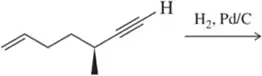
 Verified step by step guidance
 00:48
00:48