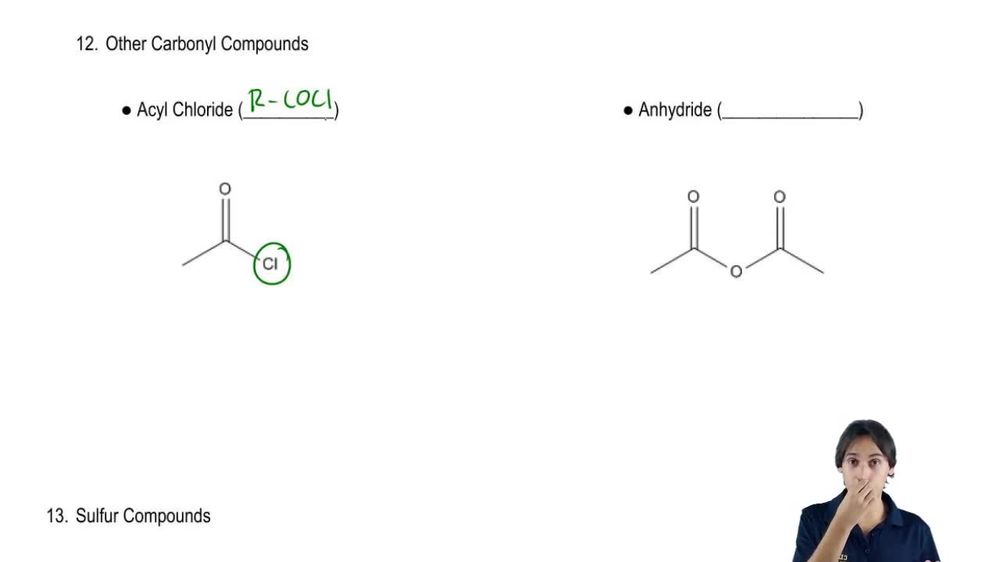
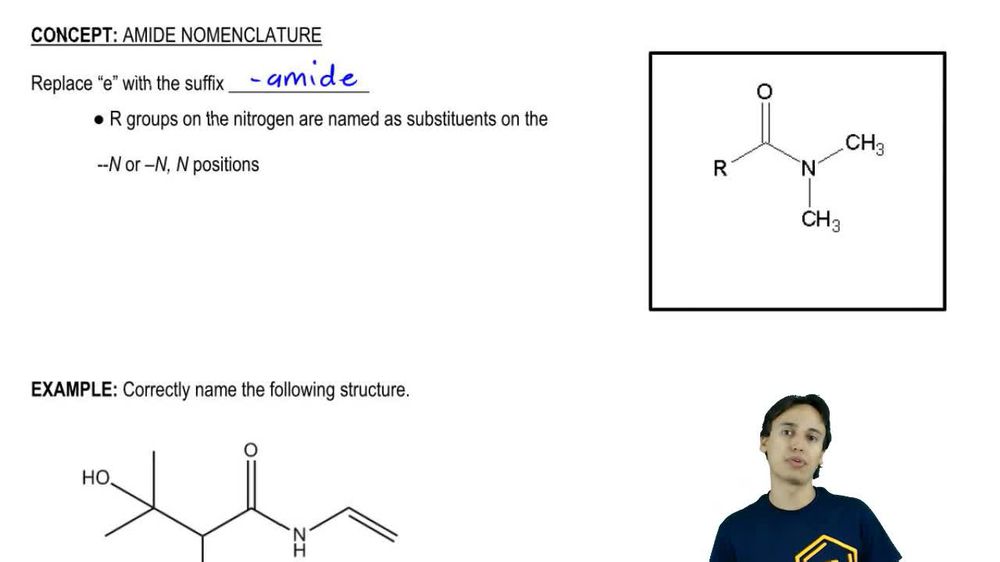
An aqueous solution of a primary or secondary amine reacts with an acyl chloride to form an amide as the major product. However, if the amine is tertiary, an amide is not formed. What product is formed? Explain.
Verified step by step guidance
1
Understand the reactivity of amines: Primary and secondary amines have a hydrogen atom attached to the nitrogen, which allows them to act as nucleophiles and react with acyl chlorides to form amides. Tertiary amines, however, lack this hydrogen atom, which makes them unable to form amides in this reaction.
Analyze the reaction mechanism: In the case of primary or secondary amines, the lone pair of electrons on the nitrogen attacks the carbonyl carbon of the acyl chloride, leading to the formation of a tetrahedral intermediate. This intermediate then eliminates HCl to form the amide product.
Consider the case of tertiary amines: Since tertiary amines do not have a hydrogen atom on the nitrogen, they cannot eliminate HCl to form an amide. Instead, they act as bases and react with the HCl produced during the reaction.
Predict the product: When a tertiary amine reacts with an acyl chloride, the tertiary amine typically forms a salt by accepting a proton from the HCl. The product is an ammonium salt, specifically a quaternary ammonium chloride.
Summarize the outcome: For primary and secondary amines, the major product is an amide. For tertiary amines, the reaction does not produce an amide but instead forms a quaternary ammonium salt as the major product.
Verified video answer for a similar problem:
This video solution was recommended by our tutors as helpful for the problem above
Video duration:
2m
Play a video:
0 Comments
Key Concepts
Here are the essential concepts you must grasp in order to answer the question correctly.
Amine Reactivity
Amines are organic compounds derived from ammonia by replacing one or more hydrogen atoms with alkyl or aryl groups. Primary and secondary amines have at least one hydrogen atom available for nucleophilic attack, allowing them to react with acyl chlorides to form amides. In contrast, tertiary amines lack this hydrogen, making them unable to form amides through this reaction.
Acyl chlorides, also known as acid chlorides, are reactive compounds containing a carbonyl group (C=O) bonded to a chlorine atom. They are highly electrophilic and readily react with nucleophiles, such as amines, to form amides. The reaction involves the nucleophilic attack of the amine on the carbonyl carbon, leading to the formation of the amide and the release of hydrochloric acid.
Amides are organic compounds characterized by the presence of a carbonyl group (C=O) directly attached to a nitrogen atom (N). The formation of amides from amines and acyl chlorides is a key reaction in organic chemistry, typically resulting in the substitution of the chlorine atom by the amine. This reaction is significant in synthesizing various pharmaceuticals and agrochemicals, highlighting the importance of understanding the reactivity of different amine types.