Starting with methyl acetate, what neutral nucleophile would you use to synthesize each of the following compounds? b. acetamide
Verified step by step guidance
1
Identify the functional group in methyl acetate. Methyl acetate is an ester with the general structure \( RCOOR' \), where \( R \) is a methyl group and \( R' \) is also a methyl group.
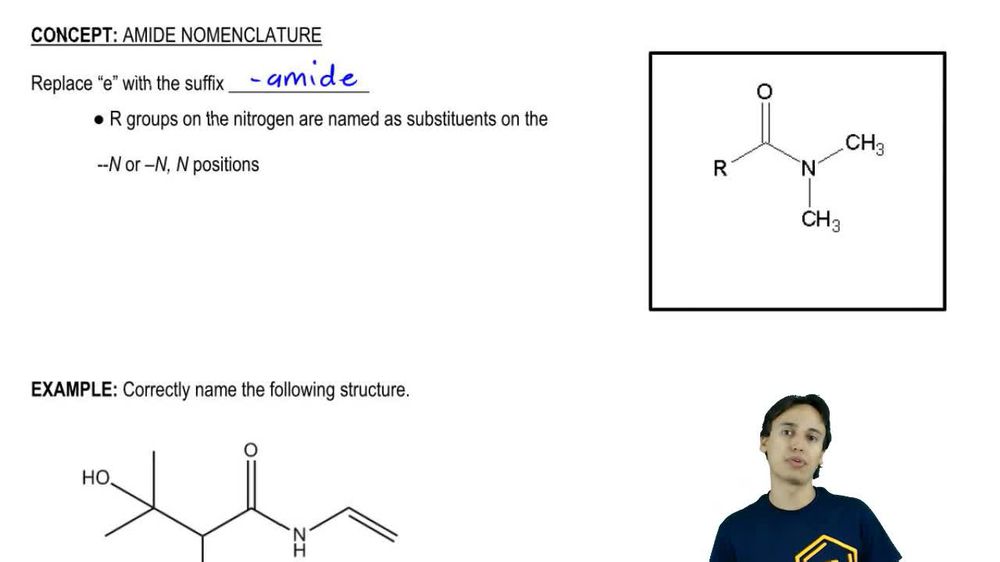
Determine the target compound's functional group. Acetamide contains an amide functional group \( RCONH_2 \), where \( R \) is a methyl group.
Recognize the type of reaction needed to convert an ester to an amide. This transformation typically involves aminolysis, where the ester reacts with an amine or ammonia to replace the \( -OR' \) group with \( -NH_2 \).
Select the appropriate neutral nucleophile. In this case, ammonia (\( NH_3 \)) is a neutral nucleophile that can react with methyl acetate to form acetamide.
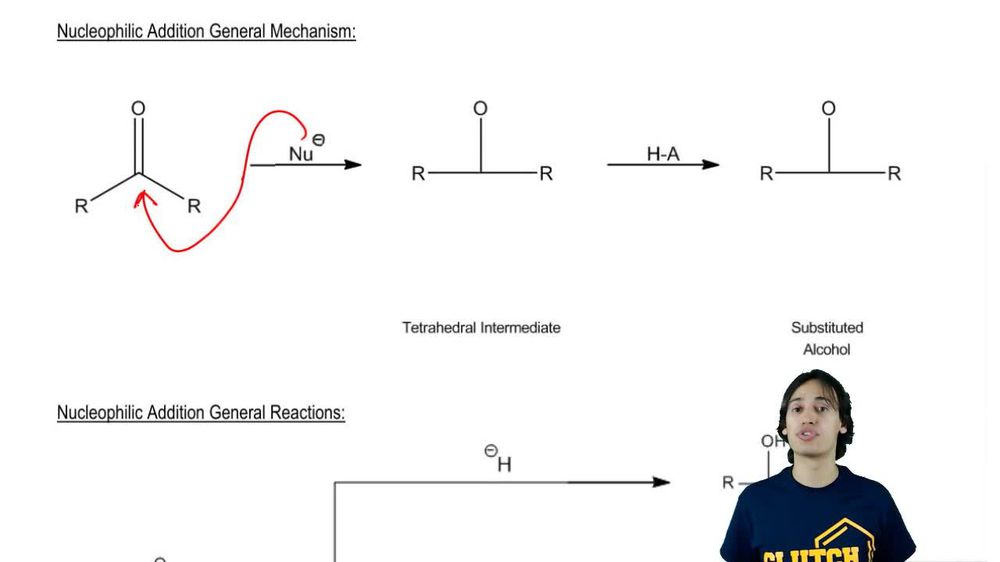
Outline the reaction mechanism. The nucleophilic attack by \( NH_3 \) on the carbonyl carbon of methyl acetate leads to the formation of a tetrahedral intermediate. This intermediate then eliminates methanol (\( CH_3OH \)) to yield acetamide.
Verified video answer for a similar problem:
This video solution was recommended by our tutors as helpful for the problem above
Video duration:
1m
Play a video:
0 Comments
Key Concepts
Here are the essential concepts you must grasp in order to answer the question correctly.
Nucleophiles
Nucleophiles are species that donate an electron pair to form a chemical bond in a reaction. They are typically negatively charged or neutral molecules with lone pairs of electrons. In organic synthesis, nucleophiles attack electrophilic centers, facilitating the formation of new bonds. Understanding the nature of nucleophiles is crucial for predicting reaction pathways and outcomes.
Nucleophilic substitution reactions involve the replacement of a leaving group in a molecule by a nucleophile. This process can occur via two main mechanisms: SN1 and SN2. The choice of nucleophile and the structure of the substrate influence the reaction pathway. Recognizing these mechanisms is essential for determining how to synthesize specific compounds from given starting materials.
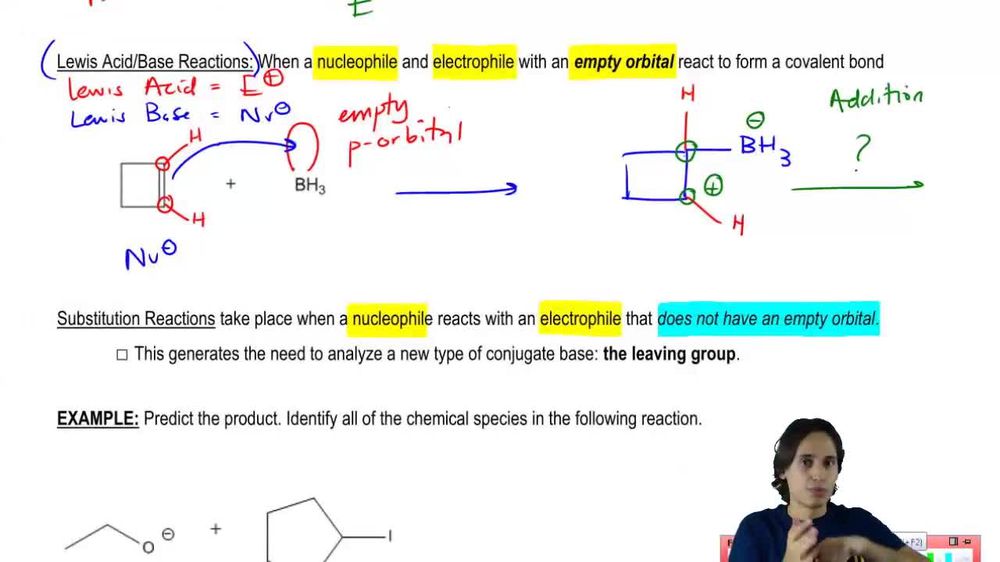
Nucleophiles and Electrophiles can react in Substitution Reactions.
Amide Formation
Amide formation is a specific type of reaction where a carboxylic acid or its derivative reacts with an amine or ammonia to produce an amide. In the context of synthesizing acetamide from methyl acetate, a neutral nucleophile such as ammonia or an amine can be used. Understanding the reactivity of carboxylic acid derivatives is key to successfully carrying out this transformation.