How many sets of equivalent hydrogens are present in the molecule that resulted in this NMR spectrum? [Recall that some signals can be split into multiple peaks—they are still just one signal.] <IMAGE>
Verified step by step guidance
1
Identify the molecular structure of the compound in question. This is crucial as the arrangement of atoms will determine the equivalence of hydrogen atoms.
Examine the symmetry of the molecule. Symmetrical molecules often have sets of equivalent hydrogens due to their identical chemical environments.
Look for groups of hydrogens that are in the same chemical environment. Hydrogens in the same environment will produce the same NMR signal.
Consider the presence of any functional groups or substituents that might affect the chemical environment of the hydrogens, leading to different sets of equivalent hydrogens.
Count the distinct sets of equivalent hydrogens based on the analysis of the chemical environments. Each set corresponds to a unique signal in the NMR spectrum, regardless of splitting patterns.
Verified video answer for a similar problem:
This video solution was recommended by our tutors as helpful for the problem above
Video duration:
1m
Play a video:
0 Comments
Key Concepts
Here are the essential concepts you must grasp in order to answer the question correctly.
Equivalent Hydrogens
Equivalent hydrogens in a molecule are those that are in identical chemical environments, leading them to produce the same signal in an NMR spectrum. These hydrogens are indistinguishable by NMR and contribute to the same peak or set of peaks. Identifying equivalent hydrogens is crucial for interpreting NMR spectra and understanding molecular symmetry.
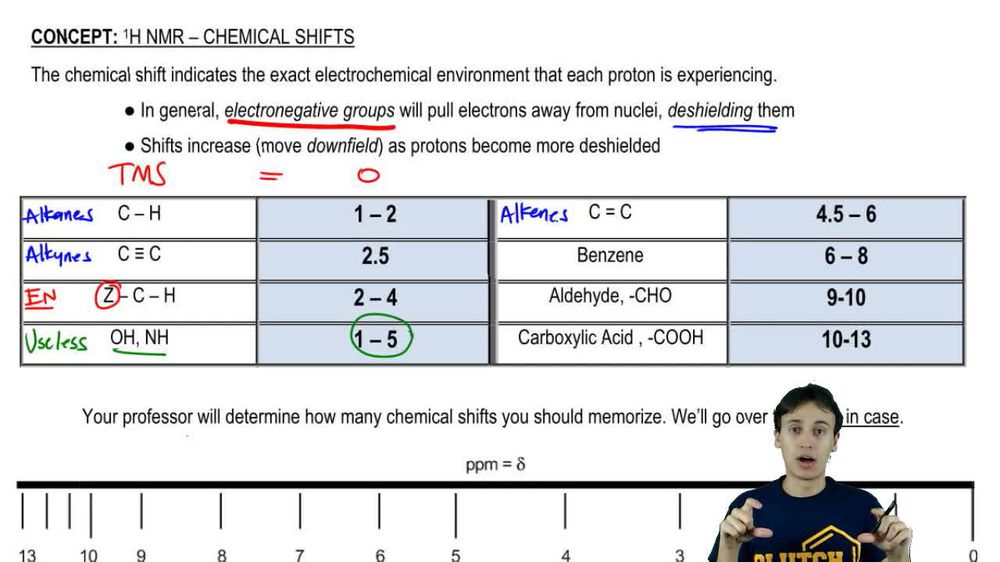
Chemical shift refers to the position of an NMR signal along the spectrum, measured in parts per million (ppm). It provides information about the electronic environment surrounding the nuclei, influenced by factors such as electronegativity and hybridization. Understanding chemical shifts helps in identifying the types of hydrogens present and their relative positions in the molecule.
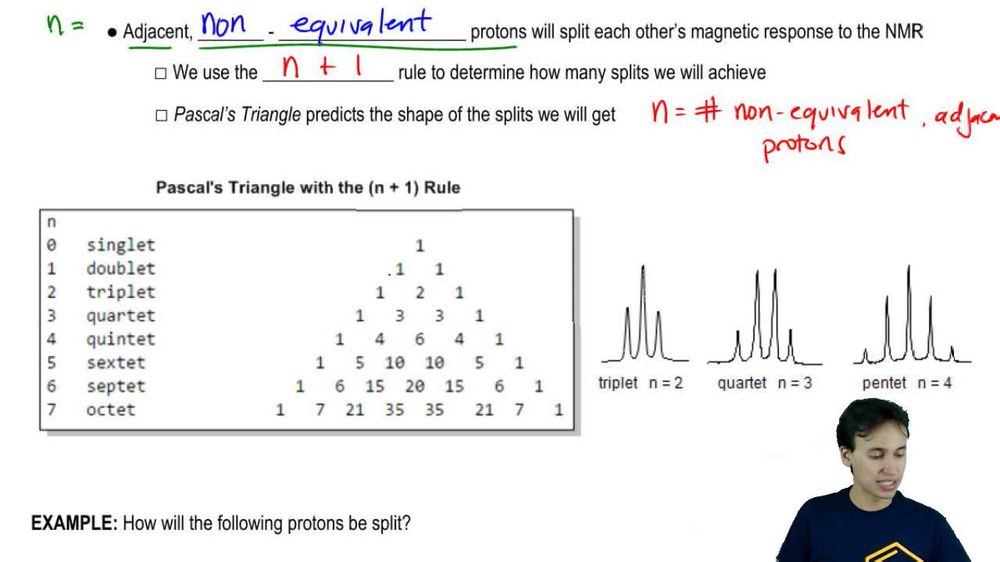
Spin-spin splitting occurs when non-equivalent hydrogens on adjacent atoms influence each other's magnetic environments, causing a single NMR signal to split into multiple peaks. The number of peaks follows the n+1 rule, where n is the number of neighboring hydrogens. Recognizing splitting patterns aids in determining the connectivity and arrangement of atoms within a molecule.

 1:39 minutes
 Verified step by step guidance
 05:21
05:21