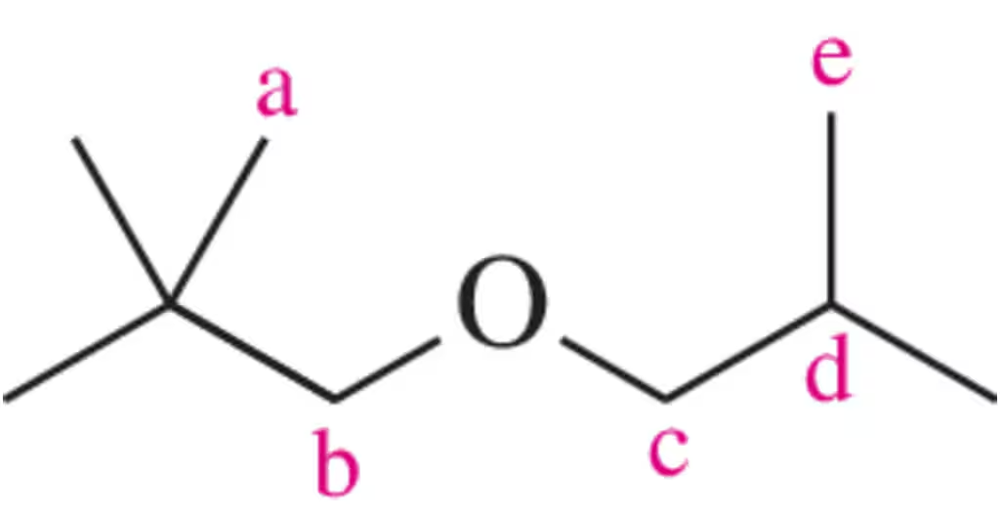
Without worrying about the relative location of the signals (i.e., the chemical shift) or the splitting patterns, draw a spectrum of the following molecule. Be sure to label each signal based on the set of equivalent hydrogens to which it corresponds.
Verified step by step guidance
1
Identify all the unique sets of equivalent hydrogens in the molecule. Equivalent hydrogens are those that are in the same chemical environment and will produce the same NMR signal.
Count the number of hydrogens in each set of equivalent hydrogens. This will help determine the relative intensity of each signal in the spectrum.
Draw a baseline for the NMR spectrum. This is a horizontal line where you will place the signals.
For each set of equivalent hydrogens, draw a vertical line above the baseline to represent the signal. The height of the line should be proportional to the number of hydrogens in that set.
Label each signal with the corresponding set of equivalent hydrogens. This helps in identifying which part of the molecule each signal represents.
Verified video answer for a similar problem:
This video solution was recommended by our tutors as helpful for the problem above
Play a video:
0 Comments
Key Concepts
Here are the essential concepts you must grasp in order to answer the question correctly.
Equivalent Hydrogens
Equivalent hydrogens are atoms in a molecule that are in identical chemical environments, leading them to produce the same signal in an NMR spectrum. Identifying these hydrogens is crucial for predicting the number of signals in a spectrum, as each set of equivalent hydrogens corresponds to one distinct signal.
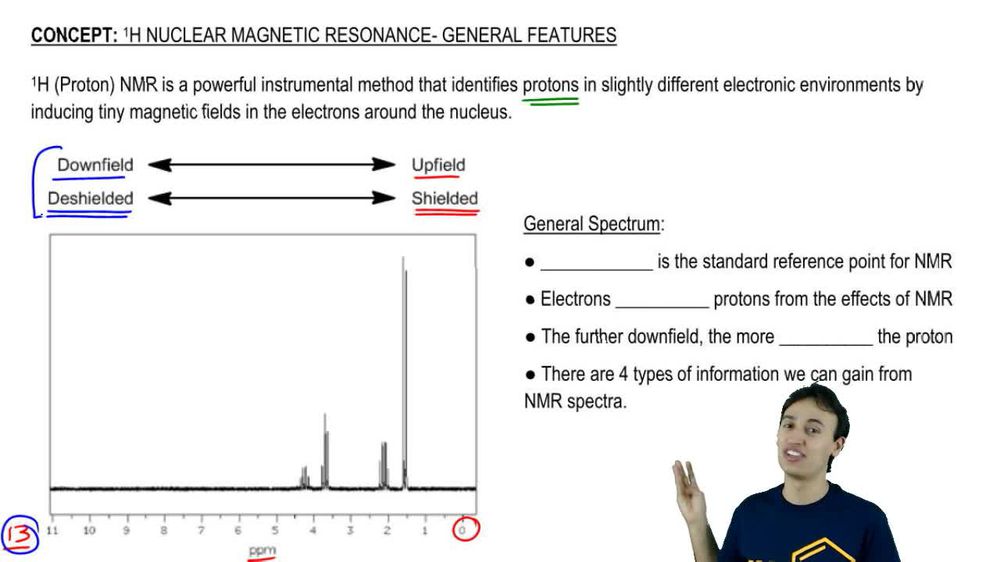
Nuclear Magnetic Resonance (NMR) Spectroscopy is a technique used to determine the structure of organic compounds by observing the behavior of nuclei in a magnetic field. It provides information about the number of hydrogen environments in a molecule, which is essential for drawing and interpreting NMR spectra.
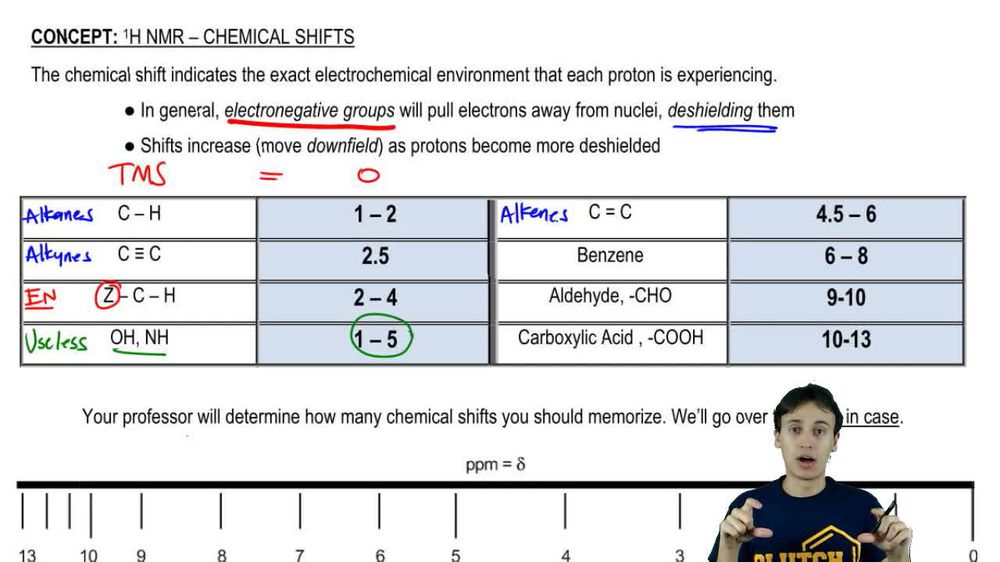
Chemical shift refers to the position of an NMR signal, which indicates the electronic environment of the nuclei. Although the question specifies not to worry about chemical shifts, understanding that they reflect the electronic surroundings of hydrogens helps in labeling signals based on equivalent hydrogens in more advanced analyses.

 Verified step by step guidance
 05:21
05:21