For the following acid–base reactions studied in Assessment 5.25, draw a likely transition state. Be sure to indicate in your drawing the degree to which bonds are broken or formed. (b)
Verified step by step guidance
1
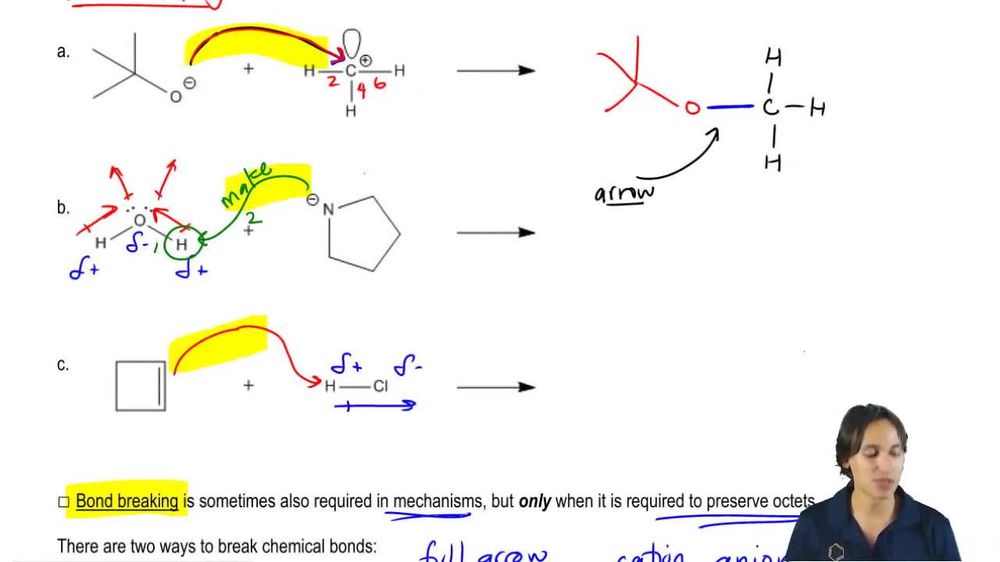
Step 1: Identify the acid and base in the reaction. In the given reaction, the molecule with the hydroxyl group (-OH) acts as the acid, donating a proton (H⁺), while the molecule with the amine group (-NH₂) acts as the base, accepting the proton.
Step 2: Recognize the transition state. The transition state represents the intermediate structure where bonds are partially broken and formed. In this case, the O-H bond of the acid is partially broken, and the N-H bond of the base is partially formed.
Step 3: Draw the transition state. Represent the O-H bond as partially broken using a dashed line, and the N-H bond as partially formed using another dashed line. Indicate the movement of electrons with curved arrows: one arrow showing the lone pair on nitrogen attacking the hydrogen, and another arrow showing the bond between oxygen and hydrogen breaking.
Step 4: Include partial charges in the transition state. The oxygen atom will have a partial negative charge (δ⁻) due to the breaking of the O-H bond, and the nitrogen atom will have a partial positive charge (δ⁺) due to the formation of the N-H bond.
Step 5: Verify the transition state drawing. Ensure that the drawing accurately represents the intermediate structure with partial bonds and charges, and that it aligns with the acid-base reaction mechanism.
Verified video answer for a similar problem:
This video solution was recommended by our tutors as helpful for the problem above
Play a video:
0 Comments
Key Concepts
Here are the essential concepts you must grasp in order to answer the question correctly.
Acid-Base Reactions
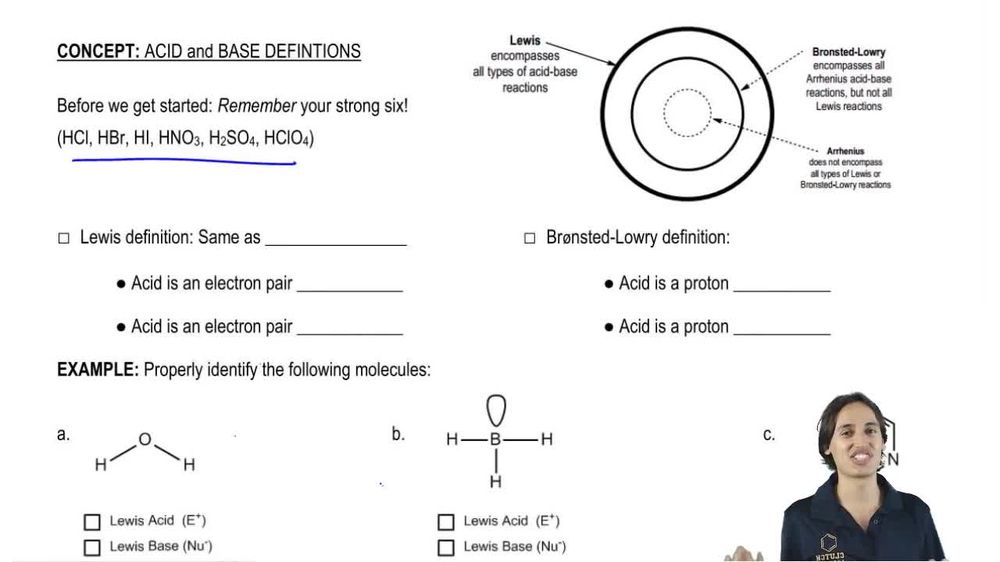
Acid-base reactions involve the transfer of protons (H+) between reactants. An acid donates a proton, while a base accepts it. Understanding the nature of acids and bases, including their strength and the concept of conjugate pairs, is essential for predicting the outcome of these reactions and drawing accurate transition states.
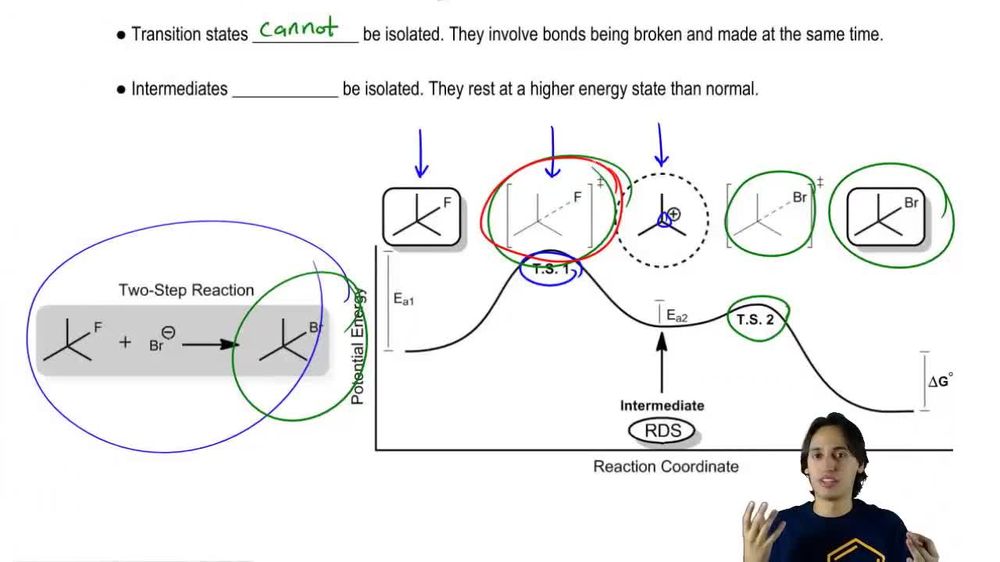
A transition state represents a high-energy, unstable arrangement of atoms that occurs during the transformation from reactants to products. It is characterized by partially formed and broken bonds. Drawing a transition state requires an understanding of the molecular geometry and the changes in bonding that occur as the reaction progresses.
In chemical reactions, bonds between atoms are either formed or broken. The extent of bond formation and breaking can be depicted in a transition state diagram. Recognizing which bonds are involved and the degree to which they are altered is crucial for accurately representing the transition state and understanding the reaction mechanism.