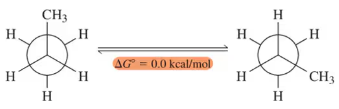
For the following equilibrium processes and the corresponding ∆G° , indicate whether you expect the equilibrium constant to be greater than, equal to, or less than 1. Justify your expectation in words. (b)
Verified step by step guidance
1
Step 1: Understand the relationship between Gibbs free energy change (∆G°) and the equilibrium constant (K). The equation that connects these two is ΔG° = -RT ln(K), where R is the gas constant and T is the temperature in Kelvin.
Step 2: Analyze the given ∆G° value. In this case, ∆G° = 0.0 kcal/mol. This indicates that there is no free energy difference between the reactants and products.
Step 3: Interpret the equilibrium constant (K) based on ∆G°. When ∆G° = 0, the equation ΔG° = -RT ln(K) simplifies to ln(K) = 0, which means K = 1.
Step 4: Consider the chemical structures provided. The two structures are conformational isomers (chair conformations of cyclohexane with a methyl group in axial and equatorial positions). Since ∆G° = 0, both conformations are equally stable, and the equilibrium constant reflects this balance.
Step 5: Conclude that the equilibrium constant is equal to 1 because the free energy difference is zero, indicating that the forward and reverse reactions occur at the same rate under standard conditions.
Verified video answer for a similar problem:
This video solution was recommended by our tutors as helpful for the problem above
Video duration:
3m
Play a video:
0 Comments
Key Concepts
Here are the essential concepts you must grasp in order to answer the question correctly.
Gibbs Free Energy (∆G)
Gibbs Free Energy (∆G) is a thermodynamic potential that measures the maximum reversible work obtainable from a thermodynamic system at constant temperature and pressure. A negative ∆G indicates a spontaneous process, while a positive ∆G suggests non-spontaneity. When ∆G is zero, as in this case, the system is at equilibrium, meaning the forward and reverse reactions occur at the same rate.
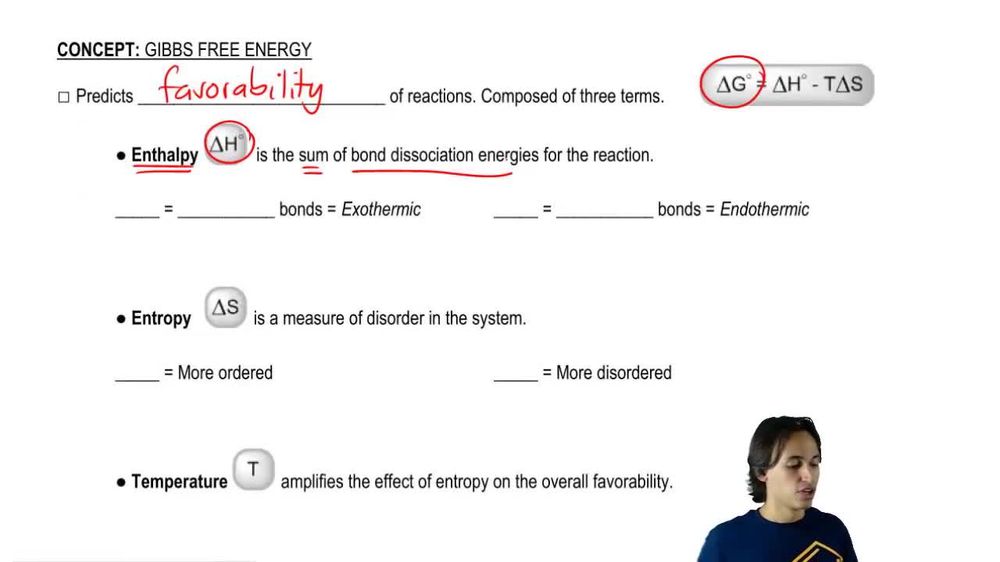
Breaking down the different terms of the Gibbs Free Energy equation.
Equilibrium Constant (K)
The equilibrium constant (K) is a dimensionless value that expresses the ratio of the concentrations of products to reactants at equilibrium for a given reaction. If K > 1, products are favored; if K < 1, reactants are favored. At equilibrium, when ∆G = 0, K is equal to 1, indicating that the concentrations of reactants and products are equal.
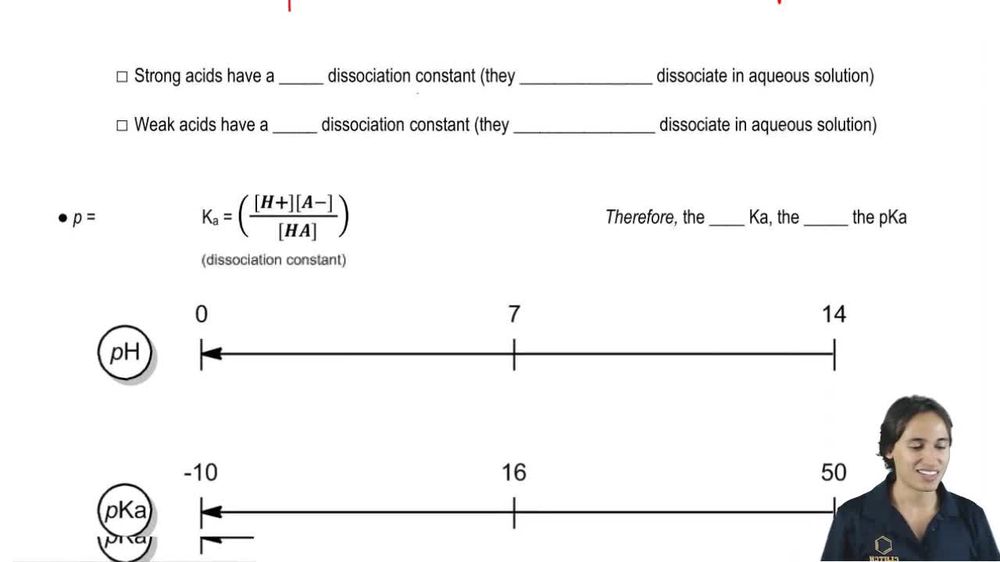
The relationship between equilibrium constant and pKa.
Relationship between ∆G and K
The relationship between Gibbs Free Energy (∆G) and the equilibrium constant (K) is described by the equation ∆G° = -RT ln(K), where R is the gas constant and T is the temperature in Kelvin. This equation shows that if ∆G° is zero, then ln(K) is also zero, leading to K = 1. This indicates that at equilibrium, the concentrations of reactants and products are equal, reflecting a balance in the reaction.