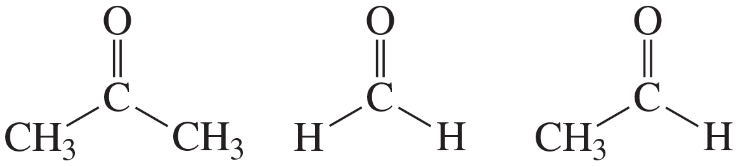
Rank the following compounds from highest wavenumber to lowest wavenumber for their C=O absorption band:
Verified step by step guidance
1
Step 1: Understand the concept of C=O absorption band in IR spectroscopy. The wavenumber of the C=O stretch depends on factors such as conjugation, inductive effects, and hydrogen bonding. Higher wavenumbers correspond to stronger bonds or less conjugation.
Step 2: Analyze the structures provided. The first compound is a ketone with two alkyl groups attached to the carbonyl carbon. The second compound is an aldehyde with one alkyl group and one hydrogen attached to the carbonyl carbon. The third compound is formaldehyde, with two hydrogens attached to the carbonyl carbon.
Step 3: Consider the inductive effects. Alkyl groups donate electron density to the carbonyl group, weakening the C=O bond and lowering the wavenumber. Hydrogen atoms do not have this electron-donating effect, so formaldehyde will have the highest wavenumber.
Step 4: Rank the compounds based on conjugation and inductive effects. Formaldehyde (third compound) has the highest wavenumber due to the absence of electron-donating alkyl groups. The aldehyde (second compound) has a lower wavenumber than formaldehyde but higher than the ketone (first compound), which has two electron-donating alkyl groups.
Step 5: Final ranking from highest wavenumber to lowest wavenumber: Formaldehyde > Aldehyde > Ketone.
Verified video answer for a similar problem:
This video solution was recommended by our tutors as helpful for the problem above
Video duration:
5m
Play a video:
0 Comments
Key Concepts
Here are the essential concepts you must grasp in order to answer the question correctly.
C=O Stretching Frequency
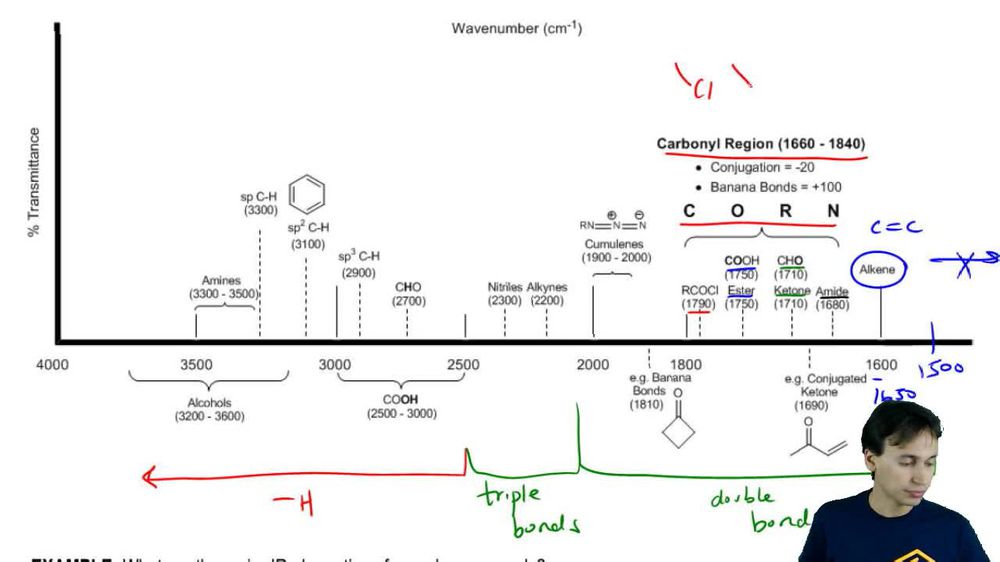
The C=O bond exhibits a characteristic stretching frequency that can be measured in wavenumbers (cm⁻¹). This frequency is influenced by the nature of the surrounding atoms and groups, with stronger bonds and less steric hindrance typically resulting in higher wavenumbers. In general, carbonyl compounds with electron-withdrawing groups show higher wavenumber absorption due to increased bond strength.
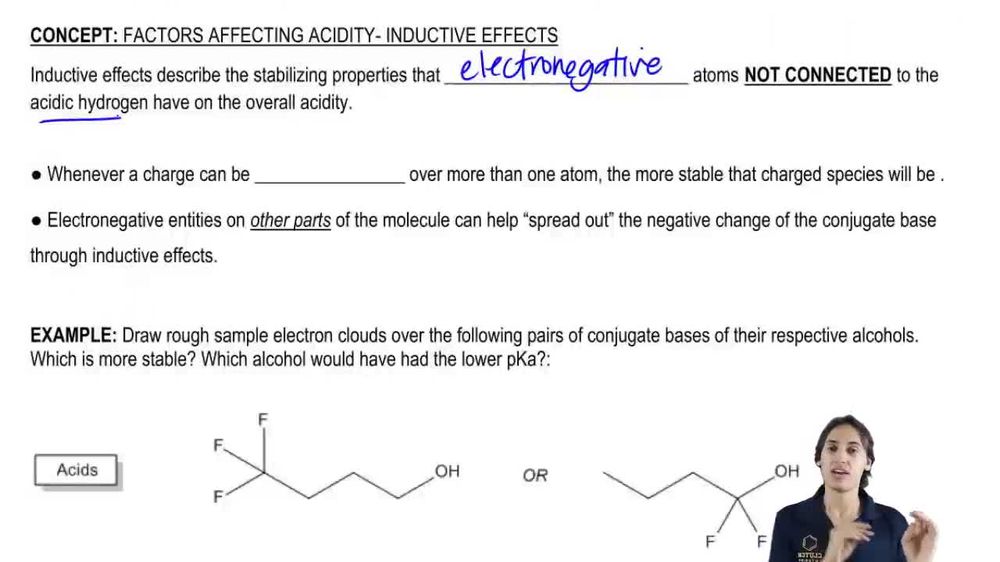
The inductive effect refers to the electron-withdrawing or electron-donating influence of substituents on a molecule. Electron-withdrawing groups, such as halogens or carbonyls, increase the positive character of the carbonyl carbon, leading to a stronger C=O bond and thus a higher wavenumber in IR spectroscopy. Conversely, electron-donating groups can lower the wavenumber by weakening the C=O bond.
Steric hindrance occurs when bulky groups around a reactive site impede the approach of other molecules or groups. In the context of carbonyl compounds, increased steric hindrance can lower the frequency of the C=O stretching vibration due to the reduced ability of the bond to stretch freely. This effect is particularly relevant when comparing carbonyls with different substituents, as larger groups can lead to lower wavenumber absorptions.