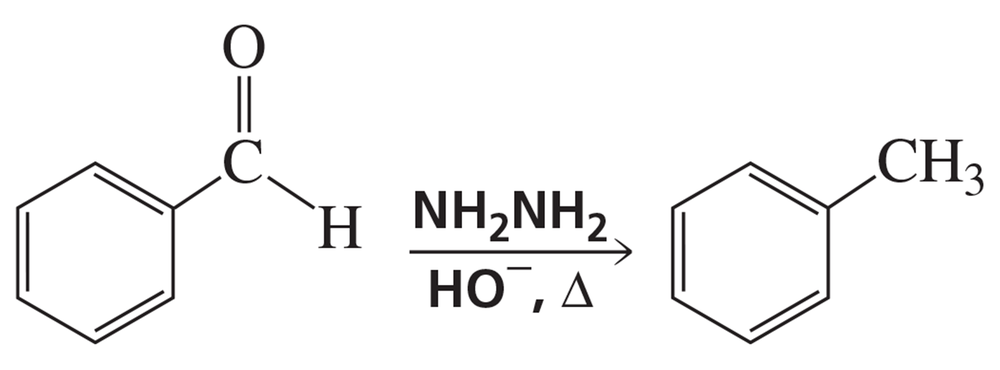
a. How could you use IR spectroscopy to determine whether the following reaction had occurred? b. After purifying the product, how could you determine whether all the NH2NH2 had been removed?
Verified step by step guidance
1
Step 1: Analyze the reaction. The reaction involves the conversion of a ketone (carbonyl group) to an alkane using hydrazine (NH2NH2) and a base under heat. This is known as the Wolff-Kishner reduction.
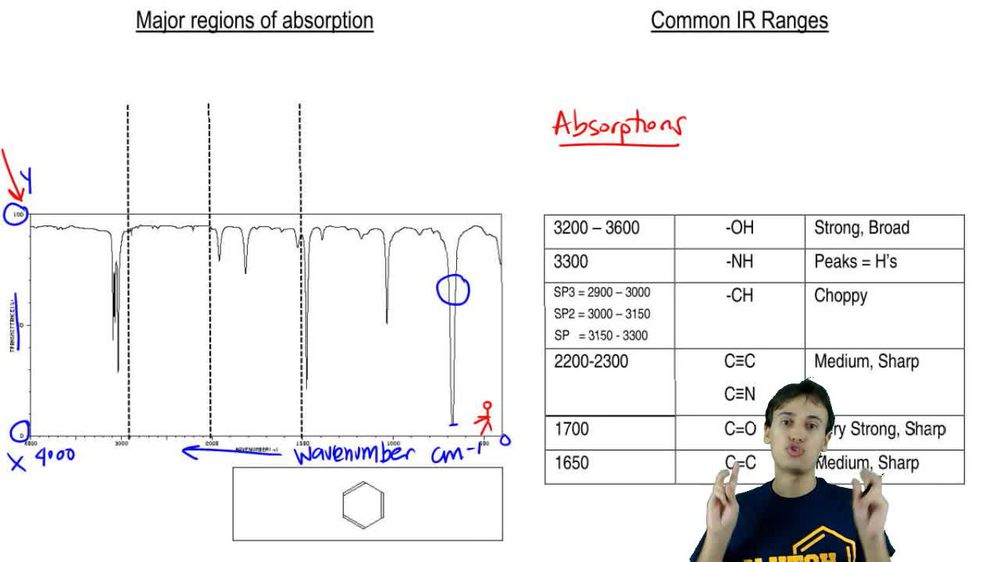
Step 2: To determine if the reaction has occurred using IR spectroscopy, look for the disappearance of the carbonyl (C=O) stretching peak. The carbonyl group typically absorbs strongly in the range of 1650-1750 cm⁻¹. If the reaction is successful, this peak should no longer be present in the IR spectrum of the product.
Step 3: To confirm the removal of NH2NH2 after purification, check the IR spectrum for the presence of N-H stretching vibrations. Hydrazine exhibits N-H stretching peaks in the range of 3300-3500 cm⁻¹. If these peaks are absent, it indicates that hydrazine has been successfully removed.
Step 4: Ensure that the purified product shows only the expected peaks for the alkane and aromatic ring. The aromatic C-H stretching peaks typically appear around 3000-3100 cm⁻¹, and the alkane C-H stretching peaks appear around 2800-3000 cm⁻¹.
Step 5: Compare the IR spectra of the starting material, crude product, and purified product to confirm the disappearance of the carbonyl group and hydrazine peaks, and the presence of peaks corresponding to the desired product.
Verified video answer for a similar problem:
This video solution was recommended by our tutors as helpful for the problem above
Video duration:
5m
Play a video:
0 Comments
Key Concepts
Here are the essential concepts you must grasp in order to answer the question correctly.
Infrared (IR) Spectroscopy
IR spectroscopy is a technique used to identify functional groups in organic compounds by measuring the absorption of infrared light. Different bonds absorb characteristic frequencies of IR radiation, allowing for the identification of specific functional groups. In the context of the reaction, the presence or absence of specific peaks corresponding to NH2 groups or carbonyls can indicate whether the reaction has occurred.
Purification techniques, such as recrystallization or chromatography, are essential for isolating the desired product from a reaction mixture. After the reaction, it is crucial to ensure that unreacted reagents, like hydrazine (NH2NH2), are removed. The effectiveness of these techniques can be assessed through subsequent analytical methods, such as IR spectroscopy or NMR, to confirm the absence of impurities.
Functional group analysis involves identifying specific groups of atoms within a molecule that determine its chemical reactivity and properties. In this reaction, the conversion of a carbonyl compound to an amine derivative involves the disappearance of the carbonyl (C=O) and the appearance of new functional groups, such as NH2. Understanding these changes is crucial for confirming the reaction's completion and the removal of starting materials.