Write the mechanism for the acid-catalyzed reaction of an amide with an alcohol to form an ester.
Verified step by step guidance
1
Step 1: Protonation of the amide oxygen. In the presence of an acid catalyst, the lone pair of electrons on the oxygen atom of the amide group interacts with a proton (H⁺), leading to the formation of a positively charged intermediate. This step increases the electrophilicity of the carbonyl carbon.
Step 2: Nucleophilic attack by the alcohol. The alcohol (R'-OH) acts as a nucleophile and attacks the electrophilic carbonyl carbon of the protonated amide, forming a tetrahedral intermediate. This step involves the breaking of the π-bond in the carbonyl group.
Step 3: Proton transfer within the intermediate. A proton transfer occurs within the tetrahedral intermediate to stabilize the structure. This step prepares the intermediate for the elimination of the leaving group.
Step 4: Elimination of the amine group. The nitrogen atom of the amide group is protonated, making it a better leaving group. The tetrahedral intermediate collapses, expelling the protonated amine (R-NH₃⁺) and reforming the carbonyl group.
Step 5: Deprotonation of the ester product. The ester product (R-COOR') is formed, and a final deprotonation step regenerates the acid catalyst (H⁺), completing the reaction mechanism.
Verified video answer for a similar problem:
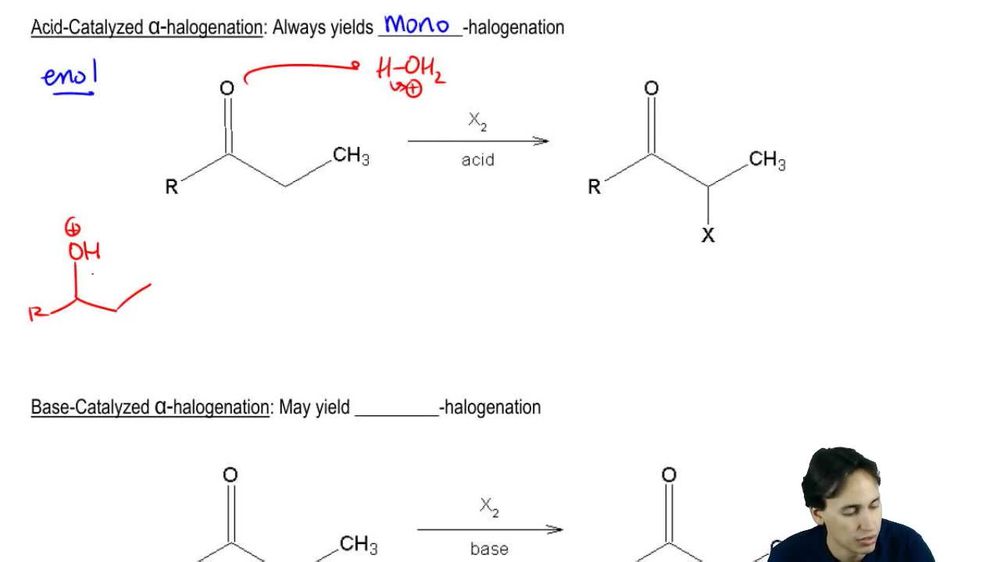
This video solution was recommended by our tutors as helpful for the problem above
Video duration:
4m
Play a video:
0 Comments
Key Concepts
Here are the essential concepts you must grasp in order to answer the question correctly.
Acid-Catalyzed Reactions
Acid-catalyzed reactions involve the use of an acid to increase the rate of a chemical reaction. In the context of organic chemistry, acids can protonate nucleophiles or electrophiles, enhancing their reactivity. This is particularly important in reactions involving functional groups like amides and alcohols, where the acid facilitates the formation of a more reactive intermediate.
Amides are organic compounds characterized by a carbonyl group (C=O) bonded to a nitrogen atom (N), while esters are formed from the reaction of an alcohol and a carboxylic acid, featuring a carbonyl group bonded to an alkoxy group (R-O). Understanding the structure and reactivity of these functional groups is crucial for predicting the outcome of their reactions, including the transformation of an amide into an ester.
Nucleophilic acyl substitution is a fundamental reaction mechanism in organic chemistry where a nucleophile attacks a carbonyl carbon, leading to the substitution of a leaving group. In the case of amides reacting with alcohols, the alcohol acts as the nucleophile, attacking the carbonyl carbon of the amide, which is facilitated by the acid catalyst. This mechanism is key to understanding how esters are formed from amides.