A chemist is planning to synthesize 3-octyne by adding 1-bromobutane to the product obtained from the reaction of 1-butyne with sodium amide. Unfortunately, however, he forgot to order 1-butyne. How else can he prepare 3-octyne?
Verified step by step guidance
1
Step 1: Recognize that 3-octyne is a symmetrical alkyne with the triple bond located between the third and fourth carbons. To synthesize it, you need two alkyl groups (butyl groups) attached to the triple bond.
Step 2: Consider alternative methods to generate the alkyne precursor. Instead of starting with 1-butyne, you can use acetylene (ethyne, C₂H₂) as the starting material. Acetylene can be deprotonated using sodium amide (NaNH₂) to form the acetylide ion (C≡C⁻).
Step 3: React the acetylide ion with 1-bromobutane (C₄H₉Br) in an SN2 reaction. This will result in the formation of 1-butyne (C≡C-C₄H₉), which is the intermediate needed for the synthesis of 3-octyne.
Step 4: Deprotonate the terminal alkyne (1-butyne) again using sodium amide to form another acetylide ion (C≡C-C₄H₉⁻). This ion can then react with another molecule of 1-bromobutane in an SN2 reaction to form 3-octyne (C₄H₉-C≡C-C₄H₉).
Step 5: Verify the structure of the final product, ensuring that the triple bond is located between the third and fourth carbons, and both butyl groups are attached symmetrically. This confirms the successful synthesis of 3-octyne.
Verified video answer for a similar problem:
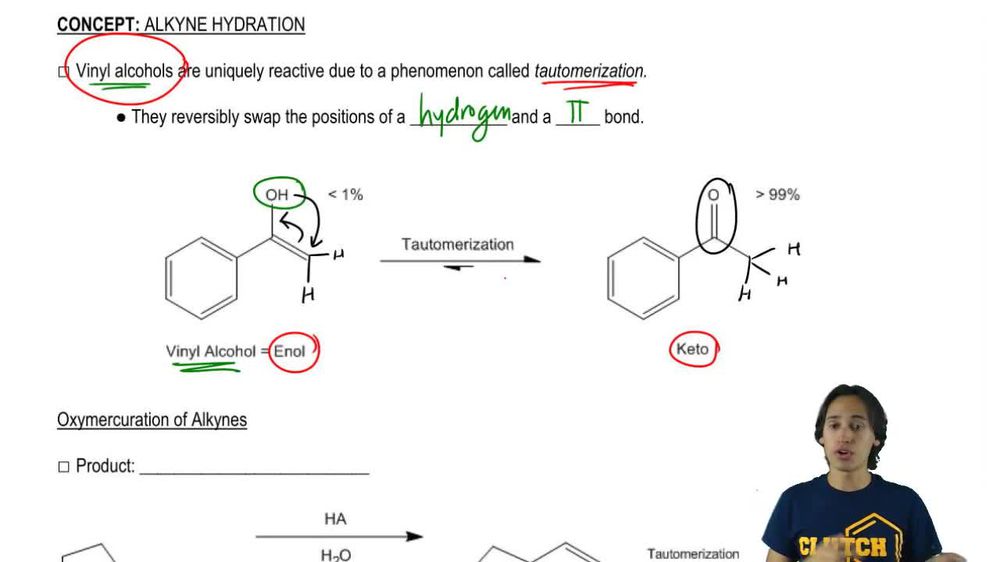
This video solution was recommended by our tutors as helpful for the problem above
Video duration:
6m
Play a video:
0 Comments
Key Concepts
Here are the essential concepts you must grasp in order to answer the question correctly.
Alkyne Synthesis
Alkynes are hydrocarbons containing at least one carbon-carbon triple bond. They can be synthesized through various methods, including the elimination reactions of dihalides or the coupling of alkyl halides with terminal alkynes. Understanding these synthesis pathways is crucial for finding alternative routes to create specific alkynes, such as 3-octyne.
Nucleophilic substitution reactions involve the replacement of a leaving group in a molecule with a nucleophile. In the context of organic synthesis, this concept is essential for understanding how alkyl halides can react with nucleophiles, such as alkynes or other carbon chains, to form new carbon-carbon bonds, which is key to synthesizing 3-octyne.
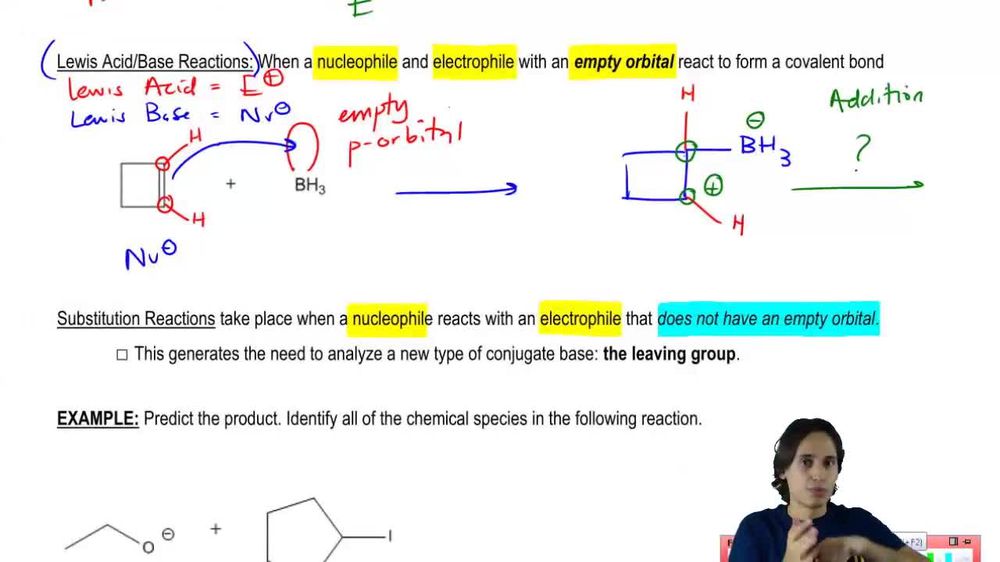
Nucleophiles and Electrophiles can react in Substitution Reactions.
Carbon Chain Elongation
Carbon chain elongation refers to the process of increasing the length of a carbon chain in organic molecules. This can be achieved through various methods, such as the coupling of smaller alkyl groups or the use of reagents that facilitate the formation of longer carbon chains. This concept is vital for the chemist to explore alternative methods to synthesize 3-octyne without 1-butyne.