Show how the following compounds can be prepared, using ethyne as one of the starting materials: 3. 2-methyl-3-hexyn-2-ol
Verified step by step guidance
1
Step 1: Start with ethyne (C₂H₂) as the base molecule. Ethyne is a simple alkyne with a triple bond between two carbon atoms. The goal is to build the desired structure step by step by adding the necessary groups.
Step 2: Perform a hydroboration-oxidation reaction to convert ethyne into an aldehyde. Use reagents such as disiamylborane (R₂BH) followed by hydrogen peroxide (H₂O₂) and sodium hydroxide (NaOH). This will yield acetaldehyde (CH₃CHO).
Step 3: Perform an aldol addition reaction to extend the carbon chain. React acetaldehyde with a suitable aldehyde or ketone (e.g., butanal) in the presence of a base (e.g., NaOH) to form a β-hydroxy ketone intermediate. This step helps in building the hexyn backbone.
Step 4: Introduce the triple bond at the desired position. Use a strong base (e.g., NaNH₂) to deprotonate the β-hydroxy ketone intermediate, followed by elimination to form the alkyne. This will yield 2-methyl-3-hexyne.
Step 5: Perform a hydration reaction to introduce the hydroxyl group (-OH) at the desired position. Use reagents such as HgSO₄ and H₂SO₄ to hydrate the alkyne selectively, forming 2-methyl-3-hexyn-2-ol as the final product.
Verified video answer for a similar problem:
This video solution was recommended by our tutors as helpful for the problem above
Video duration:
5m
Play a video:
0 Comments
Key Concepts
Here are the essential concepts you must grasp in order to answer the question correctly.
Ethyne as a Building Block
Ethyne, also known as acetylene, is a simple alkyne that serves as a versatile building block in organic synthesis. Its triple bond allows for various reactions, including addition reactions with electrophiles, which can lead to the formation of more complex molecules. Understanding how to manipulate ethyne is crucial for synthesizing target compounds like 2-methyl-3-hexyn-2-ol.
Alkynes undergo a variety of reactions, including hydrohalogenation, hydration, and alkylation. These reactions can be used to introduce functional groups or extend carbon chains. For the synthesis of 2-methyl-3-hexyn-2-ol, knowledge of how to perform these reactions with ethyne is essential to achieve the desired structure and functionalization.
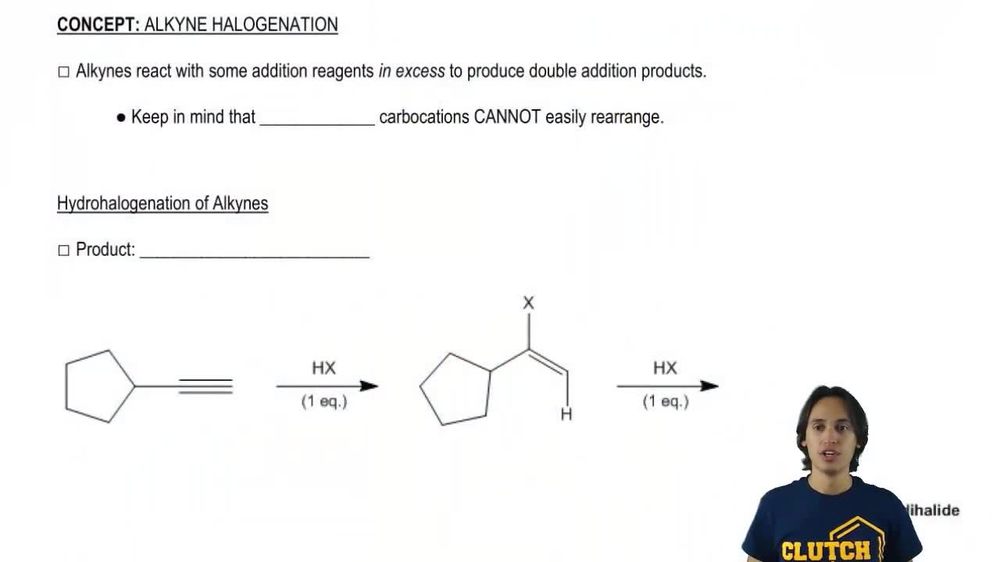
General properties of double addition reactions to alkynes.
Functional Group Interconversion
Functional group interconversion involves transforming one functional group into another, which is often necessary in organic synthesis. In the case of 2-methyl-3-hexyn-2-ol, converting an alkyne to an alcohol through hydration is a key step. Understanding the mechanisms and conditions for these transformations is vital for successfully preparing the target compound.

 5:01 minutes
 Verified step by step guidance
 16:59
16:59