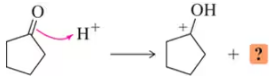
The following reaction steps are shown using conventional electron pushing. (b) Use the bouncing arrow formalism to illustrate the formation of only the product shown. (a)
Verified step by step guidance
1
Step 1: Analyze the reaction mechanism. The image shows a ketone group reacting with a proton (H⁺), which initiates the formation of a positively charged intermediate. This is an acid-catalyzed reaction.
Step 2: Use the bouncing arrow formalism to illustrate the protonation of the oxygen atom in the ketone group. The lone pair of electrons on the oxygen atom attacks the H⁺, forming an oxonium ion (positively charged oxygen). Represent this step with an arrow from the lone pair on oxygen to the H⁺.
Step 3: The positively charged intermediate undergoes nucleophilic attack by water (or another nucleophile). Use the bouncing arrow formalism to show the movement of electrons from the nucleophile to the carbonyl carbon, breaking the π bond between carbon and oxygen.
Step 4: After the nucleophilic attack, a tetrahedral intermediate is formed. Show the rearrangement of electrons using arrows to illustrate the stabilization of the intermediate.
Step 5: Finally, illustrate the deprotonation step where the positively charged oxygen loses a proton to form the neutral alcohol product. Use an arrow to show the transfer of electrons from a base to the proton on the oxygen atom.
Verified video answer for a similar problem:
This video solution was recommended by our tutors as helpful for the problem above
Play a video:
0 Comments
Key Concepts
Here are the essential concepts you must grasp in order to answer the question correctly.
Electron Pushing Mechanism
The electron pushing mechanism, often depicted with curved arrows, illustrates the movement of electrons during chemical reactions. This method helps visualize how bonds are formed and broken, indicating the flow of electron density. Understanding this mechanism is crucial for predicting the outcome of reactions and the stability of intermediates.
Bouncing arrow formalism is a simplified representation of electron movement that emphasizes the flow of electrons in a more intuitive manner. Unlike traditional electron pushing, this method uses arrows that 'bounce' to show the transfer of electrons between atoms or groups, making it easier to follow complex reaction pathways and visualize product formation.
A reaction mechanism is a detailed step-by-step description of how reactants transform into products, including all intermediates and transition states. Understanding the mechanism is essential for predicting reaction outcomes, as it provides insights into the stability of intermediates and the energy changes involved throughout the process.